Key Highlights
- The main difference between cold pressed and refined oil lies in the extraction and processing methods.
- Cold pressed oil retains more of its natural colour, aroma and taste, while refined oil offers a neutral flavour and consistent appearance.
- Cold pressed oils cater to premium and specialist markets, whereas refined oils are widely used in mass food production and industrial applications.
- Profitability in cold pressed oil exports depends on extraction yield, raw material costs, packaging and premium market demand. Refined oil exports depend more on sourcing efficiency, processing costs and shipment volumes.
- Exporters must meet applicable FSSAI, customs, quality-testing, labelling and destination-country requirements.
Introduction :
Cooking oil is an essential item. When choosing cooking oil, the way the oil has been processed will have an impact on the taste, smell, look and marketability. Recently, many importers are looking into different edible oils and food companies wish to provide the correct product. When we talk about cold pressed vs refined oil , cold pressed oils tend to be looked at when wanting a traditional extraction; however, refined oils are favoured due to the oil being consistent, having no strong taste and being ideal for mass food production.
It is important to understand the difference between cold pressed and refined oil for manufacturers, importers and exporters.

1. What is the difference between cold pressed and refined oil?
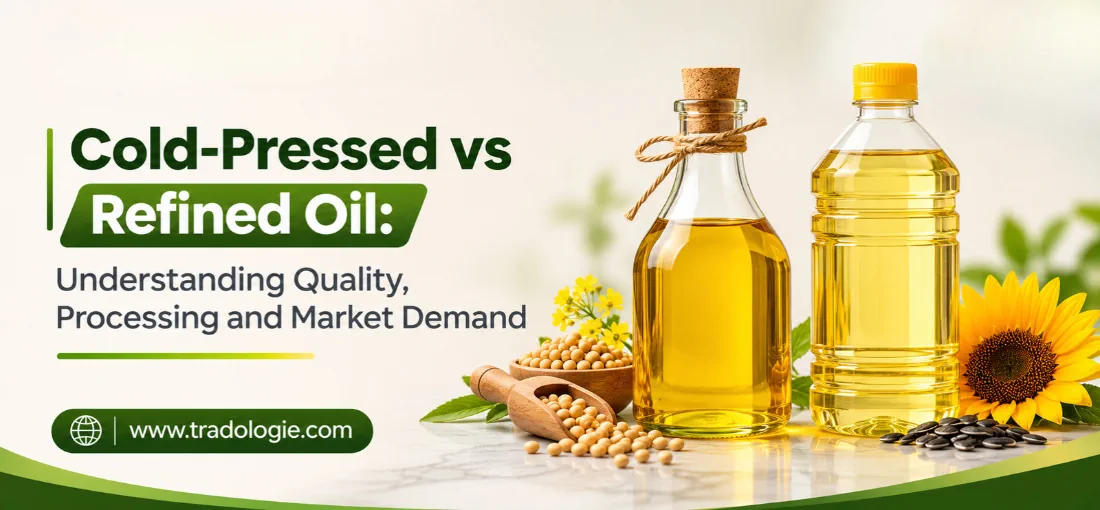
The main difference in cold pressed vs refined oil is the extraction process.
Cold pressed oil refers to oil which has been extracted using mechanical means. This means the oil seeds or fruits will be pressed under controlled conditions to extract the oil. This process tends to avoid any chemical refinement processes. This helps retain more of the natural colour, smell and taste.
Refined oils will have further processes to the oil. This could include degumming, neutralisation, bleaching and deodorising based on the material and the refinement process used. This removes any unwanted impurities, pigments, smells and free fatty acids to give a more consistent product.
| Difference | Cold Pressed Oil | Refined Oil |
|---|---|---|
| Process | Mechanically extracted | Extracted and refined |
| Colour | Natural colour | Light and consistent |
| Smell | Characteristic smell | Neutral |
| Taste | Stronger taste | Mild taste |
| Extraction | Small to large specialist units | Large scale |
| Market | High end/specialist | Mass market/industrial |
Neither oil will be the best option for every situation. However, it is important to understand the difference between cold pressed and refined oil as buyers will consider the taste, usage, quality and consumer preferences.
2. How are cold pressed and Refined Oils Produced?
Cold pressed oils are mostly extracted via a mechanical process. The raw material will be cleaned to remove any dust, stones or unwanted material. The oil will then be pressed using a mechanical press to extract the oil. The oil will be left to settle or filtered to remove any solid particles. The oil will then be stored ready for packaging.
Refined oils will also go through further processes. These can include:
- Degumming - Removes phospholipids.
- Neutralisation - Removes free fatty acids.
- Bleaching - Removes pigments and unwanted impurities.
- Deodorisation - Uses steam to remove unwanted smells.
Finally, the oil will be filtered.
The process will vary depending on the type of oil and the desired quality.

3. Benefits of cold pressed oil
Cold pressed oils are popular with consumers who like food which has been less processed. The oil will have a characteristic smell and taste.
Some benefits of cold pressed oil include:
- Natural smell/taste - More of the characteristic smell, taste and colour.
- Unique cooking uses - Mustard, sesame, groundnut and coconut oils have a unique taste for different regions.
- Mechanically extracted.
- Specialist product - Can offer a unique product based on the source, origin and extraction.
- Variety - Can offer a variety of products based on the oil seeds.
This can help with the cold pressed oil market as there are many premium, specialist and traditional food markets.
Cold pressed oil will not necessarily be healthier. The fatty acid content will mostly depend on the raw material. The oil can also be impacted by how it was stored, oxidised and handled. Buyers should look at the lab results and product specification instead of just marketing claims.
4. Marketability
Cold pressed oils are often found in premium, natural foods and specialist grocery stores. Buyers may place more value on the taste, extraction and origin.
Refined oil can be used in a variety of situations. The oil has no strong taste, looks consistent and can be supplied in large quantities. This makes it suitable for use in restaurants, commercial kitchens, packaged food and snack production.
For exporters it is important to know what market you are supplying. If you are supplying a premium cold pressed oil, you may need to have a different distribution strategy.
5. Profit margins of cold Press Oil Exports
The profit margin will depend on the price of the raw material, yield of extraction, costs of processing, packaging and selling price. Even though cold pressed oils can have high selling prices, this does not always mean they will be profitable.
The major costs include:
- Oil seed costs and delivery.
- Cleaning, preparation and mechanical extraction.
- Filtering, lab testing.
- Bottling/tinning.
- Labour, electricity and maintenance.
- Certifications and export paperwork.
- Delivery costs.
The yield will be very important. Different oil seeds will have different oil yields. The better the quality of the raw material and the better the conditions during extraction, the better the yield. The cake can also be sold depending on the quality.
The packaging can affect the overall profitability. Small packaging will generally have higher costs per litre. Exporters should ensure there are enough buyers in the market to support the premium product.
6. Profit margins of Refined Oil Exports
The profit margins are generally impacted by how efficiently the oil can be sourced, processing costs and international commodity prices.
Refining oil will require an investment in refining equipment, storage, utilities and lab testing. However, the larger the volume of oil produced the more the fixed costs can be spread.
The major costs include:
- Refining, bleaching and deodorising.
- Energy, steam and processing.
- Storage, lab testing and handling.
- Packaging/bulk.
- Freight, insurance and port costs.
- Finance and working capital.
The raw material costs can often be a large cost. International prices can fluctuate meaning it could impact the competitiveness of the exports. Refined oil exporters will also have competition from international companies so it is important to source efficiently, work efficiently and build good relationships with buyers.
As refined oils are not specialist products they will often be sold in competitive markets with high volumes. Businesses should look at the overall profitability of the shipment.
7. Which is more profitable to export - Cold pressed or Refined?
Both oils can be profitable but it will depend on your business.
| Business | Cold Pressed | Refined |
|---|---|---|
| Market | High end/specialist | Mass market/industrial |
| Price | Based on origin, extraction and product. | Tied to commodity prices and volume. |
| Investment | Can be low. | Requires more investment in infrastructure. |
| Packaging | Often for consumers. | Bulk packaging. |
| Main issue | Creating demand and keeping premium. | Managing sourcing costs and competition. |
| Profitability | Differentiation and relationship with buyers. | Volume, sourcing and plant utilisation. |
If you have a small unit, it may be easier to get into the cold pressed market as you do not need to invest in a large refining unit. If you have access to larger processing, working capital and sourcing then refined oil exports could be a good option.
There is no one profit margin percentage. It will depend on the oil, raw material, volume, market and freight and running costs.
8. Export requirements and quality checks
When exporting edible oils you will need to ensure you comply with the requirements in India and the destination country. Before accepting an order, ensure:
- FSSAI - Check the requirements.
- Exporter paperwork - Importer Exporter Code, shipping and customs.
- Quality - Free fatty acids, peroxide value, moisture, impurities and fatty acid content.
- Contaminants - Ensure you comply with pesticide requirements in destination country.
- Packaging - Ensure you have the correct labelling. This should include the product name, net quantity, batch number, origin and storage information.
- Certifications - If organic or other certification is required.
Before exporting, ensure you look up the latest DGFT notifications and the export requirements for your product. Edible oils can vary depending on the product.
Conclusion
Cold pressed and refined oils can be used for different purposes. Cold pressed products will appeal to those wanting a unique taste and traditional extraction. Refined oils can be used for larger consumer and industrial markets.
For exporters it will depend on the raw materials you have access to, processing, market demand and overall costs of the shipment. To be sustainable, ensure you have the right product for the right buyers and keep the quality consistent.
Want to expert or import edible oil in bulk? Register as a buyer or seller on Tradologie.com today and connect to the global market.
Disclaimer
The information presented in this article is intended for general informational purposes. Processing methods, raw material costs, international commodity prices, export regulations and market demand may change over time. Profitability depends on the type of oil, extraction yield, processing infrastructure, packaging, freight and other operational expenses. Exporters and importers should verify the latest DGFT notifications, FSSAI requirements, customs procedures, quality standards and destination-country regulations before entering into commercial transactions.