Key Highlights
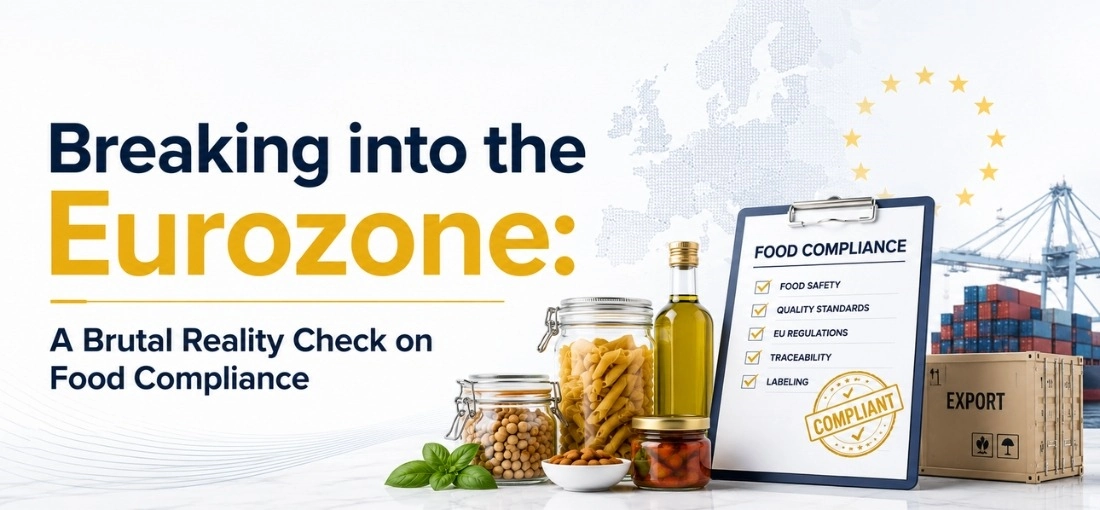
- The European Union applies some of the world's strictest food safety and compliance standards.
- A single compliance failure can result in shipment rejection, destruction, or increased inspections on future exports.
- Maximum Residue Limits (MRLs), traceability, and microbiological safety remain top priorities for EU authorities.
- The RASFF alert system allows food safety issues to be shared instantly across all EU member states.
- Exporters must maintain complete farm-to-fork traceability documentation.
- Packaging, labeling, and language compliance are just as important as product quality.
Let's be completely blunt: clearing a container through a European Union port is a world away from shipping to quicker, high-volume corridors like the UAE. In the Gulf, your main battles are container speed, terminal handling logistics, and matching wholesale price decimals. The Eurozone doesn't care about your volume. European customs operate on a philosophy that has zero-tolerance and is built around hyper-strict consumer safety, trace contaminants, and an unbroken farm-to-fork paper trail.

If you are planning food exports to Europe, you cannot treat compliance as an afterthought or a mountain of paperwork to handle at the last minute. Failing to master EU import regulations for food products right from the farm gate means your cargo will eventually be systematically flagged, rejected, or outright incinerated at entry ports like Rotterdam or Hamburg. For any serious merchant, breaking into this premium market of 440 million affluent consumers requires transitioning away from casual spot-market trading and upgrading to a highly disciplined, technical supply chain.
These compliance requirements apply across multiple food categories, whether businesses are looking to export rice in bulk, export spices in bulk, export dried fruits in bulk, or establish long-term supply contracts with European buyers.
The Four Non-Negotiable Biosecurity Barriers
The European Food Safety Authority (EFSA) runs what is essentially a zero-tolerance dragnet at the border. To safely land your goods, your processing lines must reliably clear four major regulatory hurdles.
1. The Maximum Residue Limit Trap
The EU maintains the absolute tightest pesticide restrictions on the planet. For most agricultural goods, they drop permissible chemical levels down to the absolute limit of laboratory detection—just 0.01 mg/kg. If you are shipping bulk seed spices, table grapes, or basmati rice, standard field testing won't protect you. You must work with independent, APEDA-approved laboratories to run high-performance liquid chromatography (HPLC) assays before loading the vessel. If a destination port tests even a trace of unauthorized chemicals—like Ethylene Oxide (ETO) or Triclazole—the entire container block faces immediate rejection.
2. Mycotoxin and Biological Dragnets
Managing contaminant risk is a constant headache when moving tropical agricultural products across water. European border control posts execute aggressive sampling protocols on arrival to hunt down biological hazards:
- Aflatoxins and Ochratoxin A: These are very dangerous toxins and are derived from mold. They are prone to develop in red chillies, groundnuts, and whole spice lots that have sat through long storage or humid transit cycles.
- Microbiological Cleanliness: The EU applies a hard zero-tolerance mandate for Salmonella and E. coli strains across all processed food lines and ready-to-eat products.
3. The Digital Blacklist (RASFF)
The Rapid Alert System for Food and Feed (RASFF) functions as an instantaneous, interconnected digital warning system across all EU member states. If a border checkpoint in Antwerp flags your spice shipment for a high pesticide count, a red flag goes up instantly at every custom house from Scandinavia to Italy. Slipping up once doesn't just mean losing a single cargo lot; a RASFF black mark can place your entire company under a "reinforced control" regime, meaning 100% of your subsequent containers will be held at the port for mandatory, highly expensive laboratory testing at your expense.
4. Unbroken Supply Chain Traceability
The baseline framework of EU food import regulations dictates a strict "One Step Back, One Step Forward" tracking standard. Your cargo documentation must provide an unshakeable digital and physical paper trail. You have to prove exactly which farming cluster grew the crop, which facility processed it, and how it moved from your exit desk straight to the European buyer's warehouse.
Hard Documentation: Clearing the TRACES Portal
Fulfilling European Union food import requirements demands an ironclad paper trail long before your containers are ever lifted onto an ocean liner.
For starters, your import partners must pre-notify the designated port of entry by lodging a Common Health Entry Document (CHED-D) through the EU's integrated TRACES NT portal. This digital filing has to be completely finalized at least 24 hours before the vessel ever docks at the European terminal.
On top of that, your outbound agricultural containers must carry an official phytosanitary certificate issued directly by government quarantine bodies. This document serves as your primary legal proof that the cargo has undergone rigorous physical inspection and is entirely free from quarantine pests. Finally, your processing and grinding facilities must run active, internationally accredited food safety management systems. While standard ISO compliance is a basic starting point, premium European buying houses increasingly require GFSI-recognized frameworks, such as BRCGS or FSSC 22000, to prove your processing floors eliminate cross-contamination hazards mechanically.
Packaging Laws and Labeling Technicalities
Even if your product handles every biosecurity audit perfectly, a single formatting oversight on your consumer carton or bulk bag can trigger a full border hold at the port.
The EU heavily polices any packaging material that directly touches food products to prevent chemical migration. Whether you are shipping bulk liner bags or shipment in the form of retail boxes, it is important to obtain a formal "Declaration of Compliance" from your packaging manufacturer. This document serves as verified proof that no toxic plasticizers, heavy metals, or volatile compounds will bleed from the packaging into your food products during long transits across the equator.
Furthermore, one must understand that European labeling laws demand absolute clarity and they paramount emphasis on protecting the interests of the end customers. In fact, the layout of your retail packaging must clearly feature pertinent information on allergen matrices with distinct typography highlighting (like bold fonts, italics, or contrasting background colors) for any of the 14 regulated allergens, including gluten, mustard, sesame seeds, and nuts.
Additionally, you must handle language harmonization in which all product text, nutritional descriptions, and storage warnings must be printed in the official languages of the specific EU member states where the item is actually being retailed.

Margin Protection Tactics on the Shipping Floor
Successfully executing food exports to Europe requires a massive upgrade in your day-to-day logistics management.
First, kill off your chemical compliance risks by sourcing directly from vetted farming clusters. Relying on anonymous spot markets for raw materials is an open invitation for a RASFF border disaster. By running controlled contracting loops and monitoring chemical applications on the field, you ensure that unauthorized pesticides are completely excluded from your supply chain.
Second, insulate your capital from administrative port delays. Because the European customs authorities will hold a container without hesitation if your paperwork shows a single mismatched digit. Thus, it would be a wide decision to safeguard your business by negotiating a minimum 14-day factory-to-dock free-time window directly with your shipping line. This timeline acts like a guarantee that a routine customs quality audit won't immediately trigger escalating daily demurrage and detention fees.
Third, execute precision container conditioning. Sea voyages to Europe cross drastically different climate zones, making shipments highly vulnerable to moisture shocks. Wrap your internal pallets tightly in heavy-duty shrink wrap and hang continuous strings of clay desiccants along the interior steel container walls. This setup completely neutralizes container sweat and stops mold formation, killing off potential quality disputes before your cargo ever reaches the buyer's warehouse.
Summary
Protecting your margins in the agricultural export game isn't about pulling off a massive logistical miracle. It really comes down to boring, daily discipline. Once you start tightening your CHA contracts, maximizing your container space, and locking in your bank rates, those unexpected leaks stop happening. Moving away from risky spot trading and running a tight, predictable supply chain is exactly how you turn a volatile trade desk into a highly profitable, sustainable international business.