Key Highlights
- India's agricultural exports reached USD 52.55 billion in FY 2025-26.
- Marine products, rice, spices, and buffalo meat remain key export pillars.
- Non-Basmati rice exports gained momentum following policy changes.
- Coffee, pulses, horticulture, and vegetable oils emerged as high-growth sectors.
- Traceability and compliance are becoming critical competitive advantages.
- Strong logistics and documentation management help protect export margins.
Introduction:
Stop guessing what international buyers want. Look straight at the customs clearing registers. Commerce Ministry numbers show India's total agricultural export earnings reached USD 52.55 billion in the fiscal year ending in 2026. That is a 2.8% step up from the USD 51.12 billion baseline recorded previously.
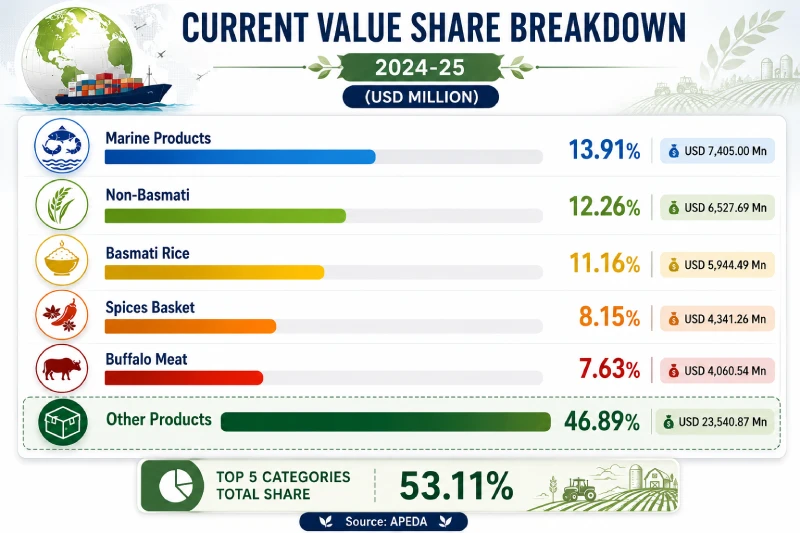
But that massive multi-billion-dollar pool isn't spread out evenly. A huge chunk of that value is locked up in just five core commodity pipelines.
If you are allocating container space or signing sourcing contracts for basmati rice exports, spices exports, marine products exports etc., for the rest of 2026, you need to know exactly how policy overhauls and global weather disruptions are changing these specific margins right now.
The Big Five: Current Margins and 2026 Friction Points
1. Marine Products
Frozen aquaculture anchors the top of the sheet at USD 7,405.00 million. Look at the destination split: the US controls a massive 36.21% slice worth USD 2,681.19 million, while China takes USD 1,211.42 million.
The big operational trap in 2026 is the heavy anti-dumping duties hitting Indian shrimp setups in North America. Combine that with relentless, zero-tolerance customs audits for antibiotic traces like chloramphenicol in Europe. If your team buys blindly from unverified regional ponds, you risk having whole containers incinerated at the destination port. Smart trade desks are running direct, audited contracts from hatcheries straight through to Individual Quick Frozen (IQF) lines. Traceability is the only way to hold onto your margins this year.

2. Non-Basmati Rice
This massive volume channel pulls in USD 6,527.69 million. West African transit hubs dominate the destination logs. Benin takes the largest share at 15.71% (USD 1,025.38 million), followed by Guinea at USD 536.00 million.
The big shift in 2026 comes from India completely lifting the Minimum Export Price (MEP) caps on raw white grains and easing previous shipment taxes. This policy change has allowed Indian trade desks to flood West African corridors again, aggressively pushing out competitors. But high volume means tight logistics. With containers spending weeks on volatile sea lanes, failing to use high-gauge moisture-barrier lining inside the steel boxes will cause your rice to clump and rot before it ever reaches the dock.
3. Basmati Rice
The premium aromatic corridor sits firm at USD 5,944.49 million. Sourcing power is concentrated heavily in West Asia, with Saudi Arabia leading at USD 1,203.67 million (20.25%), Iraq at USD 850.08 million, and Iran at USD 753.20 million.
Now that the government has wiped out the USD 950 per ton export price floor, standard and medium-grade Basmati flows have surged in early 2026. However, Red Sea maritime bottlenecks have driven up spot freight rates for European runs. Successful exporters are protecting their liquidity by avoiding CIF contracts entirely, making basmati rice buyers onto strict FOB terms where the importer absorbs the transit risk.
4. Spices
Outbound spice shipments hold a USD 4,341.26 million position, with China taking USD 767.88 million and the US absorbing USD 647.92 million.
Bulk, uncleaned seed shipments are face-planting due to intense price competition from low-cost alternative origins. The profit has migrated elsewhere. Following severe global alerts over ethylene oxide (ETO) residues, 2026 spice buyers are paying massive premiums for value-added processed items. If your desk shifts away from raw seeds toward sterile ground powders and liquid oleoresins, you dodge the weather-driven price swings of raw agricultural crops.
5. Buffalo Meat
This livestock segment closed at USD 4,060.54 million. Vietnam is the main buyer at USD 740.81 million (18.24%), followed by Egypt at USD 656.11 million and Malaysia at USD 617.50 million
Global inflation has actually worked in India's favor here. Lean, boneless Indian buffalo meat is undercutting Western beef suppliers across Southeast Asia. The core requirement in 2026 is maintaining strict cold-chain infrastructure. One temperature drop during a port delay can compromise your health certifications, leading to an immediate cargo rejection.

The 2026 Breakout: High-Growth Emerging Crops
The real surprise in the latest Commerce Ministry datasets is the rapid growth happening outside the traditional pillars. These high-value segments are expanding fast:
| Emerging Product Category | 2026 Export Position | Primary Global Sourcing Trigger | Core Sourcing Advantage |
|---|---|---|---|
| Indian Coffee | Soared past USD 1,176.31 million in recent shipment cycles. | Severe crop shortfalls in Brazil and Vietnam have driven international roasters to buy up Indian Robusta and Arabica lots. | Value-added soluble and instant coffee blends now make up 38% of this trade, commanding much higher profits than raw green beans. |
| Pulses | Jumped 21.83% to reach USD 948.11 million. | Rising global demand for plant-based proteins and alternative flour bases. | Strong domestic production has created a reliable exportable surplus for global buyers. |
| Fresh Horticulture | Expanded 12.89%, hitting USD 1.32 billion. | High premium retail demand for Thompson seedless grapes and Kesar mangoes across European supermarket chains. | APEDA’s newly verified sea-route shipping protocols have slashed transit times, making air freight unnecessary. |
| Vegetable Oils | Scaled up by 15.88% to touch USD 732.15 million. | Global supply gaps in specialty industrial and food-grade vegetable oils. | High processing capacity inside domestic crushing hubs allows for quick turnaround times. |
| Cocoa Products | Increased to USD 317.97 million, marking a 7.59% growth. | Record-breaking global cocoa bean deficits have forced international confectionery brands to seek out new suppliers. | Strong development of premium, traceable cocoa processing clusters across Southern India. |
Handling the Logistics Friction
Connecting with a buyer through an online B2B trade platform is only twenty percent of the job. If your logistics team drops the ball on contract wording, unexpected port fees will destroy your profits before the ship even drops anchor.
First, look at your carrier contracts. Standard bookings give you tiny, rigid terminal gate windows. If a foreign border post selects your container for a random manual audit or a lengthy document review, those few days vanish instantly. You need to use your shipment volume to negotiate extended demurrage and detention clauses directly on your ocean bills of lading. Having that extra time buffer means a slow customs paperwork review won't trigger immediate, daily storage penalties that bleed your bank accounts dry.
Second, clear out any typos on your manifest paperwork. Automated customs software uses strict character-matching filters. A single inverted digit on a weight certificate, a minor description mismatch on a phytosanitary certificate, or a typo in the buyer's corporate address freezes the whole file. When the computers flag an error, your container gets kicked over to a physical holding yard for a manual audit. Have your compliance team manually cross-verify every line item on the commercial invoice against the packing lists and agricultural certificates before the vessel sails. Keeping those documents perfectly synchronized is what keeps your cargo moving through customs green lanes.
Technical Verdict
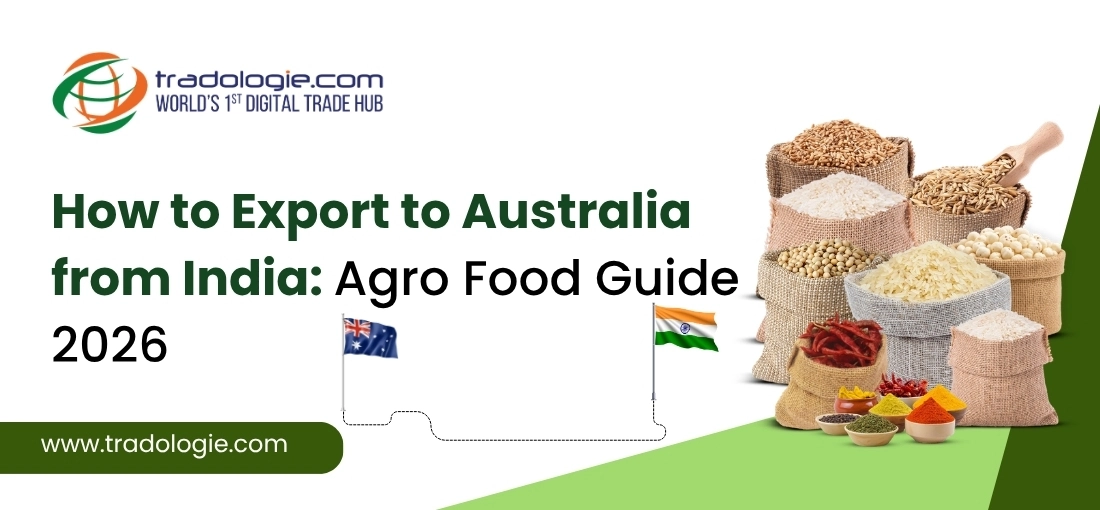
The days of the old-school commodity broker operating on loose handshakes, rough weight guesses, and uncleaned bulk crops are completely over. Lasting margins belong to structured trade desks that focus on exact laboratory certifications, strict contract language, and tight port risk management. Utilizing active trade frameworks—like the UAE Comprehensive Economic Partnership Agreement (CEPA) or the Australia Economic Cooperation and Trade Agreement (ECTA)—while keeping an error-free documentation trail allows exporters to bypass local market volatility and build a highly predictable, maximum-profit business model.