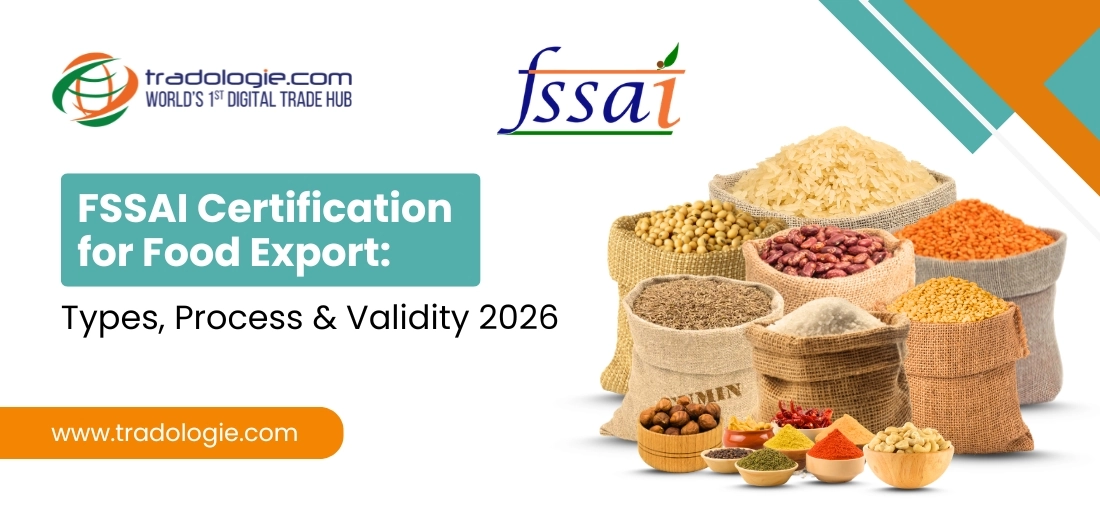
The global market for Indian farm products and processed foods is growing fast. You want to enter this profitable space. To do so, you must follow strict quality rules at home and abroad. Any business trading food in bulk strictly requires an FSSAI license for export. This is a strict legal rule.
The Food Safety and Standards Authority of India (FSSAI) works under the Ministry of Health & Family Welfare. FSSAI demands a valid license for all food business operators (FBOs) exporting goods from India. This 2026 guide explains the types of licenses you can get. It outlines the current registration process. It covers the exact FSSAI export license fee structures you need to budget for. Finally, it details the daily operating rules for large-scale farm commodity exporters.
Quick Fee Reference
| License Type | Annual Fee | 5-Year Fee | GST Applicable? |
|---|---|---|---|
| Central License | ₹7,500 | ₹37,500 | Yes (+ 18% GST) |
| State License | ₹2,000 - ₹5,000 | ₹10,000 - ₹25,000 | Yes (+ 18% GST) |
1. Why FSSAI Certification Matters for Bulk Agri-Trade
You might trade bulk farm goods like basmati rice, spices, or processed cereals. In this business, a perfect safety record is key. An FSSAI license for export acts as a formal guarantee. It proves your goods meet strict, science-backed safety standards. This proof is needed before goods cross international borders.
In India, the FSSAI Central License itself works as the legal food safety certificate for exports. You do not need a separate, standalone food safety certificate. The unique 14-digit license number goes on your packaging and shipping papers. This number serves as your global safety proof.
Exporting food without this clearance breaks the Food Safety and Standards Act of 2006. More importantly, getting a food safety certificate India builds trust. Foreign buyers rely on it. Global regulatory bodies check for it. It ensures your massive bulk shipments avoid delays. It stops foreign ports from rejecting your goods due to pest or dirt concerns.
2. Types of FSSAI Export Licenses
FSSAI groups licenses by production size and business type. For exporters, the Central License is almost always the required choice. This is especially true for large-volume shipments.
| FSSAI License Type | Ideal Business Profile | Export Capacity |
|---|---|---|
| Basic Registration | Petty retailers, very small-scale local operators. | Not applicable for direct bulk export. |
| State License | Medium-sized manufacturers and intra-state distributors. | Limited (often requires transition to Central). |
| Central License | Large-scale agri-exporters, 100% EOUs, and merchant-exporters. | Unlimited bulk export capacity. |
Important: Under the specific guidelines of FSSAI for food exporters, a Central License is mandatory regardless of annual turnover, as per FSSAI Central Licensing Authority rules.
3. The Global Rules Beyond FSSAI
Your FSSAI license is your basic domestic need. However, successful bulk farm trade means handling other global certificates too. Exporters must match their FSSAI status with global demands.
- Export Inspection Council (EIC): You need this to get a mandatory Certificate of Health. It applies to items like marine products and dairy.
- Phytosanitary Certificates: The Directorate of Plant Protection, Quarantine & Storage issues these. They prove bulk raw farm exports are free from bugs and pests.
- Destination Rules: Different countries have different rules. You may need FDA approval for the USA. Europe might demand EU organic standards. Other markets look for Halal or Kosher certificates.
APEDA Registration for Farm Goods
Are you exporting scheduled products? These include basmati rice, processed fruits, dairy, flowers, and poultry. If so, APEDA registration is mandatory.
FSSAI compliance alone does not get you an export health certificate for these items. You must also register on the APEDA portal (apeda.gov.in) at the same time. Merchant-exporters often buy these goods from third-party factories. If you do this, you must check your supplier. Your supplier must hold a valid FSSAI Central License AND a valid APEDA registration.
4. The 2026 FSSAI Registration Process
The FSSAI registration process is now mostly digital. This makes business easier for modern logistics firms. Exporters must use the FoSCoS portal carefully. This ensures your bulk trade gets legal clearance.
- Get an IEC: First, get an Importer-Exporter Code (IEC). The Directorate General of Foreign Trade (DGFT) issues this.
- Use FoSCoS: Go to the official FoSCoS website. Pick the "Central License" option.
- Fill the Form: Complete Form B. Include a full list of all food types you plan to export.
- Upload Papers: Attach all required technical and admin documents.
- Get Local NOC: Get a No Objection Certificate (NOC). Your local city or state body must issue this for your processing or storage site. Do this before submitting your FoSCoS form.
- Pay the Fee: Pay the non-refundable fee. Use the portal's built-in payment gateway.
- Pass Inspection: A Food Safety Officer will check your documents. They may also visit your site. Upon successful payment, a 17-digit application reference number is generated as acknowledgment. Once approved, the final license carries a unique 14-digit FSSAI license number which must appear on all export documentation and packaging.
5. Manufacturer-Exporter vs. Merchant-Exporter Rules
There is a big difference in rules for FSSAI for food exporters based on business type. The steps change based on how you source your goods.
Manufacturer-Exporters own the actual food factories. FSSAI inspects these sites very closely. These owners must keep detailed water test reports. They must also follow very strict cleaning rules for their buildings.
Merchant-Exporters do not make the food. They buy it in bulk from others to sell abroad. They still need a Central License. However, their main job is checking their supply chain. The supply chain must be clean and legal. They must check every third-party factory partner. Each partner must hold a valid FSSAI central license. The merchant-exporter must also make sure the goods pass a NABL lab batch test. This test must happen before the goods go into a shipping container.
6. The FSSAI Export License Fee Rules
Planning for legal costs is a normal part of global trade. The FSSAI export license fee follows a set standard. You should plan your budget based on how many years you want the license to last.
- Central License Fee: ₹7,500 + 18% GST per year.
- State License Fee: ₹2,000 to ₹5,000 + 18% GST per year.
- Modification Fee: ₹7,500 + 18% GST. You pay this if you change your product types or business details.
You can apply for a license that lasts between 1 and 5 years. Buying a 5-year license right away costs ₹37,500 + 18% GST for a Central License. This saves you from the hassle of renewing it every single year.
7. Required Documents for Your food safety certificate India
Bulk farm traders must keep perfect records. Your application will fail without the right paperwork. You need to gather the following documents:
- A valid Importer-Exporter Code (IEC).
- Proof that you own or rent your site. This can be a sale deed, rent agreement, or recent utility bill.
- A clear list of the exact food items you want to export.
- A map or layout plan of your factory or storage building.
- A water test report. This must come from an FSSAI-recognized or NABL-accredited lab.
- A recall plan. This shows how you will bring back bad bulk shipments if needed.
- A Food Safety Management System (FSMS) Plan or HACCP certificate. This shows your cleaning rules, pest control steps, and staff training records. This is mandatory for manufacturer-exporters. It is highly recommended for merchant-exporters.
Source: Ministry of Commerce and Industry Trade Documentation Protocols, 2026.
8. Labeling Rules for 100% Export-Oriented Units
Operating as a 100% Export-Oriented Unit (EOU) gives you a big edge. You get flexibility with the FSS (Packaging and Labelling) Regulations. Food packed only for foreign markets gets special passes from local Indian label rules.
Bulk export packages do not need to show Indian nutrition facts. They do not need to use local Indian languages. Instead, they must follow the laws of the country buying the goods.
There is one strict rule, though. The packaging must show an "Export Only" or "Not for sale in India" label. The text must be large and clear. This stops export-only goods from sneaking into the local Indian market.
Regulatory reference: FSS (Packaging and Labelling) Regulations, 2011, Schedule IV, Clause 7 governs labeling exemptions for products manufactured exclusively for export.
9. How FSSAI Works with ICEGATE for Customs in 2026
In 2026, getting your FSSAI license directly impacts your port logistics. FSSAI systems now talk directly to the Indian Customs Electronic Data Interchange Gateway (ICEGATE). This digital link is automatic.
A merchant-exporter files a Shipping Bill at a major port. This includes ports like Nhava Sheva (JNPT), Mundra, or Chennai. Next, the ICEGATE computer checks the exporter's IEC against the live FSSAI database.
If the license is active and matches the goods, the system instantly issues a digital No Objection Certificate (NOC). What if your license is expired, paused, or doesn't match the food category? The system puts an automatic hold on your containers. Because of this, large-scale bulk traders must monitor their real-time license status on FoSCoS.
10. FSSAI Validity, Compliance, and Application Times
Successfully navigating the FSSAI registration process is just the first step. You must work hard to keep it active. An FSSAI Central License lasts for up to 5 years. You need to start your renewal at least 30 days before it expires. If you wait too long, you will pay late penalty fees.
FSSAI is adding new digital check tools to speed up applications. These tools link your FoSCoS profile to your GST, PAN, CIN, and Aadhaar records. This cuts down the time you spend waiting for approval. Exporters should watch for news on the official FoSCoS website (foscos.fssai.gov.in). The site will announce any new, fast-track processing schemes for different business types.

.webp "How to Build a Global Network of Agricultural Importers & Exporters")