Key Highlights
- India is the dominant global supplier of Amla products.
- India recorded 332 Amla export shipments between July 2024 and June 2025.
- More than 100 active Indian exporters participate in global Amla trade.
- USA is the largest importer of Indian Amla-based products.
- Amla extract market is projected to reach USD 840.7 million by 2036.
- Amla powder and extracts generate significantly higher export value than fresh fruit.
- Nutraceuticals, functional foods, beverages, and wellness products drive demand.
- Traceability, purity, and vitamin C retention are key buyer requirements.
Introduction:
The global market for organic ingredients is seeing an active spike in volume contracts as international food processors and nutraceutical brands aggressively transition away from synthetic components. This transition places a heavy focus on high-yield botanical alternatives capable of serving as clean-label functional bases. What we are seeing on the trade floor is a steady increase in bulk container orders leaving South Asian ports. Amla is increasingly used in supplements, herbal formulations, functional foods, wellness beverages, and nutraceutical products worldwide, moving way past historical heritage applications.
This broad commercial integration reflects a deeper consumer desire for trace-verified, clean-label antioxidant sources. For an international trade desk, navigating the amla export from India corridor requires a complete shift in perspective. Success requires moving past simple, unrefined commodity trading to treat the Indian gooseberry export sector as a highly technical, value-added ingredient pipeline.

What Is Amla and Why Is It Valued Globally?
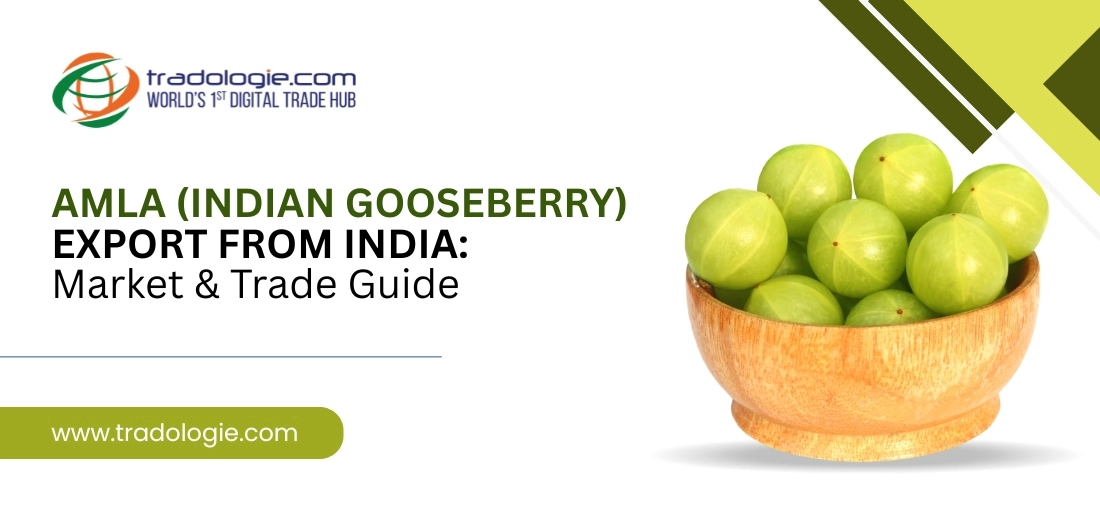
Holding a highly distinct position within the global botanical supply chain is Phyllanthus emblica. It is known in international trade circles as Amla or the Indian Gooseberry. The plant thrives across diverse subtropical terrains and produces translucent green fruits that anchor traditional South Asian medicine. This fruit has served for generations as a premier rasayana in classical Ayurveda and is celebrated for its systemic restorative properties and balancing action on bodily tissues.
The modern industrial value of the crop rests on its unique chemical architecture. Unlike many fruits where sensitive nutrients degrade quickly during processing, Amla features a complex matrix of functional polyphenols and tannins that naturally protect and stabilize its massive ascorbic acid content.
Milling facilities and processing laboratories convert this raw agricultural yield into specific commercial formats to service separate manufacturing tiers:
Biochemical and Trade Significance of Amla Components
| Component / Format | Primary Biochemical & Trade Significance | Target Industrial Application |
|---|---|---|
| Vitamin C | Acts as a potent natural antioxidant, resisting heat-induced processing degradation | Clean-label product preservation and immunity formulations |
| Polyphenols | Provides high-density gallic and ellagic acid fractions for cellular stability | Anti-aging cosmetics and active nutraceutical tablets |
| Fruit | Serves as the primary raw material harvested at peak seasonal maturity | Fresh pulp processing and base ingredient supply lines |
| Powder | Offers a stable, multi-mesh ground format with an extended storage life | Exported nutraceutical ingredients for capsule encapsulation |
| Extract | Delivers a highly concentrated crystalline powder fraction with verified bio-actives | High-end supplement manufacturing and functional foods |
International buying offices select their product formats based entirely on the technical requirements of their production lines. While raw fruit formats feed regional grocery channels, advanced nutraceutical labs demand micro-pulverized powders and standardized extracts to ensure uniform bioactive delivery per batch.
Why International Demand for Amla Continues Expanding
The expansion of the international botanical market is moving past general consumer curiosity into a permanent retail category. Driven by a widespread focus on preventive healthcare and lifestyle management, procurement volumes across North America and Europe are showing steady upward movement. Shoppers are actively demanding clear, clean-label transparency from wellness brands, shifting the ingredient spotlight toward historically validated adaptogens.
This demand is rooted in the functional nutrition sector. Food tech manufacturing labs are frequently replacing synthetic ascorbic acid with clean, fruit-derived alternatives to satisfy consumer aversion to lab-grown preservatives. This transition is creating a highly profitable niche for premium herbal supplements. For an enterprise managing an international export desk, these shifting consumption dynamics offer a reliable long-term canvas. Volume growth is anchored by corporate R&D teams building permanent, year-round functional beverage and supplement lines that require a steady, uninterrupted intake of verified antioxidant inputs.
Amla Export from India: Global Trade Position
Outbound container tracking reveals an immense concentration of supply infrastructure, with international buying networks relying almost entirely on Indian refiners to keep their production pipelines moving. Alternative producing regions handle very peripheral trading volumes.
Bilateral trade data collected across major maritime shipping points outlines this absolute market control:
Global Amla Export Activity Comparison
| Export Sourcing Nation | Absolute Shipment Volume Share | Registered Enterprise Footprint |
|---|---|---|
| India | 332 Shipments | 109 active exporters managing global trade routes |
| China | 47 Shipments | Minority participant focused on localized regional supply |
| Sri Lanka | 16 Shipments | Boutique trade flows handling small specialty lots |
Source: Volza Trade Database (Jul 2024 - Jun 2025)

India accounted for approximately half of the recorded global Amla export activity during the period. This high level of supplier concentration stems from a deeply entrenched commercial ecosystem. With over one hundred professional shipping desks continuously coordinating with domestic extraction plants, India handles bulk international orders with unmatched scale and efficiency. For foreign procurement managers, this consolidation makes India the only viable sourcing partner capable of guaranteeing batch-to-batch quality across high-volume contract cycles.
Why India Remains the Natural Hub for Global Amla Exports
India's absolute leadership across this botanical sector is anchored by an exceptional combination of native geographic advantages, specialized agricultural expertise, and advanced industrial extraction infrastructure. The plant thrives naturally under specific semi-arid environmental parameters that alternative agricultural zones find incredibly difficult to replicate.
The primary cultivation footprint spans across a few key territories:
- Uttar Pradesh: The Pratapgarh region serves as the historic global nerve center for Amla production, utilizing sophisticated irrigation networks to deliver uniform fruit lots.
- Madhya Pradesh: The dry plains provide excellent well-drained soil profiles that maximize nutrient accumulation.
- Gujarat: Offers specialized arid tracts that yield highly resilient crop strains with dense fibrous structures.
- Rajasthan: The arid climate stimulates the natural synthesis of withanolides and functional polyphenols within the root and fruit tissues.
Beyond the favorable climate, India's deep Ayurvedic heritage gives local farming communities an unmatched baseline of cultivation and harvesting expertise. Generations of field experience dictate the exact visual and tactile markers required to pull the fruits at peak chemical maturity. Connecting rural farms directly with advanced extraction plants is a massive domestic supply network supported by processing infrastructure. Delivering water-soluble or alcohol-based standardized powder fractions capable of meeting international pharmaceutical criteria is entirely possible for these sophisticated extract manufacturing units. This integrated network allows the industry to scale production rapidly to match sudden increases in international buying volume without compromising the biochemical integrity of the raw material.
Which Countries Import Amla from India?
Distribution desks must analyze regional market variations before planning their shipping allocations. Botanical import priorities differ significantly depending on the target country's retail regulatory frameworks.
Outbound tracking metrics point toward a few core destination gateways:
Major Global Destination Gateways for Indian Amla
| Target Destination | Primary Regulatory & Trade Driver | Main Industrial Product Format |
|---|---|---|
| USA | Dominates as the largest global marketplace for high-volume dietary supplements | Standardized extracts and clean-label micro-powders |
| Germany | Rigid botanical safety standards coupled with heavy nutraceutical demand | Steam-sterilized, organic-certified powders |
| UK | Deeply entrenched consumer preference for traditional herbal supplements | Finished capsules and value-tier wellness packs |
| Australia | Rapid retail expansion focused entirely on premium wellness products | Fine-mesh powder lots and cosmetic-grade extracts |
| Canada | Expanding industrial demand for functional food and natural ingredients | Bulk dried fruit segments and juice bases |
| UAE | Functions as a critical multi-directional distribution hub for Middle Eastern markets | Diversified mix of retail-ready and bulk cargo |
Source: Volza Trade Database Sourcing Blueprints
The North American corridor remains the dominant consumer of Indian Amla by a significant margin, driven by the mainstream adoption of antioxidant gummies, fortifying sports powders, and daily immunity supplements. Across European hubs like Germany, the focus shifts squarely onto safety metrics. Buyers there enforce exceptionally rigid purity standards, specifically demanding steam-sterilized, chemical-free lots to pass strict continental residue regulations.
Which Amla Products Are Exported Internationally?
Trade desks categorize outbound botanical freight strictly by processing depth, fiber purity, and active compound concentration rather than basic weight metrics. International buying protocols dictate clear differences in how raw fruit lots and refined extract materials are managed.
The product mix shifts across several distinct commercial formats to meet specific buyer requirements:
Export Product Forms
| Product Form | Application | Relative Value |
|---|---|---|
| Fresh Amla | Food Industry | Medium |
| Amla Powder | Nutraceuticals | High |
| Amla Extract | Functional Foods | Very High |
The choice between shipping unrefined crops and processed variants comes down to value addition. While a raw amla fruit export shipment involves basic drying and sorting workflows, exporting specialized amla powder export India lots demands advanced mechanical milling arrays to reach targeted mesh specifications. For long-haul sea transits, the raw formats face severe moisture and spoilage risks, pushing modern exporters to prioritize refined, shelf-stable derivatives.
Why Amla Extract Is Becoming More Important Than Raw Amla Exports
Refined extract alternatives are steadily capturing market share from unrefined agricultural inputs. International food tech labs and pharmaceutical firms actively prefer standardized botanical ingredients because raw crops naturally feature variable chemical profiles depending on the season. An extract ensures completely uniform bioactive delivery per dosage unit.
The global trajectory of this value-added segment displays a highly steady upward climb:
Amla Extract Market Outlook
| Metric | Value |
|---|---|
| 2025 Market Size | USD 391.3 Million |
| 2026 Market Size | USD 419.5 Million |
| 2036 Forecast | USD 840.7 Million |
| CAGR | 7.2% |
Source: Future Market Insights (FMI)
What these figures suggest to an active exporter is a clear path toward high-margin processing. A market size projected to break past USD 840 million confirms that international wellness brands are prioritizing concentrated raw materials over bulk agricultural hauling. Because extracts command significantly higher prices per container load than raw fruit, switching production capacity to handle advanced evaporation and vacuum-drying workflows allows Indian firms to secure premium pricing contracts with global nutraceutical conglomerates.
Why Amla Powder Commands Strong International Demand
Securing a reliable position inside international supply chains is standard for high-grade amla powder export India lines. Raw berries will experience rapid visual and nutritional degradation if exposed to humidity during standard storage, whereas fine-mesh ground powders offer an extended shelf life spanning up to two years. This durability dramatically reduces transit risk during deep-water sea voyages.
Furthermore, the ground format simplifies global shipping logistics. Because milling factories can compress high volumes of dried fruit flesh into dense, uniform bags, container space utilization is maximized. This compact density cuts overall ocean freight costs per kilo, making fine-mesh powder an incredibly efficient, blend-ready ingredient for overseas food manufacturers who look to enhance the nutritional profile of their cereals, snack bars, and powdered health drink mixes.
How Amla Is Exported from India
Exporters typically establish the regulatory and quality foundation required for international trade long before any physical agricultural material moves toward a port terminal. For a professional trade desk, the export process doesn't follow a simple government checklist. It functions as a carefully synchronized quality loop that balances farm-level cultivation with international custom clearance protocols.
Transitioning cargo cleanly from local fields to an overseas destination port requires the process to move through several operational stages:
Systematic fruit selection and harvesting kick off the workflow right on the farm floor, where mature fruits are carefully extracted from the branches to protect their vitamin-dense skins. Mechanical washers handle the fruits once harvested, clearing away soil particles and dust before transferring the lots to controlled drying sheds where moisture levels are brought down below a strict threshold to prevent internal mold growth during sea transit. Dividing the dried fruit pulp into distinct quality tiers based on thickness and color is the responsibility of sorting and grading teams, who route lower-grade lots into high-speed micro-pulverizers to produce uniform, multi-mesh powders.
Next comes technical validation. Sample lots from the batch are sent to independent labs to run complete pesticide, microbiological, and heavy metal residue assays, ensuring compliance with foreign entry rules.
Finally, packaging teams stow the finished powder or sorted fruits into clean multi-wall paper bags or heavy-duty polymer sacks that are vacuum-sealed and are equipped with inner desiccants to protect the hygroscopic material from absorbing ocean humidity during the transport process. Customs brokers review the entire compliance folder, verify the export declarations, and seal the ocean freight containers prior to vessel loading.
| Stage | Activity |
|---|---|
| 1 | Harvesting |
| 2 | Cleaning |
| 3 | Drying |
| 4 | Processing |
| 5 | Testing |
| 6 | Packaging |
| 7 | Documentation |
| 8 | Shipment |
Export Documentation
Customs agents at major international ports evaluate incoming botanical cargo based on documentation precision, matching chemical test readouts with physical packing manifests. Gaps in these files can lead to immediate terminal detention and expensive demurrage fees.
To ensure trouble-free border clearance, the trade desk must assemble a complete compliance folder:
- IEC: Export authorization baseline issued directly by the DGFT in India.
- Commercial Invoice: Declares the absolute transaction value, weight parameters, and custom item codes for duty check metrics.
- Packing List: Itemizes cargo details, including net container weights and packaging dimensions.
- Certificate of Origin: Crucial customs documentation confirming the geographic zone of production.
- Phytosanitary Certificate: Mandatory declaration issued by plant protection authorities verifying that the crop lot is completely free of stored-product pests or organic contaminants.
- Bill of Lading: Official contract of carriage detailing shipping lines, port points, and title transition data.
- Quality Certificates: Independent laboratory readout confirming active chemical profiles and vitamin C levels meet buyer contract specifications.
The regulatory gates in destination markets place immense weight on product traceability. Exporters must verify destination-specific limits on active biological traits and organic residues well in advance of vessel scheduling to avoid downstream cargo holdups.
Quality Parameters Buyers Look For
Foreign nutraceutical brands run comprehensive risk-assessment loops before onboarding an international supplier, focusing entirely on a few key biochemical parameters to ensure raw materials will pass regulatory audits in their home markets.
The technical benchmarks that dictate batch acceptance can be categorized into four core quality fields:
Quality Parameters
| Parameter | Importance |
|---|---|
| Purity | Acceptance profile requires zero foreign organic matter or dirt specs. |
| Moisture | Shelf life stability demands moisture caps strictly below 8% to 10%. |
| Vitamin C | Functional value verification proving core nutrients survived processing. |
| Residues | Regulatory compliance ensuring zero trace counts of heavy metals or pesticides. |
The processing temperature and microbial count represent major hurdles during laboratory checks at entry ports. If a batch shows even minor trace counts of heavy metals like lead or arsenic, or carries residues of unpermitted pesticide components from old farming practices, it faces immediate border rejection, forcing expensive return shipping or destruction at the exporter's expense.
Why International Buyers Are Increasingly Focused on Traceability
Farm-to-processing traceability has transformed into a mandatory requirement for securing high-tier supply contracts. Large-scale retail chains in North America and Western Europe operate under strict transparency rules, meaning their legal teams must be able to trace every batch of powder back to specific regional farmer cooperatives.
According to industry tracking observations from Future Market Insights, buyers are systematically using traceability metrics to establish long-term price security. A trace-verified production line guarantees batch consistency and protects the buyer from the risk of adulteration with low-cost fruit fillers. Exporters who can provide audited documentation showing clean growing origins, sustainable field harvesting, and chemical-free milling can easily command multi-year premium contracts, bypassing volatile spot-market price competition entirely.
Amla Price Per Kg Export: What Influences Pricing?
Wholesale trading values in this sector do not follow a flat, predictable trajectory. The amla price per kg export structure is highly sensitive to processing depth, organic certification layers, and seasonal crop volumes coming out of major regional yards.
The market pricing levels split significantly based on the final format of the commodity:
Indicative Export Price Ranges (2026 Estimates)
- Fresh Amla Fruit: USD 1.20 – USD 1.80 per kg
- Dried Amla Segments: USD 3.50 – USD 5.00 per kg
- Standard Amla Powder: USD 6.00 – USD 9.50 per kg
- Standardized Amla Extract: USD 22.00 – USD 45.00 per kg
Mandatory Disclaimer: Export prices are indicative only and may vary based on product grade, organic certification, destination market, order volume, packaging requirements, quality specifications, and prevailing market conditions.
Emerging Opportunities for Amla Exporters India
Excellent structural paths forward are appearing for agribusiness groups that move past simple, transaction-based container shipping. Sourcing networks are actively looking for reliable partners who can deliver specialized inputs tailored for the expanding functional beverage, nutritional supplement, and preventive healthcare lines.
Higher-Value Opportunity: Extract-Based Exports
The future of long-term profitability sits squarely in the value-added segment. Relying purely on raw amla fruit export loops exposes a trade desk to severe seasonal price drops and rapid spoilage variables. Conversely, redirecting company resources to supply standardized extracts allows domestic amla exporters India operations to step directly into premium ingredient spaces. By installing modern vacuum-evaporators and air-classified milling networks, Indian refiners can deliver blend-ready, high-potency powder fractions directly to global wellness brands, locking down substantial corporate margins across the expanding Indian gooseberry export corridor.
What Recent Export Data Suggests About Future Demand
Outbound container statistics combined with long-term revenue tracking prove that India's leadership in this sector is backed by structural demand changes across the West. Reviewing the data from Volza clarifies that India's processing ecosystem operates on an unmatched scale, handling the clear majority of recorded trade movements. This pattern demonstrates that global buyers are actively standardizing their formulations around Indian crop parameters.
What the Extract Market Suggests
The steady expansion of the extract sector—projected by FMI data to scale from USD 391.3 million to over USD 840 million—confirms that international consumer brands are moving away from raw commodities. Sourcing offices are looking for scientifically validated, highly consistent botanical extracts that can fit directly into automated manufacturing loops. For a forward-looking enterprise, this behavioral shift means that long-term commercial security belongs entirely to refiners who invest in certified laboratory assays and state-of-the-art steam-sterilization infrastructure, matching the strict transparency needs of the global preventive healthcare market.
Conclusion
Succeeding in the modern amla export from India corridor requires balancing commercial flexibility with complete regulatory discipline. The global adaptogen market offers exceptional long-term volume loops, but it remains accessible only to suppliers who prioritize absolute chemical purity and meticulous documentation.
As corporate procurement managers continue to enforce strict traceability guidelines and lower their maximum residue limits, unverified spot brokering will continue to lose market relevance. True commercial longevity belongs to asset-backed processing firms that align their workflows with the exact technical standards of foreign food and drug agencies. By investing in modern continuous steam-sterilization systems, maintaining clear farm-level traceability, and optimizing the international supply chain under the amla powder export India framework, Indian agricultural enterprises can secure a premium, dominant position across the world's most active botanical consumption frontier.