
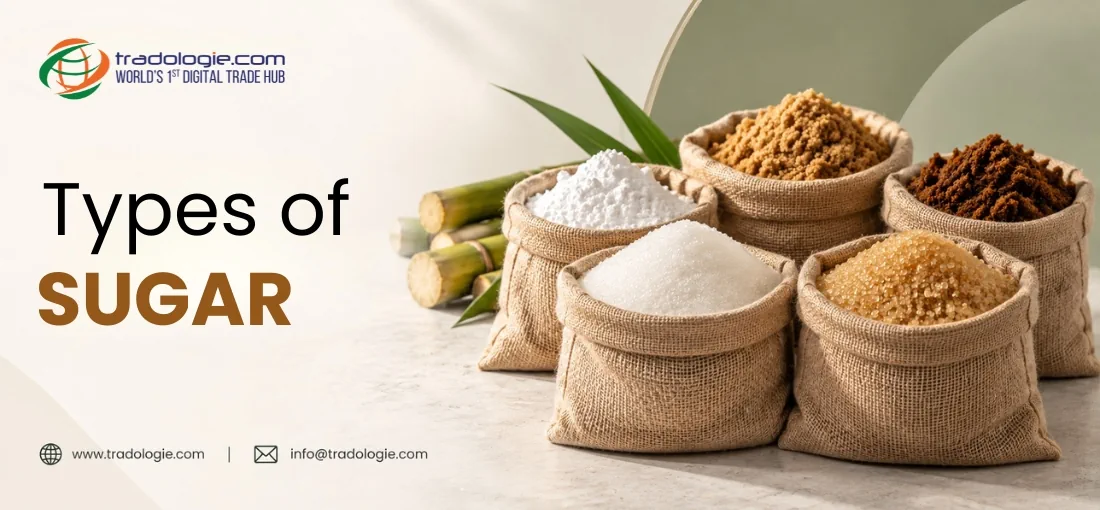
Sugar looks like a simple commodity until you get into the trade. The types of sugar in the global trade industry are not all bought for the same reason, and the difference between raw, refined, brown or powdered sugar can matter quite a bit to a food manufacturer, refinery or bulk buyer. Knowing the top varieties of sugar is therefore less about memorising names and more about understanding what each type is actually used for for exporters.

Walk through the international sugar trade industry and a few varieties appear again and again when it comes to types of sugar . Raw cane sugar moves in enormous quantities, usually as an industrial feedstock rather than a finished consumer product. Refined white sugar is a different proposition altogether, where colour, purity and crystal characteristics become much more important.
| Sugar Type | Typical Trade Specification | Common Use |
|---|---|---|
| Raw Cane Sugar / VHP Sugar | High-polarisation raw sugar; darker colour and higher ICUMSA values than refined sugar | Refineries, food processing |
| Plantation White Sugar | White sugar with comparatively low colour; less refined than premium refined sugar | Food processing, beverage and domestic markets |
| Refined White Sugar - ICUMSA 45 | Very low colour refined sugar; fine, clean crystals depending on contract specification | Beverages, confectionery, food manufacturing |
| Refined White Sugar - ICUMSA 100/150 | Refined white sugar with somewhat higher colour than ICUMSA 45 | Food processing, bakery, general industrial use |
| Brown Sugar | Moist or partially refined sugar with more colour and molasses characteristics | Bakery, beverages, sauces and specialty foods |
| Muscovado / Demerara-type Sugar | Specialty brown sugars, generally with larger crystals and stronger molasses character | Specialty foods, bakery and retail |
| Icing / Powdered Sugar | Very finely pulverised sugar; particle size is a key specification | Confectionery, bakery, creams and toppings |
Note: ICUMSA values and crystal-size specifications are normally agreed as part of the commercial contract. They should not be treated as universal definitions for every market or supplier. ICUMSA has official methods covering sugar colour and particle-size determination.
If there is one variety that deserves to be called the workhorse of the global sugar trade, it is raw cane sugar.
It is an intermediate product rather than the finished white sugar found on supermarket shelves. A large part of its commercial value lies in what happens next: the buyer takes the raw sugar into a refinery and processes it into a cleaner, whiter product.
Brazil is in a league of its own here. In 2024, Brazil exported around $15.93 billion of raw cane sugar , far ahead of other exporters. Thailand, India, South Africa and Guatemala also featured among significant exporters. On the buying side, Indonesia, China, the United States, India and Morocco were among the largest importers of raw cane sugar.
VHP sugar is another term buyers and sellers frequently encounter in this part of the market. The exact contractual specification can differ, but the discussion usually comes back to polarisation, colour, moisture, ash and other quality parameters rather than simply calling it “raw sugar.”
This is where the specifications become more interesting.
Plantation white sugar sits closer to the finished product, but it is not necessarily the same thing as highly refined white sugar. Codex Alimentarius distinguishes plantation or mill white sugar from white sugar, with different purity specifications.
Then you have refined white sugar, where ICUMSA colour is one of the most commonly discussed commercial specifications. ICUMSA 45, for example, is widely used in international trade as a reference for very low-colour refined sugar.
But colour is only part of the story. Buyers may also specify:
So when a buyer asks for “white refined sugar,” that description alone may not be enough to close a deal.
Sugar is also traded according to granulation or particle size, particularly when the end-use is important.
Fine-grain sugar dissolves quickly and is useful in products where rapid dissolution matters.
Medium or regular granulated sugar is the familiar general-purpose format used across food processing and consumer applications.
Coarse-grain sugar has larger crystals and can be useful where texture or slower dissolution is desirable.
Powdered or icing sugar sits at the other end of the spectrum. The crystals are mechanically reduced to a very fine size, making the product suitable for confectionery, bakery decoration, creams and icings. Codex Alimentarius specifically recognises powdered sugar/icing sugar as finely pulverised white sugar.
This is an important point for B2B buyers: two sugars can have an absolutely similar colour and purity specifications but still be unsuitable substitutes if their particle-size requirements are different, even slightly.
Brown sugars occupy a rather different corner of the market.
Some are partially refined sugars retaining more molasses, while others are produced or marketed specifically for their colour, flavour and crystal characteristics. Demerara-type sugar is generally associated with larger crystals and a noticeable molasses character, whereas muscovado is darker, softer and more strongly flavoured.
They are therefore not simply “white sugar but brown.” Their applications and buyer requirements can be quite different.
At a broader level, the major categories of sugar can be understood through how far the product has moved from the original cane or beet material and what the buyer intends to do with it.
| Category | Examples | Main Trade Characteristic |
|---|---|---|
| Raw Sugars | Raw cane sugar, VHP | Industrial/refinery feedstock |
| White Sugars | Plantation white, refined white | Food and beverage manufacturing |
| Brown & Specialty Sugars | Brown sugar, Demerara, Muscovado | Flavour, colour and specialty applications |
| Fine-Grain Sugars | Fine granulated sugar | Fast dissolution and food processing |
| Powdered Sugars | Icing sugar | Confectionery and bakery |
| Liquid Sugars & Syrups | Liquid sugar, sugar syrups | Beverage and industrial processing |
Codex's sugar standards similarly distinguish white sugar, plantation/mill white sugar, raw cane sugar, soft white and brown sugars, powdered sugar and other sugar products.

For anyone buying or selling sugar internationally, the commercial specification is often more useful than the product name itself.
ICUMSA Colour: Indicates the colour of the sugar solution. Lower values generally correspond to whiter, more highly refined sugar. ICUMSA maintains specific analytical methods for different colour ranges.
Polarisation: Measures the sucrose content by polarimetry and is particularly important in raw-sugar trading. ICUMSA describes polarimetric sucrose determination as a method used for statutory, trade and factory analysis.
Crystal Size: Fine, medium, coarse and powdered forms behave differently during processing, so particle-size requirements can become part of the purchase specification. ICUMSA also maintains methods for particle-size determination in sugar.
Moisture and Ash: These can affect storage, handling, processing behaviour and the suitability of the sugar for particular industrial applications.
The global trade is heavily concentrated in cane-sugar producing countries. Brazil is the standout exporter, while Thailand, India, South Africa and Guatemala also have an established presence in international shipments. On the import side, refinery capacity, domestic consumption and local production gaps all influence the buying pattern.
And that is really why talking about the most traded sugar types only in terms of colour can be misleading. A refinery buyer looking for raw sugar is solving a very different procurement problem from a beverage company asking for low-colour refined sugar or a confectionery manufacturer looking for powdered sugar.
Tradologie provides a transactional environment where buyers and sellers can discuss sugar requirements directly rather than working through a long chain of intermediaries.
The process supports live negotiation, allowing buyers to make counteroffers against supplier quotations and continue the discussion until pricing is not finalised. Tradologie does not interfere in the pricing decided between the buyer and seller.
Depending on the agreed transaction, payment can be structured through mechanisms such as a Letter of Credit or advance payment with the balance against agreed proof of dispatch. The platform also provides end-to-end transactional support around the trade process.
Want to export or import sugar in bulk globally? Register as a buyer or seller on Tradologie today.
This content is for general informational purposes and is based on the trade classifications, specifications and information provided in the source material. ICUMSA values, crystal sizes and other specifications can vary by contract, supplier and destination market. Buyers and sellers should confirm the exact commercial specification before finalising a transaction.
Raw cane sugar, VHP sugar, plantation white sugar, refined white sugar, brown sugar and powdered sugar are among the major types discussed in international trade.
VHP, or Very High Polarisation, is a type of raw cane sugar commonly traded as an industrial or refinery feedstock. Its commercial specification can include polarisation, colour, moisture and ash.
ICUMSA 45 is a commonly used reference for very low-colour refined white sugar. Buyers may also specify polarisation, moisture, ash, crystal size and other quality parameters.
Plantation white sugar is less refined than premium refined white sugar and generally has comparatively higher colour. Refined white sugar is produced to tighter specifications for applications such as beverages and confectionery.
Both are specialty brown sugars. Demerara-type sugar is associated with larger crystals and a molasses character, while Muscovado is generally darker, softer and more strongly flavoured.
Brazil is the standout exporter of raw cane sugar. In 2024, it exported around $15.93 billion of raw cane sugar, according to the source.