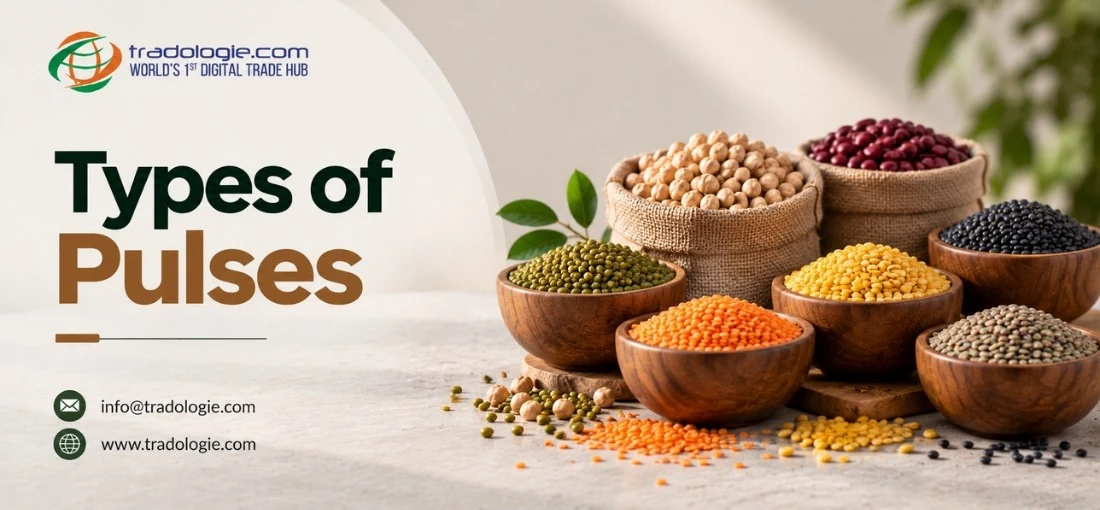
Pulses are everyday foods in many parts of the world. However, the types of pulses which are traded internationally can be quite different. Lentils are a staple in dals, chickpeas move through retail and foodservice markets, while peas and beans are used in food processing as well as household cooking.
There is a sizable international trade behind these products. Global pulse trade was around 18.8 million tonnes in 2023, according to the OECD-FAO Agricultural Outlook. The trade is concentrated around a few major pulses, although each has its own supply and demand pattern.

Global trade: around 5.8 million metric tons in 2024
Dry peas are one of the biggest products in the types of pulse trade. Canada has a strong position in this market, with Russia also supplying international buyers.
The crop is used for food, animal feed and ingredients. Pea protein has also created another outlet for processors and exporters.
Global trade: around 5.2 million metric tons in 2024
Dry beans cover different varieties of pulses and beans rather than one single product. Kidney beans, black beans and navy beans are among the types that move across international markets.
The United States, Canada and Argentina are active suppliers. China and several African countries also participate in the trade, depending on the variety and destination.
Global trade: around 4.5 million metric tons in 2024
Lentils have a large and established international market. Canada is one of the main sources for global buyers, while India remains a major destination.
Red and green lentils are commonly traded, with demand coming from both retail markets and food processors.
Global trade: around 2.3 million metric tons in 2024
Chickpeas have a particularly broad food market. They are used in dishes such as hummus, curries and snacks, and are also sold as flour and other processed ingredients.
Australia is an important supplier, while India is one of the major markets for chickpeas. Turkey and other producing countries also have a role in international supply.
Global trade: around 1.2 million metric tons in 2024
Broad beans, often called fava beans, are traded both as food and for processing. Their importance varies from one market to another, so the trade is not as uniform as it is for lentils or dry peas.
European and Mediterranean markets have long been familiar with the product, while other markets use it in processed foods and animal feed.
Global trade: around 984,000 metric tons in 2024
Pigeon peas have a much more concentrated market than some of the larger pulse categories. India is a major consumer, and imports become important when domestic production does not cover demand.
Myanmar is one of the important suppliers to the international market. For traders, the India-Myanmar corridor is therefore worth watching when working with pigeon peas.
Trade: around 900,000 metric tons exported from Myanmar in 2024
Black gram, or urad, is closely associated with the South Asian food market. It is quite commonly used in dals and is also an important ingredient in idli and dosa batter.
India accounts for a large part of the demand. At the same time Myanmar supplies a significant share of the international market.
Trade: around 1.8 million metric tons in Asia-Pacific in 2024
Mung beans are widely consumed across Asia and have also found markets in sprouting, food processing and packaged foods.
Australia, Myanmar and China are among the countries involved in the trade. Unlike some bulk pulses, buyers can be quite particular about quality when the beans are intended for a specific food application.
A country can grow plenty of pulses and still need to import different varieties of pulses . India is a good example. It is one of the world's largest pulse-producing countries, but it also buys heavily from overseas.
Agriculture and Agri-Food Canada puts India's pulse imports at about 3.6 billion kilograms in 2023. China was another major market, with imports of roughly 3.4 billion kilograms.
The supply side varies by product too. Canada is particularly strong in lentils and peas, Australia has a strong position in chickpeas, and Myanmar is important in several pulses consumed across South Asia.
For exporters, this is where the opportunity lies. Pulse trade is not one single market. Each variety has its own buyers, origins, quality expectations and preferred destinations.

Tradologie is the leading AI solution that facilitates the global trade of different varieties of pulses. There are many benefits of exporting and importing pulses in bulk through this platform, which are as follows:
Verified buyers and sellers: The platform has a strict verification protocol when it comes to verifying buyers and sellers of different agricultural commodities, including pulses, so you can rest assured that you deal only with verified parties.
Dedicated Trade Manager: Suppose you want to export and import purchases in bulk locally. You get a dedicated trade manager that assists all throughout the transactional process because of the transaction-oriented approach of the platform.
One-to-one live negotiations: The platform allows one-to-one live negotiations between pulses buyers and sellers without any interference in pricing. It charges only a 1% success fee of the total trade value, no heavy commission like middlemen.
Want to export or import pulses in bulk? Register as a buyer or seller on Tradologie.
The information provided in this article is for general informational and business-research purposes only. Trade volumes, market conditions, production, imports and exports may change over time. Readers should verify the latest market data and applicable regulations before making commercial decisions.
The blog covers dry peas, dry beans, lentils, chickpeas, broad/fava beans, pigeon peas, black gram and mung beans.
Among the categories listed, dry peas have the largest trade volume at around 5.8 million metric tonnes in 2024, followed by dry beans at approximately 5.2 million tonnes.
Global lentil trade was around 4.5 million metric tonnes in 2024. Canada is identified as one of the main sources for global buyers, while India remains a major destination.
Global chickpea trade was around 2.3 million metric tonnes in 2024. Australia is an important supplier, while India is one of the major chickpea markets.
The major suppliers vary by pulse. Canada is particularly strong in lentils and peas, Australia has a strong position in chickpeas, and Myanmar is important for several pulses consumed across South Asia.
Pigeon peas have a concentrated market, with India being a major consumer. Imports become important when domestic production does not meet demand, while Myanmar is an important international supplier.
Black gram, also known as urad, is closely associated with South Asian cuisine. It is commonly used in dals and in products such as idli and dosa batter.
Mung beans are widely consumed across Asia and are also used for sprouting, food processing and packaged foods. Australia, Myanmar and China are among the countries involved in their trade.
Different countries have different production capabilities and consumer requirements. Even major pulse-producing countries such as India import pulses when particular varieties or additional supply are required.