
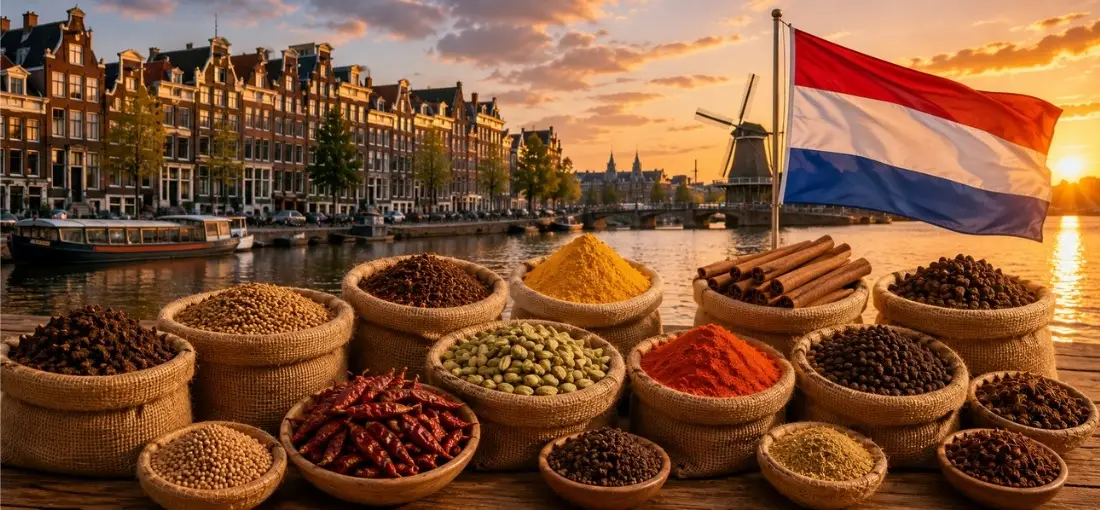
The Netherlands is the absolute maritime gateway and strategic turnstile for European agricultural trade. For an international supplier, the operational reality here is intense: you are selling to highly automated, bulk-purchasing industrial processors who distribute raw materials across 32 European countries.
The seasoning & spices market in the Netherlands is expected to reach a projected revenue of US$ 110.2 million by 2030. A compound annual growth rate of 7.5% is expected of the Netherlands seasoning & spices market from 2025 to 2030.

Driven by a massive continental shift toward clean-label food manufacturing and a thriving multi-ethnic culinary landscape, the Dutch spice sector operates at an institutional scale. This isn't just a basic retail trend; it's a compliance-driven movement where strict European Union food regulations and absolute microbiological purity dictate terms.
Tradologie provides the direct digital gateway needed to navigate this high-volume landscape. We offer an AI-enabled trade ecosystem where you can engage with major spices importers in Netherlands networks through a streamlined, transparent process that prioritizes direct communication, live buying requirements, and secure capital clearing .
The Dutch spice trade is anchored by historic global trading houses, high-capacity milling giants, and specialized ethnic distributors positioned near key maritime corridors.

| Rank | Company Name | Headquarters | Market Focus | Unique Market Position |
|---|---|---|---|---|
| 1 | Nedspice Group | Rotterdam | Industrial & Wholesale | A global titan in sustainable sourcing and processing; they control immense automated distribution loops across Europe. |
| 2 | BCFoods Europe B.V. | Purmerend | Large-Scale Industrial | Operates a massive 3PL warehouse near Rotterdam, supplying over 30 crop lines to food brands in 32 countries. |
| 3 | Natural Spices | Amsterdam | Clean Label & FMCG | Founded in 1935; specialists in producing salt-free blends, sauces, and functional flavorings with zero additives. |
| 4 | Spicedesk | Garderen | Food Industry Supply | An elite B2B supplier specializing in spiral cleaning, sterilization, grinding, and custom mixing. |
| 5 | Spicemasters | Harderwijk | Processed Ingredients | Provides highly customized, traceable herbs and spices tailored strictly to corporate manufacturing specs. |
| 6 | Spice United Europe B.V. | Breda | Specialized Import | Leading direct importer of non-irradiated, allergen-free tropical spices and premium vanilla lines. |
| 7 | KRG Asian Food | Rotterdam | Ethnic Distribution | Manages a modern 4,000 m² facility distributing over 2,500 authentic products to retailers across Europe. |
| 8 | Spice King Holland (SKH) | Enschede | Extracts & Essential Oils | Prominent producer utilizing advanced supercritical extraction techniques for spice oils and natural flavors. |
| 9 | Amar Import & Export | Amsterdam | Caribbean & Asian B2B | Wholesale distribution powerhouse supplying authentic, raw, and ground variations to European ethnic lines. |
| 10 | Unispices Wazaran | Badhoevedorp | Sustainable Sourcing | Dedicated niche processor focusing strictly on traceable, naturally handled Indonesian tropical crops. |
The Netherlands is a marketplace that values food safety certification and supply chain transparency far above cheap spot-market deals. The logic is blunt: if your product can't pass rigorous testing by accredited European laboratories or exhibits a single discrepancy under IFS Broker or BRC regulations, your entire container will be frozen at the Rotterdam dock. However, for those who can prove absolute chemical and microbiological purity, the rewards are immense—the European sustainable spice segment is climbing rapidly as corporate buyers pledge to eliminate untraceable supply blocks.
The current volume is heavily dominated by whole and tailored powdered forms that can be seamlessly fed into automated manufacturing grids. Furthermore, centralized digital networks have become the ultimate tool for optimizing lead times, allowing international suppliers to interact directly with Tier-1 processing plants . If you can provide bulk raw materials that feature stable volatile oil levels and clear tracking data, you can build the kind of recurring B2B relationships that define sustainable trade.
In the Netherlands, logistics is all about tapping into world-class maritime infrastructure to achieve rapid, frictionless delivery across mainland Europe.
Aligning your shipping schedules and port destinations directly with your buyer's localized milling or sterilization centers is essential. It remains the only practical method to eliminate costly demurrage fees and protect your hard-earned export margins.
Exporters can grow by using AI-enabled trade solutions like Tradologie to access verified buyers and structured demand. Focusing on bulk shipments, maintaining quality consistency, and optimizing logistics helps scale operations. Building direct relationships with buyers is key to long-term success.
You can connect with bulk spices importers in Dubai through AI-enabled trade solutions like Tradologie, which provide direct access to verified buyers. Instead of random inquiries, exporters receive live bulk RFQs and negotiate in a structured environment. This improves deal closure and reduces time spent on unqualified leads.
Dubai is the commercial hub of the global spice trade and acts as a re-export gateway for the Middle East and North Africa. Spices imported into Dubai are redistributed across multiple countries, creating continuous demand. This makes it a high-volume and high-margin market for exporters.
Spice buyers in Dubai include bulk importers, industrial processors, wholesalers, HORECA suppliers, and re-export traders. Large companies and food processors purchase spices in bulk, while trading houses manage international redistribution. Each segment offers different scale and pricing opportunities.
Turmeric, black pepper, cumin, chilli, and cardamom are among the most in-demand spices. These are widely used in food processing, retail packaging, and seasoning blends. Industrial buyers require consistent quality and grading for large-scale usage.
Tradologie provides an AI-enabled trade ecosystem where exporters can access verified Dubai buyers, receive real-time bulk requirements, and negotiate directly. It removes dependency on middlemen and ensures transparency. This structured approach helps exporters scale faster and build long-term trade relationships.
Jebel Ali Port is the primary hub and handles nearly 70% of spice imports in the UAE. Other ports like Khalifa Port, Port Rashid, and Sharjah Port are also used based on buyer location and logistics efficiency. Choosing the right port reduces cost and transit time.
Yes, exporting spices to Dubai is profitable due to premium pricing, strong demand, and re-export potential. Buyers focus on quality and consistency rather than just price. This allows exporters to achieve higher margins compared to many Asian markets.
Importers expect consistent quality, proper grading, competitive pricing, and reliable delivery timelines. Certifications and efficient logistics also play an important role. Long-term business depends on meeting these expectations consistently.
Dubai’s re-export model ensures that spices imported into the UAE are redistributed across the Middle East, Africa, and beyond. This creates continuous demand cycles and larger volume opportunities. Exporters benefit from both direct sales and indirect regional reach.