
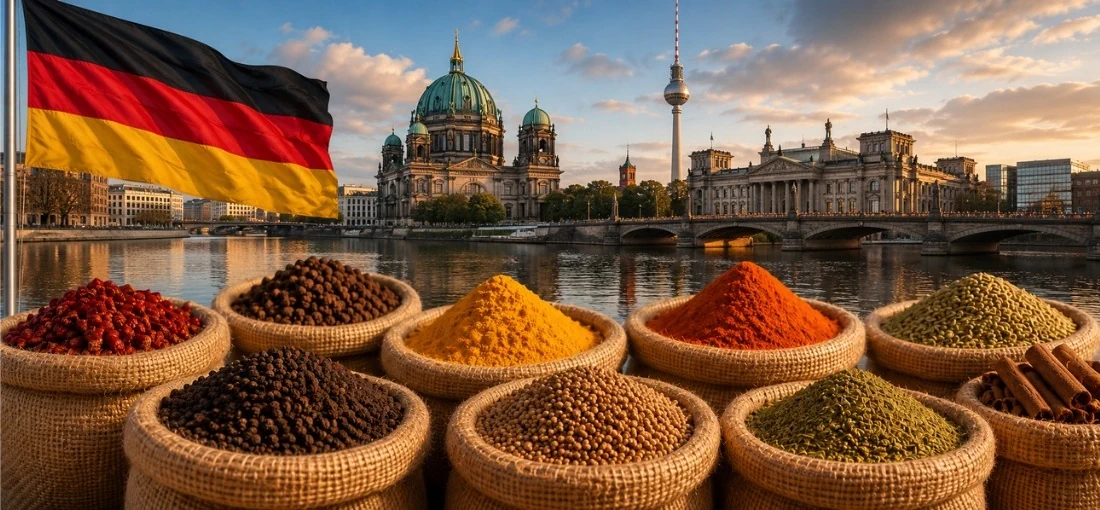
Germany isn't just a major consumer; it is the commercial engine of the European spice trade. The market reality here is one of high stakes and even higher standards. In 2025, the seasoning sector reached a valuation of roughly USD 189.2 million , and despite previous long-term plateaus, it just saw a massive 30% spike in imports . This surge is being driven by a food-processing industry that is currently desperate for ultra-pure, high-purity ingredients to feed a health-conscious public.
Tradologie provides the direct digital gateway needed to navigate this quality-obsessed landscape. We offer an AI-enabled trade ecosystem where you can engage with major spices importers in Germany through a streamlined, transparent process that prioritizes compliance with strict EU safety protocols.
How Tradologie simplifies the German trade:

The German landscape is defined by century-old family mills and massive industrial conglomerates that supply the country's high-volume meat, bakery, and retail sectors.
| Rank | Company Name | Headquarters | Market Focus | Unique Market Position |
|---|---|---|---|---|
| 1 | Fuchs Gruppe | Dissen | Retail & Industrial | The absolute giant of the German market; they control the majority of retail shelf space. |
| 2 | Hartkorn Gewürzmühle | Koblenz | Retail & Tradition | A family-run powerhouse that has been a staple of German spice refining for over a century. |
| 3 | Ph. Seyfried (Seyma) | Mannheim | Industrial & Wholesale | A specialized importer that focuses almost exclusively on precision milling for the meat industry. |
| 4 | McCormick (Germany) | Various | Retail & Foodservice | The German division of the global titan, focusing on high-volume branded and store-label solutions. |
| 5 | Döhler Group | Darmstadt | Food Ingredients | A massive industrial buyer that pulls in bulk spices specifically for large-scale flavor extraction. |
| 6 | Gewürzmühle Nesse | Loxstedt | Industrial Processing | A critical player for providing customized, high-volume spice blends to industrial food plants. |
| 7 | Hela Gewürzwerk | Ahrensburg | Sauces & Ketchup | Famous for their spice-based sauces; they need massive, steady bulk volumes to keep their lines running. |
| 8 | Raps GmbH | Kulmbach | Meat & Savory | A leader in functional spice blends designed for the massive European convenience food sector. |
| 9 | Kräuter Mix | Abtswind | Herbs & Specialty | They focus on the high-purity end of the market, including the pharmaceutical and premium food sectors. |
| 10 | Ostmann Gewürze | Dissen | Retail | A legacy brand that remains a household name for traditional home cooking across Germany. |
In Germany, logistics centers around the "Gate to the World." Getting your cargo to the right port puts it directly into the industrial heartland without the massive inland freight costs.

Don't just ship to any hub; align your logistics with the port nearest your buyer's milling facility. It's the only way to ensure your spices importers in Germany get their stock without the typical trans-European bottlenecks that eat into your profit.
Pepper is one of the largest categories, followed by ginger, nutmeg, cumin, cinnamon, coriander, turmeric, cardamom and chilli.
Italy imported about US$25.59 million of whole dried pepper in 2024, along with US$8.02 million of crushed or ground pepper.
The article highlights Sidea Spezie, Roma Fine Foods, Droghe Palma Commerciale, Yes Spices, Alfa Food & Ildia, Webb James, Orodorienthe, Terza Luna and Spezieria di Classi Marino.
Important origins include India, Indonesia, Vietnam, China and Sri Lanka, while Italy also sources through European trading centres such as the Netherlands, Germany, France and Spain.
Genoa, Trieste, Livorno, La Spezia and Venice are among the important gateways for spice imports.
Depending on the product and shipment, exporters may need correct HS/CN classification, commercial invoice, packing list, Certificate of Origin, product specification, Certificate of Analysis, pesticide-residue reports, microbiological and contaminant testing, phytosanitary documents, traceability information and customs documentation.
Yes. The article states that EU authorities increased identity and physical checks on Indian cumin seeds to 50% of consignments in June 2026 because of pesticide-residue concerns.
Requirements can include specific product grades, processing, mesh size, microbiological limits, laboratory testing and regular supply.