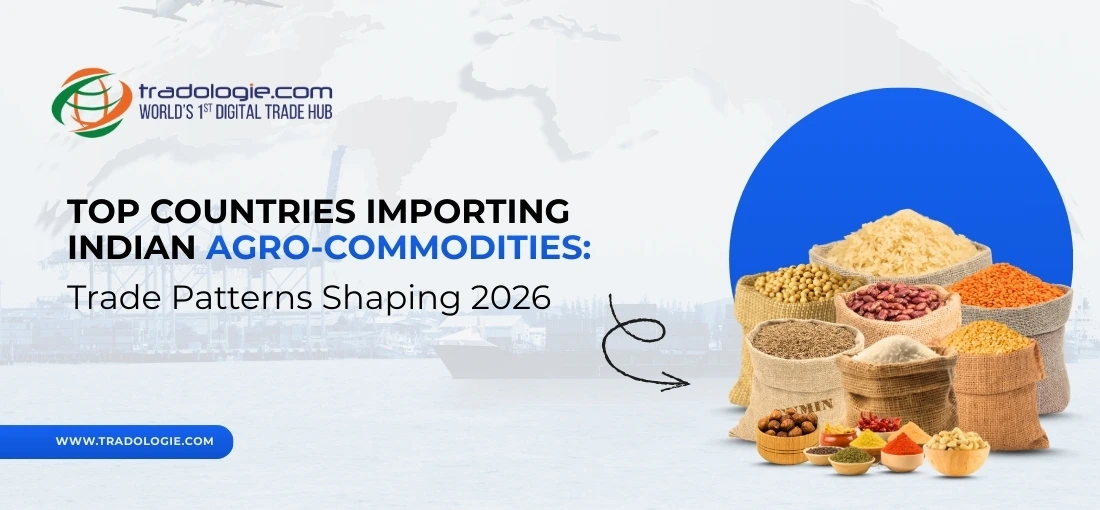
India’s agricultural export story isn’t standing still. It isn’t exploding either. It’s stretching, shifting, and quietly recalibrating itself.
Rice, spices, pulses — yes, they’re still the backbone. That hasn’t changed. What has changed is where Indian produce is landing, how buyers are using it, and what they expect once it gets there. By the time we step into 2026, the real story won’t be volumes alone. It’ll be intent — who’s buying, for what use, and how replaceable India really is in each lane.
Agro-food exports continue to form a meaningful slice of India’s outbound trade, crossing USD 51 billion in FY25, even as competition tightens. But numbers without context don’t tell you much. You have to look market by market.
.webp)
A Wide Footprint, Not One Big Bet
India’s agri exports today don’t hinge on one region or one product. They move across Asia, the Middle East, Africa, Europe, and North America — staples mixed with value-added foods, and a growing share of processed and semi-processed items.
Rice still anchors the system. After export curbs were lifted, India’s rice shipments jumped 19.4% in 2025, touching roughly 21.55 million metric tonnes. Both basmati and non-basmati moved. But rice alone doesn’t explain the resilience. It’s the spread.
United States — Value, Not Just Volume
The U.S. remains one of India’s most important agri markets, with imports estimated around USD 5.6 billion in recent periods. But it’s not a rice-only relationship.
What moves here is a mixed basket: turmeric, chilli, cumin, pepper, pulses, ready-to-eat foods, organic products, oilseeds. Consumption is driving this — not shortages. Indian products fit into plant-based diets, ethnic food demand, and clean-label trends.
For exporters, the U.S. is not forgiving. Documentation, residue limits, traceability — all non-negotiable. Price helps, but compliance closes the deal.
United Arab Emirates — Gateway More Than Destination
The UAE buys big, but more importantly, it redistributes.
With agri imports crossing USD 2.2 billion, it remains one of India’s highest-value destinations. Basmati rice leads. Fruits, vegetables, sugar, cereals, spices, processed foods follow.
What makes the UAE strategic isn’t consumption alone. It’s logistics. Ship here, and your product often doesn’t stop here.

China — Inputs, Not Dinner Plates
China’s agri imports from India aren’t about household consumption. They’re industrial.
Rapeseed meal, oilseed cakes, cotton fibre, selected spices — inputs that feed processing and manufacturing chains. Total values often cross USD 1 billion, but this trade behaves differently from consumer markets.
Price sensitivity is high. Substitution risk is real. China buys when the math works — and stops when it doesn’t.
Bangladesh — Predictable, Tight, Essential
Bangladesh doesn’t spike. It doesn’t disappear either.
Indian exports here crossed USD 2 billion in FY25, and food staples dominate — non-basmati rice, Parboiled Rice, wheat, fruits, vegetables, spices. Geography does most of the work. Short routes. Similar food habits. Structural supply gaps.
For exporters, this is a steady market. Less volatile than distant destinations. But margins are tighter. Buyers know the numbers cold.
Southeast Asia — Quiet Growth Corridors
Indonesia and Vietnam rarely make noise, but they matter.
Indonesia pulls in Buffalo Meat, sugar, cotton, oilseed meals. Vietnam sources oilseeds, cotton yarn, spices. These are processing inputs, not impulse buys.
ASEAN linkages help. Food processing capacity is expanding slowly. Growth isn’t explosive — but it shows up year after year. Miss it, and you won’t feel it immediately. Stay in it, and it compounds.

Saudi Arabia, Iran, Iraq — Rice Sets the Tone
In West Asia, rice still writes the first line of the contract.
Saudi Arabia consistently ranks among the top importers of Indian basmati, often crossing 1 million tonnes annually. Iran and Iraq follow closely. Once rice flows are stable, spices, processed foods, and ready meals move alongside.
These markets don’t chase novelty. They reward consistency. One shipment gone wrong is remembered longer than ten good ones.
Nepal and Malaysia — Smaller, Steadier Lanes
Nepal and Malaysia aren’t volume giants, but they’re stable.
Nepal imports rice, cereals, fruits, vegetables, spices — basic consumption. Malaysia sources spices, rice, processed foods, feeding a diverse foodservice ecosystem.
These are maintenance markets. They don’t redefine strategy, but they reward reliability.
What the Trade Map Is Really Saying
Put together, the picture is clear.
India’s agri exports aren’t riding a single wave. They’re spread across staples, processing inputs, premium foods, and value-added categories. Rice still anchors flows, but spices, pulses, processed foods, oilseeds, and meat products are shaping where growth sticks.
The biggest importers — the UAE, Saudi Arabia, Bangladesh, the U.S. — aren’t just buying more. They’re buying differently.
Looking Into 2026
India enters 2026 with scale, diversity, and reach. But volume alone won’t protect market share.
Exporters who understand end-use, buyer intent, and market-specific expectations will stay relevant. Those who chase only tonnage will feel pressure first.
The next phase of agro trade won’t be decided by who ships the most.
It’ll be decided by who fits best into how the world actually consumes food.