The text of the recently concluded BRICS Agriculture Ministers’ Meeting in Indore—culminating in the unanimous adoption of the "Indore Declaration"—outlines a structured blueprint for global agricultural cooperation. At a time when international commodity flows face complex logistical pressures and shifting climate parameters, a unified statement has been put forward by the core and expanded partner nations of BRICS.
Representing roughly 42% of the planet's agricultural land, this geopolitical bloc also holds an identical 42% slice of global foodgrain output. With a footprint that massive, the decisions made here hold the physical scale to significantly influence how the world grows, prices, and distributes food. In fact, India is one of the major rice and spices suppliers in the global markets.
Yet, the primary challenge of the Indore Declaration lies in its practical execution. How do we take these ambitious official mandates—such as expanding digital agriculture, protecting family farms, and stabilizing trade—and turn them into measurable market results on the ground? That is the main question everyone is asking now that the summit has wrapped up. State mechanisms provide the overarching policy framework, but agile commercial infrastructure is required to manage daily cross-border transactions smoothly for rice exporters, sugar exporters, spices exporter etc
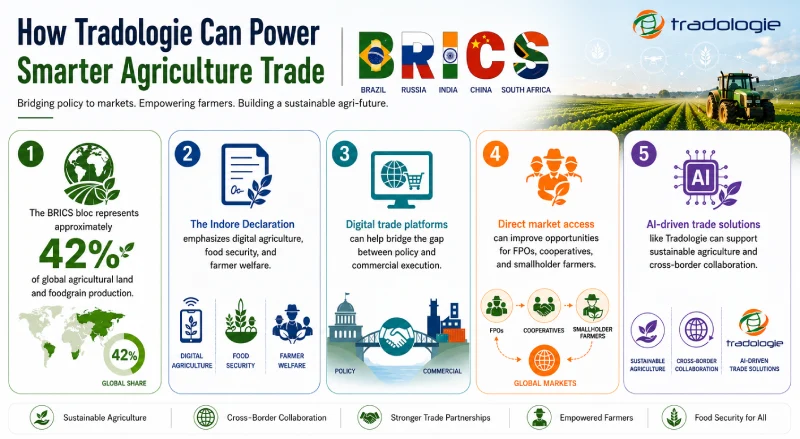
To transform the Indore priorities into active trade flows, the bloc can look to modern digital marketplace systems to bridge the gap. Specifically, a digital trade-enablement platform like Tradologie can support the BRICS vision by connecting agricultural producers, buyers, and input suppliers across member countries, thereby promoting food security, farmer prosperity, and technology-driven agricultural trade.
Connecting Policy and Commercial Execution
Governments are highly effective at signing declarations, establishing cross-border networks, and absorbing the shock of volatile input costs through domestic subsidies. Take state interventions as an example—the ones that keep essential fertilizers affordable for local farming communities during periods of international market instability. However, a formal treaty requires a responsive commercial mechanism to handle the practical details of global supply lines, from matching specific buyers to managing real-time trade documentation.
When international corridors face sudden operational adjustments, the administrative processes required to reroute food supplies must operate efficiently. For the Indore Declaration to achieve its long-term objectives, these official frameworks need to connect directly with modern trade platforms. Digital marketplace infrastructure can serve as an effective operational layer, translating policy goals into predictable, cross-border trade flows.

Activating the Digital Agriculture Mandate
A headline institutional outcome from the Indore meetings is the formal establishment of the BRICS Network on Digital Agriculture. The official mandate focuses heavily on building a practical bridge between artificial intelligence, geospatial data, and actual farm-level outcomes. Concurrently, deep-level discussions regarding a unified BRICS Grain Exchange have gained fresh momentum, aiming to create a fair, inclusive, and transparent multilateral trading system.
This is where digital frameworks meet daily transaction realities. While a state-run network can track regional crop yields via satellite data, a unified digital commerce floor is best suited to manage multi-thousand-ton quality specifications and contract compliance between international procurement houses.
By moving the transaction lifecycle—from initial inquiry generation and exact grade specification to price discovery and trade compliance—onto a single digital interface, private trade platforms provide a practical path toward the declaration's goals. In this landscape, Tradologie can serve as a practical example of digital trade infrastructure by digitizing sourcing, negotiations, tenders, and procurement processes. Tradologie can connect buyers, sellers, exporters, importers, and government agencies across BRICS markets through a unified digital marketplace, ensuring that fragmented regional systems do not slow down the broader economic cooperation outlined in the declaration.
Opening Direct Market Access for Family Farmers
The Indore Declaration explicitly dedicated a core session to the systemic vulnerabilities of small and marginal farmers, categorized globally as family farmers. The assembly focused heavily on their ongoing challenges: a lack of direct market linkages, limited credit availability, and the constant struggle to secure remunerative prices for their crops.
The standard international trading pipeline can often be difficult for smallholders to navigate independently. A farming cooperative or a localized aggregator typically has to work through multiple layers of consolidators, regional wholesale brokers, and port-level commission agents before their product reaches a vessel. By the time the crop lands at an international destination, a significant share of the margin has been absorbed by intermediate handling.
An integrated digital trade network helps streamline these intermediate layers. Through FPOs, cooperatives, and aggregators, Tradologie can help farmers and merchant exporters reach international buyers directly, reducing dependence on multiple intermediaries. By registering collective volumes directly on a global platform, Farmer Producer Organizations (FPOs) and agricultural cooperatives can connect more directly with the market. Instead of relying entirely on local spot-market buyers, smallholder groups can view incoming international tenders directly. A cooperative managing pulse or oilseed volumes can interact with verified overseas processors or retail category buyers, securing stable terms that directly advance the farmer-welfare goals established in Indore.

Optimizing Supply Chains to Reduce Post-Harvest Loss
The overarching theme of the ministerial assembly was securing long-term food availability amid severe environmental disruptions, such as variable weather patterns across the Asia-Pacific region. Here, the declaration zeroed in on a critical metric: reducing post-harvest losses and minimizing food wastage. Food lost during storage, delayed transit, or inefficient buyer matching directly impacts available food supplies and global resource efficiency.
Post-harvest loss is frequently an issue of logistical timing rather than farming production. When bulk grain sits in regional warehouses for extended periods due to prolonged brokerage negotiations, the risk of moisture damage and localized product degradation increases.
Modern trade architectures help mitigate this by facilitating a more synchronized procurement model. By improving trade visibility, procurement efficiency, and international buyer-seller matching, Tradologie can help reduce supply chain bottlenecks and ensure smoother movement of agricultural commodities. Because international buyers can connect with verified sellers and lock in specific grading profiles before the grain leaves the processing mill, cargo can move more directly from processing floors to sealed containers and onto cargo vessels. Reducing unmonitored storage intervals between sales helps preserve product quality. Improved transparency across the trade corridor allows the BRICS bloc to maintain highly efficient supply lines, moving food surpluses to deficit zones with minimal waste and maximum logistical speed.
Supporting Sustainable Agriculture and Input Networks
The final institutional pillars announced at the summit—including the BRICS Network of Centres of Excellence on Agro-Ecology and Regenerative Agriculture and the BRICS AgriN (Agro Inputs, Genetic Resources and Information Network)—focus heavily on transitioning farms toward sustainable practices and the balanced use of fertilizers and crop protection. The goal is to share superior crop varieties, genetic resources, and sustainable methods more effectively across member borders.
However, a shift toward organic or natural farming practices creates a specific requirement for exporters: reliable verification. If a farmer cooperative transitions to regenerative methods, they must be able to prove that their lot meets the precise maximum residue limits (MRLs) and organic tracing rules required by international buyers.
A tech-driven marketplace handles this verification by embedding data collection directly into the transaction workflow. When an exporter lists a cargo lot under a sustainable or low-chemical designation, the platform can require that the listing be paired with live verification files from an accredited testing lab. At the same time, input networks can utilize these digital marketplaces to efficiently distribute certified alternative inputs and traditional seed varieties directly to farming clusters across member nations. By providing a transparent space where these inputs can be evaluated and procured at clear wholesale prices, digital trade platforms turn sustainable farming into a highly scalable, economically viable commercial system.
Technical Verdict
The Indore Declaration demonstrates that the BRICS nations are focused on building regional self-reliance across food supply chains. The creation of dedicated digital, inputs, and ecological networks indicates a clear shift toward structured, international cooperation.
While state policy establishes the essential boundaries and guidelines, digital infrastructure plays a vital role in daily execution. Lasting agricultural resilience is enhanced when trading desks utilize modern digital tools to implement these geopolitical priorities. By leveraging platform ecosystems to digitize cross-border negotiations, open direct trade corridors for smallholders, and maintain independent tracing, the BRICS bloc can effectively build a highly synchronized, resilient, and stable global trade architecture.