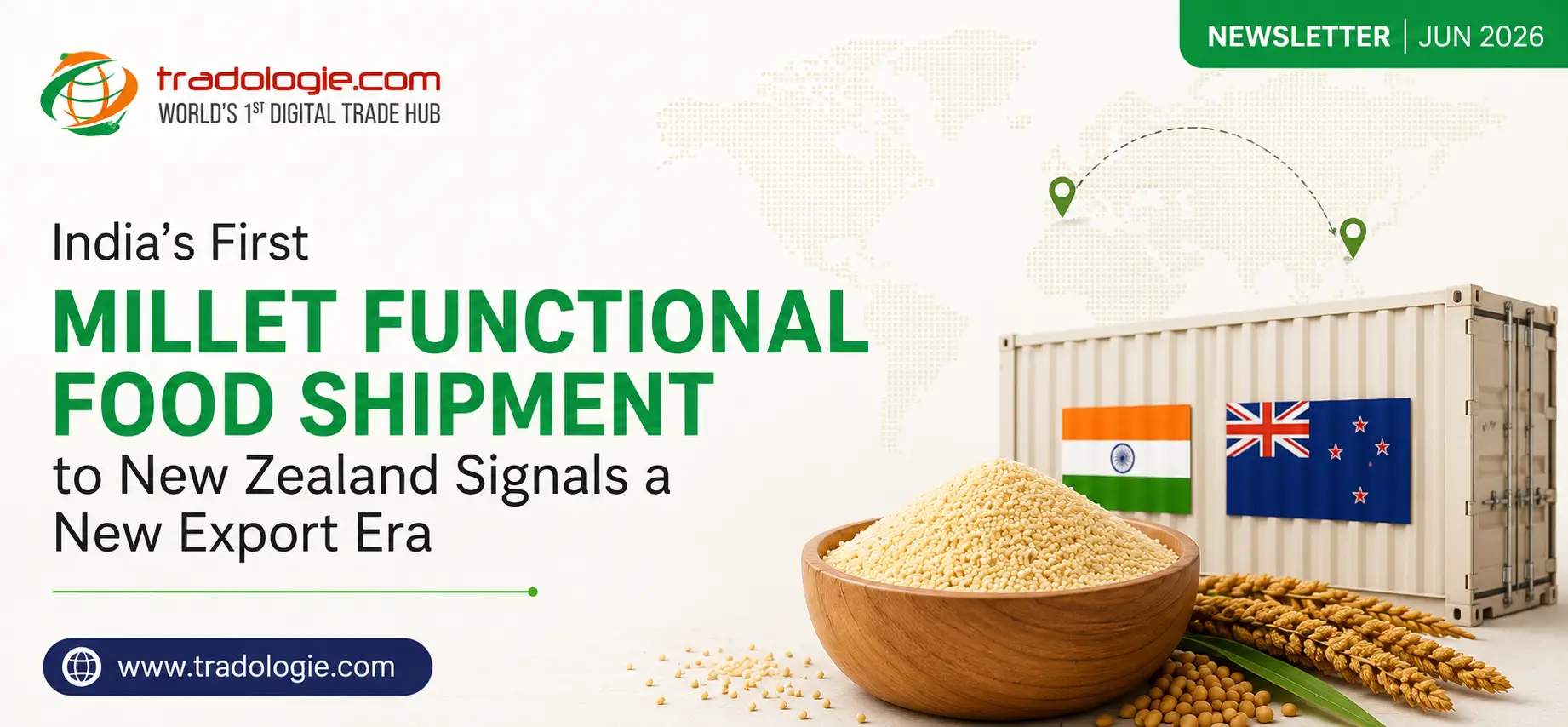
Something deliberate is changing in the global grain trade. It isn't happening in the price pits of bulk commodities, either. On June 3, a single ocean container left a port in Karnataka bound for New Zealand. Its cargo? Just one metric ton. On a standard shipping manifest, that weight is a rounding error. Yet, this specific container carried India’s first-ever sea shipment of millet-based, ready-to-cook functional foods to the Kiwi market.
The Agricultural and Processed Food Products Export Development Authority (APEDA) backed the play, which was executed by Infini Agrotek LLP. For an active export desk, this dispatch serves as a textbook proof-of-concept. The strategy is clear: stop competing on raw, low-margin volumes and start capturing the premium, shelf-stable consumer goods market.
This informative piece of article is a must read if you want to export Millets in bulk.
By the Numbers: The Indian Millet Exports Data
The raw domestic surplus in India is massive. To realize the true scale of the government's global 'Shree Anna' push, you have to weigh production capacity against current export values. Data from the Ministry of Agriculture & Farmers Welfare (MoA&FW) defines the agricultural base:
Domestic Production Baseline
- FY25 Production Volume: 18.01 Million Metric Tons (Mil MT)
- FY25 Total Cultivation Area: 12.86 Million Hectares (Mil ha)
This vast growing footprint should give domestic traders an enormous global edge. Historically, though, export desk returns have stayed stubbornly flat. Outbound shipping logs from the Directorate General of Commercial Intelligence and Statistics (DGCIS) lay out the baseline:
Export Realization Profiles
| Commodity Segment | Volumetric Export Weight | Total Financial Valuation | Sourcing Core & Trade Partners |
|---|---|---|---|
| Primary Raw Millets | 1.21 Lakh Metric Tons (MT) | USD 59.23 Million | Core destinations include UAE, Saudi Arabia, Nepal, USA, Germany, Libya, and Bangladesh. |
A stark reality emerges when you contrast 18 million tons of field harvest with roughly 121,000 tons of raw outbound shipments. The raw bulk grain market is overcrowded. To find real margin growth, Indian exporters must turn that agricultural surplus into value-added retail formats.
Market Outlook: The Multi-Billion Global Value Play
This momentum isn't limited to a few scattered ocean lanes. Market data from Grand View Research shows the global millet market reached a valuation of roughly USD 11.2 billion in 2023. Projections show a steady compound annual growth rate (CAGR) of 4.9% extending through 2030, a trajectory driven by a structural shift in Western grocery buying. Refined carbohydrates are losing floor space; nutrient-dense, gluten-free options are winning it.
Traditionally, India treated millets as a rural safety net or a local dietary staple. On the international trade floor, that narrow view is dead. Global millet buyers no longer see sorghum or pearl millet as cheap filler for animal feed mixes. Instead, they treat them as functional, clean-label raw ingredients destined for premium consumer portfolios.
It is also important to note that the growth is largely concentrated in the industrial snack and breakfast cereal segments and the related industries. Western food companies that procure in bulk look for reliable processing hubs that can supply uniform millet flakes, pre-gelatinised starches, and flour blends which are of high quality. In fact, they have become an essential base for modern lifestyle brands because of the fact that millets naturally carry a low glycemic index and a strong amino acid profile.
Industry Perspective: Why Bulk Grain is a Dead End for Premium Margins
If we talk in general terms, the standard playbook for Indian agri-exporters a few decades ago was simple: pack raw grain into 50kg gunny bags, load a bulk carrier, and compete purely on price in spot markets like North Africa or the Middle East. However, if you talk to anyone on the logistics floor today, they will definitely tell you that model is getting harder to sustain. This is because the raw grains expose your business to volatile domestic minimum support price (MSP) shifts, high maritime freight rates, and strict rejections based on the phytosanitary norms at destination ports due to storage dampness.
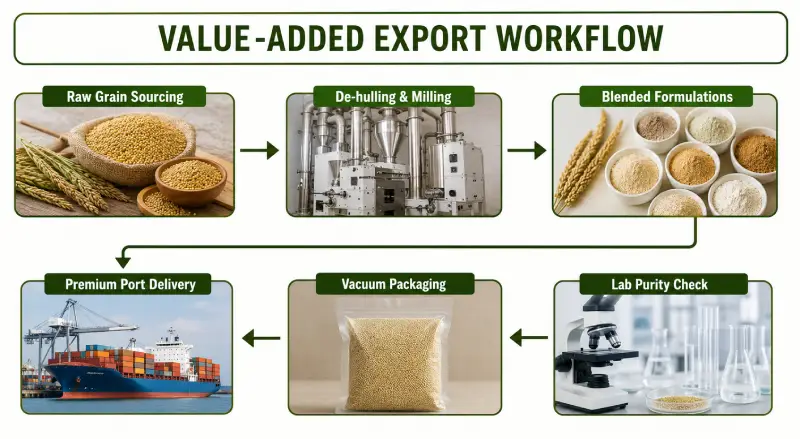
The New Zealand shipment proves a long-standing market thesis: value addition is the only way to shield your margins from inflation. When you convert raw pearl millet or finger millet into a ready-to-cook formulation, you are no longer selling a commodity; you are selling a proprietary food tech solution.
Furthermore, Western consumer behavior has fundamentally changed. Modern millet buyers in high-income regions aren't purchasing millets out of novelty. They want ancient grains because they are gluten-free, low-glycemic, and packed with micro-nutrients. However, they don't want to spend hours cleaning and boiling hard hulls. By exporting ready-to-cook functional formats, Indian processors are directly tapping into the premium convenience sector—a space where retail margins can easily double compared to bulk grain trading
Practical Windows of Opportunity for Indian Exporters
This policy pivot opens up several clear commercial avenues for forward-looking trade desks and food tech startups:
1. The Functional & Ready-to-Cook (RTC) Retail Space
The days of selling millet raw are gradually getting numbered. The real growth is in pre-mixes, smart breakfast cereals, instant porridges, and gluten-free baking bases. The New Zealand shipment consists entirely of functional foods—meaning products engineered to retain high dietary fiber and protein while offering a preparation time under ten minutes. If you can establish an automated clean-label processing line that avoids synthetic binders, Western retail chains will secure long-term contract positions.
2. Capitalizing on Extreme Climate Resilience
From a sourcing perspective, millets are an absolute dream for supply chain stability. Water-heavy crops like rice and wheat face sudden production caps or export bans as climate patterns become more erratic. Millets require just a fraction of the water and very minimal synthetic inputs to thrive and grow across the dry belts of Rajasthan and Gujarat. This literally means your raw material pipeline remains highly stable and predictable, even during weak monsoon cycles as an exporter.
3. Untapped Regional Corridors
While the DGCIS data shows that the UAE, Saudi Arabia, and Nepal absorb the bulk of current volumes, these are primarily traditional consumer blocks. The entry into New Zealand marks the opening of a high-value Oceanic and Asia-Pacific corridor. Developed markets with high disposable incomes present a massive opportunity for certified organic, trace-verified millet portfolios.
Navigating the Operational Hurdles
Despite the clear financial upside, moving processed food items into strict biosecurity environments like New Zealand or the European Union requires zero-error execution.
Exporters need to carefully manage these technical baselines:
- The Moisture Equilibrium Capping: Ready-to-cook mixes must maintain a residual moisture level strictly below 10–12%. Anything higher will trigger internal mold development inside container lines during long equatorial voyages, leading to immediate custom rejections.
- Aflatoxin and Pesticide Testing: Western laboratory gates enforce absolute zero-tolerance limits for storage fungi and chemical residues. Processing floors must run independent HPLC testing on every single batch before sealing ocean containers.
- Traceability and Packaging Integrity: High-end retailers require clear batch tracking back to the regional farming cluster. Utilizing high-barrier, oxygen-scavenging polymer liners is standard practice to preserve the delicate fatty acids in processed millets, preventing rancidity before the product hits supermarket shelves.
The Strategic Path Ahead
The endorsement of this shipment by Union Minister Piyush Goyal highlights a clear institutional push. The government is actively building an export ecosystem around 'Shree Anna,' meaning that early movers in the value-added segment can expect streamlined APEDA subsidies, faster laboratory clearing channels, and dedicated marketing support at international trade expos.
The roadmap for long-term commercial success is clear. Relying on spot-market raw grain sales leaves your trade desk exposed to global price corrections and local harvest variables. The profitable play is to move upstream. By investing in modern extrusion setups, automated milling lines, and verified vacuum-packaging systems, Indian food entrepreneurs can transform a humble, drought-resistant crop into a dominant, premium asset across the global wellness market.


.webp "Beyond the Numbers: The Structural Transformation Behind India's $52.5 Billion Agricultural Export Boom")