.webp "Sinking the Costs")
Sending fresh Indian mangoes to premium overseas markets has always felt like an uphill battle against time. Since mangoes go bad quickly, Indian mango exporters have basically been forced to rely on expensive air freight to get varieties like Alphonso, Kesar, or Banganappalli onto foreign supermarket shelves before they spoil. But flying fruit across borders has a massive downside: it costs a fortune. This has always restricted the total volume of exports and kept Indian mangoes locked into a high-priced luxury bracket abroad.
That financial bottleneck just faced its first real structural disruption.
The Ministry of Agriculture recently announced that a 4.3-tonne batch of Banganappalli mangoes from Andhra Pradesh successfully landed in Singapore via an ocean route. Packed into a specialized, temperature-controlled reefer container, this pilot run is a massive step toward making large-scale fruit exports genuinely affordable and commercially viable. It shows that once you crack the technical side of extending shelf life, the basic math of international trade changes completely.
The Numbers That Upend the Market
To see why a simple boat trip is causing such a buzz in the agribusiness sector, you just need to look at how much cheaper ocean freight is compared to flying.
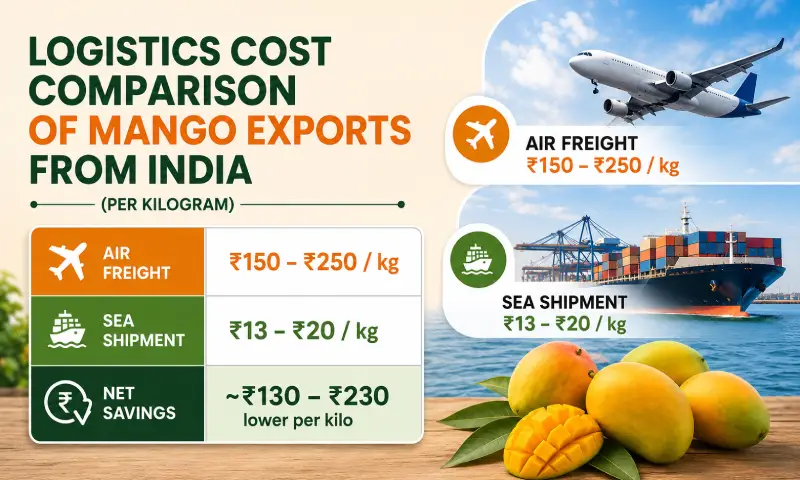
Air shipment usually demands anywhere from ₹150 to ₹250 for every single kilogram of fruit you move. This new ocean shipping protocol slashes that entire expense down to a mere ₹13 to ₹20 per kilogram.
For local growers and mango exporters, a massive cost drop like this alters the entire playing field. High freight bills used to eat up almost all the profit margins, which forced businesses to target only ultra-premium, niche boutiques. Getting transit costs down to a tiny fraction of air freight means Indian mangoes can finally compete on price in everyday international supermarkets.
Using Science to Pause the Clock
You can't just toss a regular box of mangoes onto a cargo ship and cross your fingers. Without special care, the fruit would rot long before making port. This successful journey relied entirely on a new sea shipment protocol engineered by the ICAR-Central Institute for Subtropical Horticulture (ICAR-CISH) in Lucknow, working hand-in-hand with APEDA.
The CISH system isn't just a simple quick-fix spray; its an end-to-end quality control pipeline. It tracks everything from residue-free orchard farming and Good Agricultural Practices (GAP) right down to careful harvesting and sorting.
To survive the long voyage, these Banganappalli mangoes went through two crucial post-harvest steps:
- Hot Water Treatment (HWT): A precise warm bath that cleans the fruit and knocks out latent fungal issues or fruit fly larvae.
- CISH-Met Wash: A unique post-harvest wash developed by ICAR-CISH that slows down the fruit's natural aging process, lowers disease risks, and preserves skin quality.
Because of this technology, researchers managed to push the reliable shelf life of these mangoes out to about 30 days in sea transit conditions. That extra buffer easily covers the time needed to sail to major Southeast Asian ports while ensuring the fruit arrives fresh enough to look great on retail shelves.
Finding Indias Place in the Global Market
This logistical win comes at a highly strategic moment for Indian agriculture. While a lot of major mango-exporting nations are dealing with rough weather and shrinking harvests, Indias supply situation is looking incredibly solid.
If you look through the global trade trends tracked in the "MIC_Monthly_dashboard_Mango_15122025.pdf", plenty of key producing regions have hit severe climate speedbumps. For instance, extreme summer heatwaves in Egypt caused a devastating 70% to 80% drop in flowering. Unpredictable weather and intense heat lines squeezed crop volumes in Pakistan, while unusually heavy rains disrupted early flowering phases across southern Mexico.
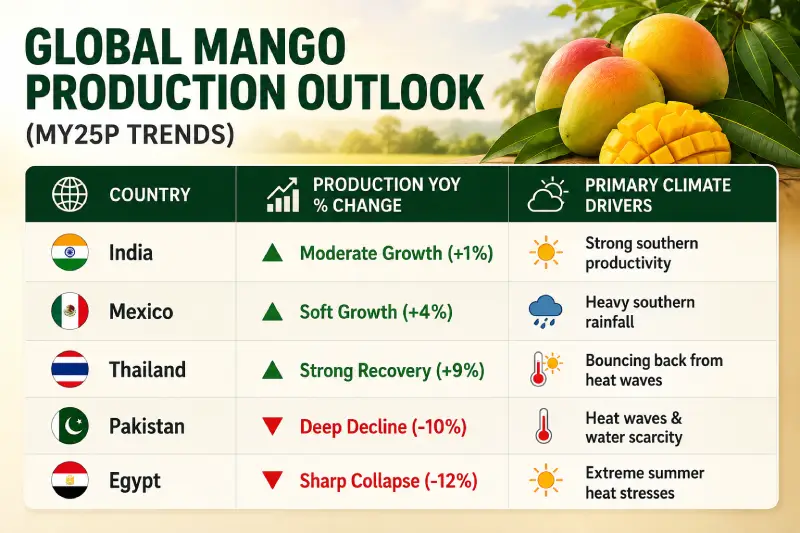
Meanwhile, Indias total harvest numbers have actually moved upward, largely driven by great yields across southern production hubs like Andhra Pradesh and Karnataka.
Even though India grows a massive share of the world's mangoes, its fresh fruit export footprint has always been minor because of short shelf lives and a historical tendency to just ship processed pulp to the Gulf. Fresh fruit sales to places like the UAE or Saudi Arabia frequently ran into trouble because of uneven quality or quick spoiling during transit. Mixing cheap ocean freight with a dependable 30-day shelf life gives India the exact toolkit it needs to fix those old supply pain points.
The Mekong Lesson: Copying Vietnams Approach
As India begins rolling out this ocean shipping strategy on a larger scale, there's a lot to learn from how Vietnam recently captured the Chinese market. For a long time, Thailand was the undisputed leader in China's mango imports, using the high-speed Laos-China railway line to quickly move its premium Nam Dok Mai variety. But sudden jumps in Thai labor costs coupled with severe railway bottlenecks started causing costly delays.
Vietnam jumped on that opening immediately. By setting up highly coordinated regional farming clusters across the Mekong Delta, registering local orchards to strictly meet export rules, and opening up quick 48-to-72-hour land transit routes, they managed to undercut Thailand's prices by nearly 74%. They also timed their harvests perfectly to land right when China's domestic supply dropped.
India can use that exact same playbook across Southeast Asia. By leaning on low-cost sea routes and keeping quality uniform, Indian mango exporters can position varieties like Banganappalli or Kesar as incredibly reliable options for international buyers who want to diversify where they buy from.
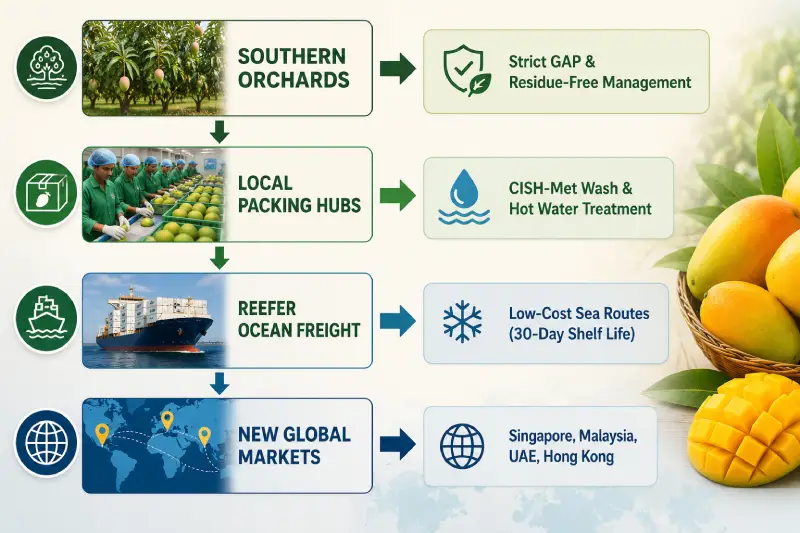
The long-term goal of this ocean breakthrough goes way beyond a single shipment to Singapore. The Ministry of Agriculture openly noted that this milestone opens up a clear path to expand deep into Malaysia, Hong Kong, and nearby regional spots where the current import market sits around USD 4 to 5 million. Even better, it offers a scalable blueprint to take on massive premium fruit markets like the UAE, which is currently valued at an estimated USD 20 to 25 million.
For local fruit growers across Andhra Pradesh and beyond, affordable ocean shipping is a massive economic safety net. It means their income is no longer held hostage by collapsing local prices when the domestic market gets flooded during peak harvest weeks. By establishing an affordable, long-distance trade route, India is showing that its best fruit can travel the globe without a luxury price tag.





.webp "Beyond the Numbers: The Structural Transformation Behind India's $52.5 Billion Agricultural Export Boom")