Key Highlights
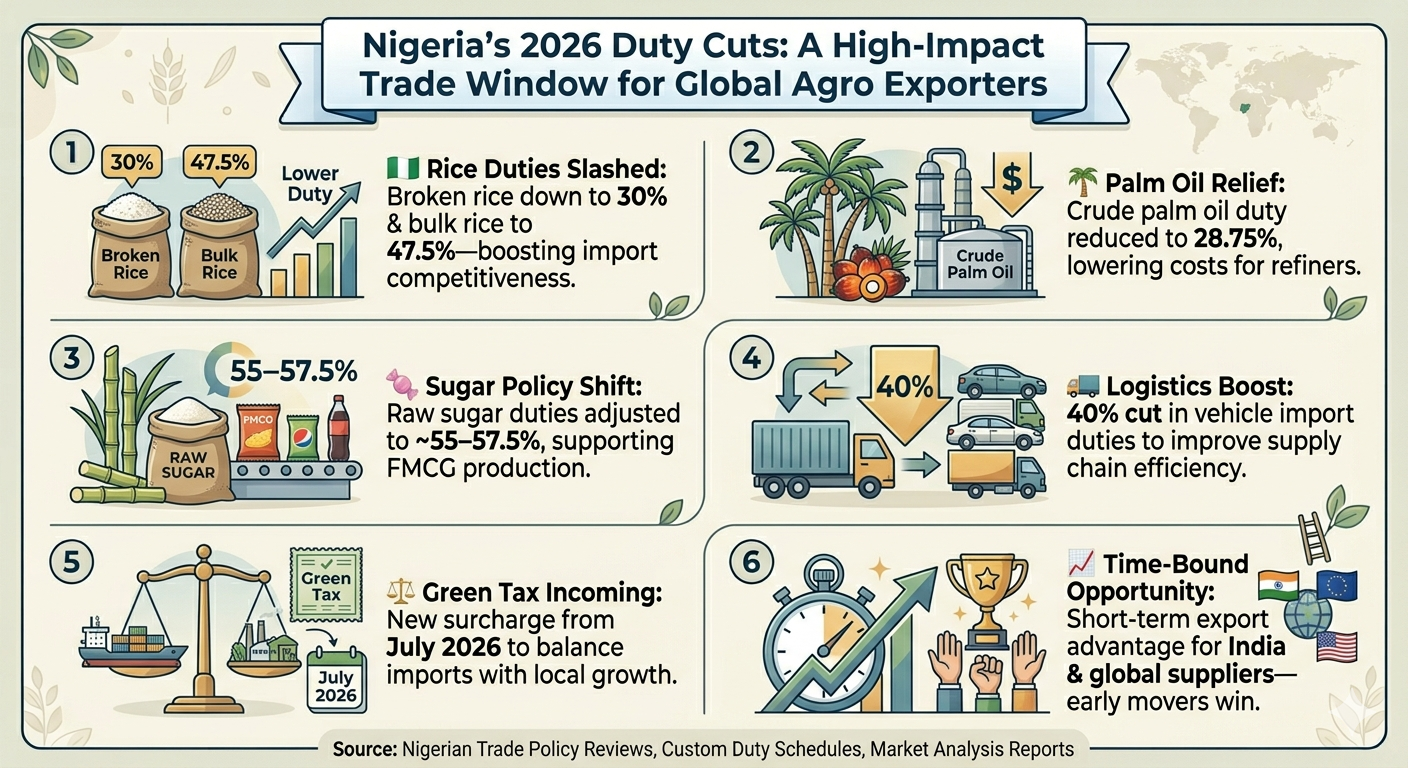
- Nigeria reduced import duty on broken rice from 70% to 30%, opening trade opportunities.
- Bulk rice duty dropped to 47.5%, making imports more competitive.
- Crude palm oil duty reduced to 28.75%, lowering input costs for refiners.
- Raw sugar duties adjusted to 55%–57.5%, boosting FMCG production economics.
- Vehicle import duties cut by 40%, improving logistics and supply chain efficiency.
- New Green Tax Surcharge (July 2026) to balance imports with local industrial growth.
- Indian exporters gain short-term advantage in rice, sugar, and palm oil supply.
- Policy aims to control inflation while maintaining long-term domestic production strength.
- Trade opportunity is time-sensitive, favoring early movers in 2026.
A Bold Move to Tackle Inflation and Reset Trade
The Nigerian government just flipped the scenario on its agriculture trade landscape. With the 2026 fiscal policy measures now official, we are seeing a calculated, high-stakes bold move to break the back of domestic inflation. And what’s that? A dramatic slash in import duties on the "big four"—rice, palm oil, sugar, and vehicles.
It’s a massive move.
The goal isn't just about making basic commodities cheaper at the Lagos docks; it’s a strategic stimulus package wrapped in a protectionist shell. By lowering the barriers for essential food and transport, the administration is trying to cool down a boiling economy while simultaneously dangling new "Green Tax" surcharges to keep local industrialization from being cannibalized. It’s a tightrope walk.
For the B2B trader, the message is clear:
- the gates are opening
- but the rules of engagement just got a lot more technical
A Tactical Pivot, Not Just a Policy Change
The 2026 fiscal framework isn't a mere adjustment; it’s a tactical pivot. The Federal Government of Nigeria is essentially using a "shock and awe" approach to duties to break the back of inflation. By slashing import barriers on the "big four" essentials, they are betting on immediate market cooling.
But for the B2B trader, the devil is in the technical layers. It’s a surgical intervention that balances:
- aggressive liberalization
- new, localized taxes designed to force industrial growth
Key Policy Highlights: The 2026 Tactical Shift
The 2026 fiscal framework isn't just a tweak; it’s a high-velocity pivot. The Federal Government is using a "shock and awe" approach to duties, slashing barriers on the "big four" essentials to stop the inflationary bleed. But for the B2B trader, the devil is in the technical layers. It’s a surgical intervention that balances aggressive liberalization with new, localized taxes designed to force industrial growth.
Food Security Intervention
To curb the soaring cost of staples, the duty on Broken Rice has been gutted from 70% to 30%, while Bulk Rice has dropped to 47.5%. This isn't just a reduction; it’s a market reset.
The Palm Oil & Sugar Correction
Crude Palm Oil duties have been trimmed to 28.75%, and Raw Cane Sugar is now hovering between 55% and 57.5%. It’s a calculated move to lower the input costs for refiners and FMCG giants who have been choking on high raw material prices.
Logistical Stimulus
The automotive sector saw a massive 40% reduction in vehicle import duties. This is the government’s way of subsidizing the "muscle" of the economy—the trucks and transit units that move goods across the Federation.
The "Green" Stick
Starting July 2026, a new Green Tax Surcharge kicks in alongside phased excise duties. This is the price of entry. The government is opening the door for essentials but raising the wall for anything that doesn't align with a "value-added" local industrial base.
This policy isn't a broad liberalization; it’s a tactical trade cycle. The focus is on keeping the agro-processing and industrial sectors alive without letting the cost of living burn the house down. You import the "essential" to survive today, but the tax structure is designed to make you build "local" to survive tomorrow.
Why Nigeria Took This Step
The "why" behind this policy isn't a secret—it’s a desperate race against the clock. Nigeria is currently battling a brutal inflationary cycle that has made basic survival a luxury for millions. When you have a currency like the Naira fluctuating wildly, your domestic supply chain becomes a hall of mirrors where prices change before the goods even hit the shelf.
The government had no choice but to drop the hammer on duties.
By slashing tariffs on rice and sugar, they are effectively injecting an "emergency dose" of supply to stabilize food security. It’s a tactical retreat on protectionism to ensure the country can actually eat.
But there is a deeper layer here. The policy is also targeting cost structures:
- lowering vehicle duties to reduce the "hidden tax" of transportation
- easing movement costs across the domestic supply chain
It’s a high-stakes balancing act:
- opening the door to imports just wide enough to stop a crisis
- keeping the "Green Tax" and industrial levies in place
They are buying time with one hand and building a defensive wall with the other.
Trade Opportunities for Exporters
The 2026 fiscal pivot isn't just about changing numbers on a spreadsheet; it’s about shifting the commercial gravity of the entire West African corridor. For the B2B trader, these duty slashes create immediate windows of opportunity, but they also signal a much more competitive—and potentially volatile—domestic landscape in Nigeria.
Here is the breakdown of how the 2026 measures are redrawing the map for key commodities.
Rice: The Door Swings Open
The Nigerian government has made a definitive move to cool the retail market.
- Bulk rice tariffs have been slashed from 70% to 47.5%
- Broken rice now attracts a significantly lower 30% duty
The Export Opportunity: For exporters in India, Thailand, and Vietnam, this is a green light. The lowered barrier makes Indian parboiled rice and Thai jasmine significantly more viable at the Lagos docks, likely leading to a surge in formal trade volume.
The Local Squeeze:
- local Nigerian rice millers are now in a high-pressure environment
- they are losing the "tariff wall" that protected their higher production costs
- success now depends on their ability to match the efficiency of Asian imports
Palm Oil: A Shift in Protectionism
Crude Palm Oil (CPO), which was once a heavily guarded line item, now sees its effective duty dropped to 28.75%.
Strategic Gain:
- Malaysia and Indonesia are the clear beneficiaries
- Nigerian refiners can source CPO more affordably
The Margin Game:
- local plantations may feel the pressure
- cheaper raw inputs are expected to support manufacturing
Sugar: Powering the FMCG Engine
The duty on raw cane sugar has been adjusted to a range of 55% to 57.5%, a notable drop from the previous 70% benchmark.
Industrial Backbone:
- a direct subsidy for Nigeria’s food and beverage industry
- exporters from Brazil and India gain stronger positioning
B2B Demand:
- lower input cost for raw sugar
- improved competitiveness of "Made in Nigeria" FMCG products
India Opportunity: A Short-Term Advantage
For Indian exporters, Nigeria’s 2026 fiscal pivot is essentially a "flash sale" on market entry.
- broken rice duty: 70% → 30%
- bulk rice duty: 70% → 47.5%
The window of opportunity is narrow but lucrative:
- Rice & Sugar: Indian suppliers can undercut global competitors
- The Re-export Play: Indian refiners can supply refined palm oil efficiently
Early movers will capture the lion's share of this market before the new Green Tax Surcharge and protective excise duties kick in this July.
If your cargo hits the Lagos docks now, you're trading on the most favorable terms seen in a decade.
Don't wait for the competition to realize the map has changed.
ShoWhat Exportersuld Do Now
Here is your tactical checklist for the next 90 days:
- Monitor the Price Realization: Watch landed cost vs domestic market gap
- Lock Your Contracts Now: Demand surge will push procurement costs up
- Leverage Digital B2B Infrastructure: Ensure transparency and verified buyers
- Zero-Tolerance on Compliance: Documentation errors can wipe out margins
The gates are open, but they won't stay this way forever.
Move now, or watch the competition take the lead.
Strategic Takeaway: A Time-Bound Trade Window
Nigeria is doing more than just adjusting tax lines; it is rebooting its entire trade cycle. This selective opening is a tactical retreat designed to stop the bleeding of inflation, and for the B2B exporter, the signal is flashing green.
But make no mistake—this isn't a permanent invitation.
- The government is buying time to build its own industrial muscle
- The play here is speed
- The exporters who will win are those who can move volume while the duty walls are low, before the local manufacturing base catches up or the new excise duties tighten the grip
It is a narrow, high-stakes window.
If you aren't positioning your cargo to hit the Lagos docks now, you’re missing the most significant trade pivot in West Africa this decade.
Strategic entry isn't just about the shipment; it’s about timing the cycle perfectly.