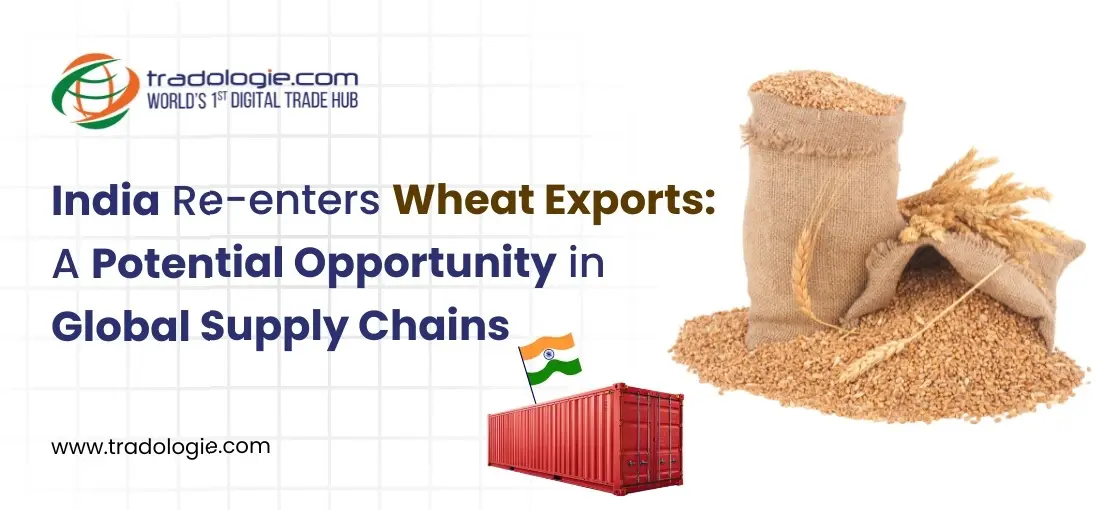
India Re-enters Wheat Exports: A Potential Opportunity in Global Supply Chains
For nearly four years, India kept a firm lid on its wheat exports. The restrictions, introduced in May 2022 after an intense heatwave, were aimed at safeguarding domestic availability and keeping inflation in check. Over time, global markets did what they usually do—they adapted. Trade flows shifted. Competing exporters stepped in and strengthened their presence. The void left by India was not dramatic, but it was certainly felt.
Now, India has decided to step back into the market. Not in a hurry, and certainly not without caution, but with a scale that many did not expect. The government has cleared exports of 25 lakh metric tonnes of wheat, along with another 5 lakh tonnes of wheat products. This is more than a token reopening. It reflects a degree of confidence that domestic conditions can support limited participation again.
Domestic availability has improved. Stocks are comfortable. Inflation, while still watched closely, appears less threatening than it did earlier. That combination has created room for policy flexibility.
Why India’s Return Matters More Than Volume
In a global wheat market that moves hundreds of millions of tonnes every year, these volumes may not look transformative. But commodity markets rarely move only on numbers. They move on expectations.
When a large origin returns after a long pause, the first impact is psychological. Buyers begin to review their sourcing plans. Procurement teams reopen conversations that had gone quiet. Exporters in competing origins start adjusting price signals, sometimes even before cargo flows begin.
The ripple effect usually starts well before the first shipment leaves the port.
For importers across Asia, Africa, and the Middle East, the message is fairly straightforward. India is not trying to flood the market. But it is no longer on the sidelines. And the last few years have shown that even absence can influence trade patterns as much as active participation.
The Real Trigger: Surplus and Stability
The current reopening is less about ambition and more about arithmetic. Acreage has improved. The crop outlook is stronger. Stocks are comfortable. That creates room.
But the approach remains measured. India is unlikely to chase market share or attempt to disrupt dominant exporters. The objective appears different—participation without destabilisation.
This is consistent with past behaviour. When stocks exceed buffer norms, exports are allowed. When inflation risks rise, restrictions return. The cycle is familiar.
What has changed is the global backdrop. Food prices remain politically sensitive almost everywhere. Even incremental supply helps calm sentiment. In such an environment, optionality carries weight. Importers value the ability to switch origins, even if they do not do so immediately.
India’s Role Is Evolving
Earlier, India acted as an emergency supplier in a moment of global disruption. Going forward, it may play a more stabilising role. Enter when supply tightens. Step back when markets ease.
This flexibility has its advantages. It limits exposure to global volatility while preserving influence. Earlier exports were largely opportunistic. Future participation is likely to be cyclical. Domestic stability will continue to guide policy. Market presence will remain selective.
This is not hesitation. It is maturity.
Competing in a Different Segment
India’s wheat does not compete directly with premium European milling grades or ultra-high protein categories. Its strength lies in price competitiveness, freight proximity to key destinations, and scale of production.
Russia continues to dominate through aggressive pricing and volume. Australia holds strong positions in Southeast Asia. The European Union remains strong in quality-driven niches. India sits somewhere in the middle.
This middle ground is often underestimated. It becomes especially relevant when freight costs rise, when buyers seek diversification, when price sensitivity increases, and when governments look for stable and politically neutral suppliers.
In volatile markets, this segment often proves the most resilient.
Demand Patterns Still Support India
Historically, India’s wheat exports have found traction in bulk and government procurement programmes. Many developing nations rely on diversified sourcing to manage inflation and ensure supply continuity.
Even during the earlier surge, structured procurement outweighed spot trading. That pattern is unlikely to change.
Today, importers are building multi-origin strategies. The focus is no longer only on price. It is on resilience. India’s re-entry strengthens this approach.
Market Psychology Matters
Commodity markets move as much on perception as on physical supply. When traders see rising stocks and policy flexibility, volatility tends to soften. Speculative behaviour becomes more cautious. Procurement becomes more structured.
India’s reopening contributes to this balance. Even modest shipments can shape sentiment. Pricing may stabilise in the near term, though competition will intensify.
That is not a contradiction. It is the nature of evolving markets.
Beyond Economics
Agricultural trade is increasingly intertwined with diplomacy. Food supply partnerships shape geopolitical relationships. Over the years, India has used agricultural exports to build goodwill across several developing regions.
A calibrated reopening reinforces that image. Reliability matters. Consistency matters. In the long run, credibility often outlasts price advantage.
What This Means for Exporters and Traders
For global suppliers, India’s return introduces competition in selected regions rather than across the board. For Indian exporters, the opportunity lies less in expansion and more in execution.
The coming phase will reward discipline—consistent quality, timely shipments, strong buyer relationships, efficient logistics, and long-term contracts.
The focus shifts from scale to trust.
A Measured Reset
This is not a dramatic shift in global wheat flows. It is a reset. And resets, though quieter, often shape markets more deeply than sudden surges.
The global wheat trade is becoming more regional, more fragmented, and more conscious of risk. Multiple dependable origins strengthen resilience. India’s return adds another layer.
Not dominance. Not disruption.
But flexibility.
And in an uncertain world, flexibility may well be the most valuable commodity of all.