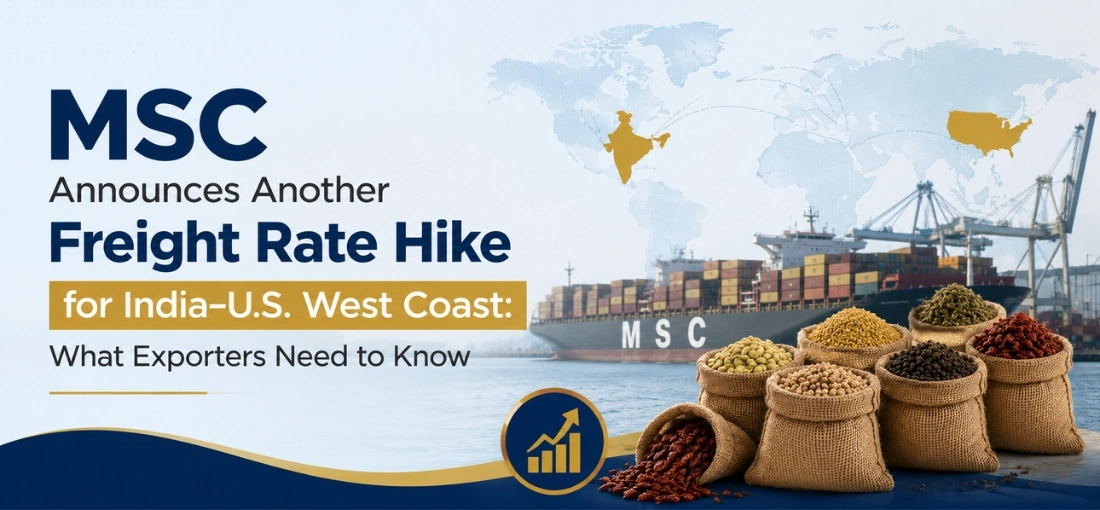
MSC just made doing business on the India-US West Coast lane significantly more complex. Starting September 1, 2026, shipping a container through them will cost an extra $1,800 for a 20-foot box and $2,000 for a 40-foot or 45-foot High Cube.
The money itself is a key factor, but the timing is what really stands out. MSC isn't replacing their August 15 rate increase with this one. They're adding it directly on top of it. Two major freight adjustments in the span of roughly fifteen days on the exact same routing. For anyone trying to move commercial cargo out of Mundra, Nhava Sheva, or Hazira right now, cost sheets calculated in July need immediate updating.
If you operate on spot freight rates , this isn't just a minor shift. It's a direct shift in your bottom line.
Keep reading this informative piece of article if you want to know the impact on the India to USA freight rates of this change on agro commodities.

Why Agri-Exporters Feel the Pressure First
Not all export cargo handles ocean rate adjustments the same way. High-value manufactured goods or pharmaceuticals can usually absorb a bump in freight because transport costs represent a small fraction of the total invoice value. Agricultural commodities don't have that luxury.
India's agri-export trade—everything from Basmati rice and non-basmati rice to cumin, turmeric, sesame seeds , pulses , and oilseed meals—runs on extremely tight price spreads. When you're exporting agri commodities in bulk, you fill a 20-foot container up to its maximum payload weight, maybe 24 to 26 metric tons of product.
When MSC adds a $1,800 GRI onto that 20-foot box, your shipping cost per ton jumps by around $70 to $75 almost overnight. On a commodity selling at $500 or $600 a ton FOB, a $75 per ton freight shift substantially alters your profit margin if you sell on CIF (Cost, Insurance, and Freight) or DDP (Delivered Duty Paid) terms.
Agricultural exporters locked into fixed-price landed deliveries to American buyers are suddenly faced with two distinct choices. You either honor the contract price and absorb the difference on the voyage, or you try to re-open price discussions with the buyer in California or Washington.
The second option requires careful negotiation. US buyers know the market. When Indian suppliers request mid-contract price revisions due to freight surcharges, buyers often pause orders or look for temporary fill-in orders out of Thailand, Vietnam, or Cambodia, where ocean rates to the US West Coast might not be under the same immediate pressure.
Furthermore, agricultural cargo can't just sit in inland container depots (ICDs) or port yards waiting for freight rates to adjust downward. Grain and spice shipments carry real moisture risks, storage costs, and tight buyer delivery windows. Demurrage and port storage fees add up fast. Most agro-exporters end up incorporating the rate hike and shipping anyway because holding the stock creates additional overhead.
Spot Market Traders vs Contracted Volumes
This double-GRI highlights a distinct divide across India's export ecosystem: the gap between large institutional traders and smaller merchant exporters.
If you're a multi-thousand-TEU exporter running long-term Service Contracts (SCs) directly with ocean lines, you have a cushion. Carrier contracts usually mandate minimum advance notice periods for GRI implementations, or they cap seasonal surcharges under negotiated framework terms. You might still see some peak surcharges, but you aren't exposed to raw, unbuffered market shifts.
If you're a small-to-medium agricultural exporter relying on spot quotes from freight forwarders week-to-week, the impact is immediate. In a fast-moving market, a spot freight quote issued on a Tuesday may no longer be available by Friday unless you already have a container gate-in confirmation. Booking space under spot terms during a multi-carrier rate push requires rapid execution.

Will the Rest of the Market Follow MSC?
Right now, this specific advisory comes from MSC alone. But experience in container shipping shows that ocean lines rarely stay isolated for very long on high-density trade lanes like the Transpacific and India-US corridors.
Liners watch each other constantly. When a market leader moves toward a higher price structure, competing lines—Maersk, CMA CGM, Hapag-Lloyd, ONE—evaluate their own vessel utilization numbers.
If ships leaving West Coast India ports are sailing full, and if container yards at Mundra and Nhava Sheva are filled with booking requests, rival lines may issue matching GRI advisories for September sailings.
The scenario where competing lines hold their rates usually occurs if they have excess vessel space they need to fill quickly. Shippers will naturally try to pivot booking allocations away from MSC toward lines with lower freight rates . However, securing available empty containers and open vessel slots on short notice during a seasonal volume surge can be challenging for spot shippers. Carrier allocations fill up fast, and forwarders will prioritize clients moving active volumes.
What Export Desks Need to Do Right Now
Navigating carrier adjustments requires export logistics teams to move proactively before September 1 arrives.
First, clear as much ready inventory as possible before midnight on August 31. Any container that clears port gate-in or ICD hand-over before September 1 locks in the pre-increase freight rate. Coordinate with factory floors, adjust packing schedules, and work with your forwarders to move up cut-off dates if cargo is already packed.
Second, consider quoting FOB (Free On Board) or FCA (Free Carrier) terms on new Q4 orders. Shifting freight procurement and rate management to the overseas buyer protects your product margin. Let the US importer handle the ocean freight negotiations through their own carrier accounts.
Third, audit your freight forwarders. Work with multiple logistics partners rather than relying on a single source. Check if secondary forwarders hold unused contract space or allocation slots with alternative ocean lines that haven't matched MSC's rate adjustment.
Global container shipping is naturally variable, and carrier rate adjustments are part of international trade. The exporters who manage these freight changes effectively are those who adjust their contract terms, accelerate cargo movement, and protect their margins before the cutoff date arrives.