
Zero-duty access has improved the commercial equation for Indian agricultural exports. But for millers and merchant exporters, the real opportunity will depend on competitive pricing, consistent quality, regulatory compliance and the ability to turn initial orders into repeat business.
On 20 October 2026, the India-New Zealand Free Trade Agreement (FTA) came into force, opening a new chapter in agricultural trade between the two countries. For Indian millers, commodity processors and merchant exporters, the most immediate development is straightforward: New Zealand has eliminated customs duties on Indian goods, including eligible agricultural and processed food products. The agreement also provides New Zealand with preferential access to selected segments of India's market, including apples, kiwifruit and mānuka honey.
The commercial implications deserve a closer look. Removing tariffs can improve the price at which an Indian exporter competes, but it does not automatically create demand or guarantee a better margin. For businesses operating on relatively thin commodity-trading margins, the real question is whether the duty advantage can be converted into commercially viable orders without compromising quality, delivery schedules or payment terms.
The existing trade relationship offers a starting point
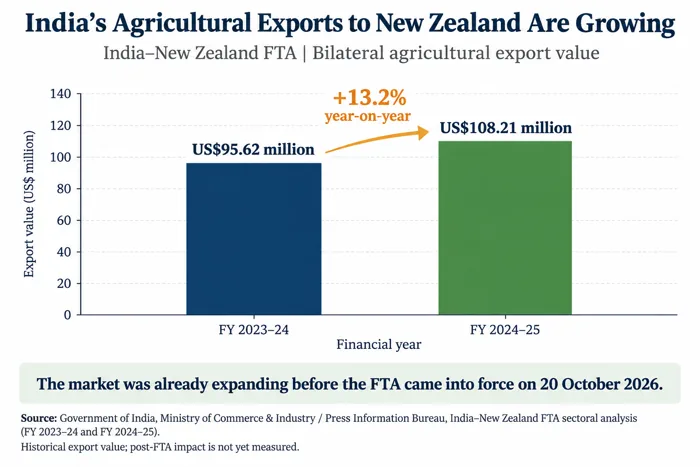
According to the Government of India's FTA sectoral analysis, India's agricultural exports to New Zealand increased from US 95.62 million in FY2023-24 to US 108.21 million in FY2024-25, a rise of approximately 13.2%. The market was therefore expanding before the agreement took effect.
The wider export base is substantial. APEDA's export overview puts India's agricultural exports, including cotton, at approximately US 51.91 billion in FY2024-25,of which US 27.90 billion comprised products monitored by APEDA.
| Indicator | Figure |
|---|---|
| Indian agricultural exports to New Zealand, FY2023-24 | US$95.62 million |
| Indian agricultural exports to New Zealand, FY2024-25 | US$108.21 million |
| Year-on-year growth | Approximately 13.2% |
| India's total agricultural exports, FY2024-25 | US$51.91 billion |
| Indian organic exports to New Zealand, FY2024-25 | 2,401.53 tonnes, valued at US$3.18 million |
Sources: Government of India, PIB and APEDA. Figures follow their respective reporting classifications.
For Indian merchant exporters, these numbers suggest a market worth examining more closely, rather than one where demand must be created from scratch. Yet New Zealand remains a relatively small destination within India's enormous agricultural export network. The opportunity is not to assume that every commodity will find a buyer, but to identify the products for which Indian suppliers can offer the right combination of price, quality and reliability.

Zero duty changes the landed-cost calculation
Consider a hypothetical shipment valued at US100,000thatpreviouslyattracteda5%customsduty.EliminatingthatdutyremovesUS5,000 from the importer's customs-duty bill, assuming all other factors remain unchanged.
That saving can be shared in different ways. An importer may negotiate a lower purchase price, an exporter may retain a better margin, or both parties may benefit. The outcome depends on competition, bargaining power and how sensitive the buyer is to price.
This distinction matters particularly for millers and merchant exporters handling rice, spices, cereals, processed foods and other eligible agricultural products. A lower landed cost can help an Indian supplier compete against alternative origins, but the advantage can disappear quickly if freight costs rise, quality claims arise or a shipment fails to meet import requirements.
New Zealand's zero-duty access should therefore be treated as a commercial advantage to be used strategically, not a reason to quote aggressively without calculating the full cost of fulfilling an order.
Where Indian exporters can find a realistic opening
The opportunity extends beyond raw commodities. Processed foods, spices, cereal preparations, preserved vegetables and differentiated agricultural products may offer routes to market for Indian businesses that can meet the required specifications.
APEDA's November 2025 mango market-intelligence dashboard offers a useful example. It reported that New Zealand imported 3,455 tonnes of mangoes in 2024, while India's exports to that market amounted to 280 tonnes—approximately 8% of the import basket covered by the report.
The figures show that Indian mangoes already have a presence in the market, but also that competing suppliers are established. For an exporter, the commercial question is not simply whether duty has disappeared. It is whether the product can arrive at the right time, retain its quality during transit and compete with alternative origins on the buyer's final landed cost.
The same principle applies to millers and merchant exporters selling bulk or processed commodities. Buyers need dependable specifications, consistent lots and confidence that the shipment they receive will match the contract. A competitive first quotation may secure an inquiry, but consistency is what helps convert it into repeat business.

What New Zealand expects from agricultural suppliers
For Indian exporters, quality is not merely a matter of appearance or a buyer's preference for a particular grade. It is also a question of regulatory compliance.
According to New Zealand's Ministry for Primary Industries (MPI), food importers must assess whether imported food is safe and suitable for consumption. Depending on the product, this involves appropriate production and handling conditions, control of biological, chemical and physical hazards, and evidence supporting the product's specifications and safety.
For millers and merchant exporters, the practical requirements may include:
- Consistent product specifications: The grade, variety, ingredients, moisture levels and other relevant parameters must match the agreed contract and applicable standards.
- Contamination control: Products must comply with relevant food-safety requirements, including applicable limits for contaminants, residues and foreign material.
- Traceability and documentation: Batch identification, product specifications, certificates of analysis and other supporting records may be required, depending on the product and shipment.
- Suitable packaging and shelf life: Packaging must protect the product from contamination and deterioration during storage and transport. Retail products must also comply with applicable labelling requirements.
- Product-specific import clearance: Fresh produce may require phytosanitary certification, inspection, treatment or other measures under New Zealand's import health standards.
These requirements differ between bulk rice, packaged foods, spices and fresh produce. Exporters should confirm the applicable rules with their New Zealand importer before committing to a shipment.
This is where established millers and merchant exporters can distinguish themselves. Businesses that maintain reliable grading, testing, traceability and documentation systems are better positioned to satisfy buyers who cannot afford inconsistent consignments or avoidable clearance delays. Zero duty helps the price; operational discipline helps protect the transaction.
New Zealand's agricultural exports will also compete in India
The trade relationship will not move in only one direction. New Zealand has secured preferential access for selected products, including apples and kiwifruit, through tariff-rate quotas and product-specific conditions.
According to New Zealand's Ministry of Foreign Affairs and Trade, the agreement provides additional quota access for these fruits, with volumes scheduled to grow over time. Kiwifruit also receives a 50% tariff reduction outside its quota, while preferential treatment for mānuka honey is phased over five years.
For Indian importers and merchant traders, these provisions create opportunities to source selected products under more favourable tariff conditions. At the same time, imported fruit may compete with domestic produce in particular segments, depending on season, quality and price.
The agreement does not open every agricultural category without restriction. India has retained protection for sensitive sectors, including major dairy products, sugar and edible oils, although specific tariff lines must always be checked against the agreement.
For commodity businesses, the lesson is to examine the actual tariff schedule and product conditions rather than treating the FTA as a blanket exemption from import duties.
The real opportunity lies in repeat business
Tariff reductions can improve competitiveness, but they cannot compensate indefinitely for inconsistent quality, weak documentation or unreliable delivery. Nor does a lower customs duty eliminate freight, insurance, handling, testing, storage and distribution costs.
Merchant exporters will need to calculate the landed cost carefully, identify the correct tariff classification and confirm that their products qualify under the agreement's rules of origin. Importers must also meet New Zealand's applicable customs, food-safety and biosecurity requirements.
The agreement's agricultural productivity cooperation may offer longer-term benefits through technology transfer, better post-harvest handling and improved practices. However, these are prospective gains, not results that can already be attributed to the FTA.
For Indian millers and merchant exporters, the immediate task is more practical: identify products with an established route to market, understand the specifications buyers require and build relationships that can sustain repeat orders.
The FTA has removed an important cost barrier. Whether that translates into higher export volumes and stronger margins will depend on how effectively Indian businesses use the advantage. In commodity trade, a favourable tariff can open the door, but a reliable shipment, a competitive landed price and a satisfied buyer are what bring the next order.