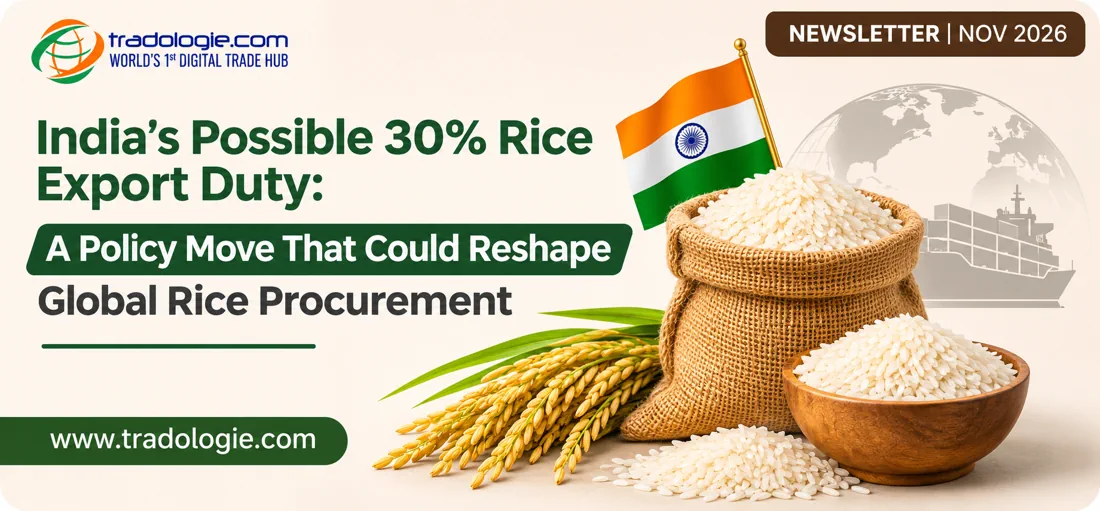
There's more to India's potential new export duty than initially meets the eye. Concerns over inflation and a possible reduction in the kharif rice crop appear to have prompted the Government to consider the introduction of an export duty of up to 30%. Reports suggested that discussions were also taking place over the introduction of a Minimum Export Price (MEP) – both on 22 November 2026.
As yet, there has been no official announcement on this issue. Therefore, the current export situation remains unchanged. Yet, interestingly, and inevitably, discussion is now moving beyond India's borders. As one of the world's leading rice exporters, any significant change to its export policy will command attention from international importers.
Importers often commit to importing large quantities of Indian rice. They must then manage contracts, stock and customers. Consequently, they will wish to analyse any potential policy development.
Whilst many will be interested to see how Indian rice prices are affected, the key for importers will be to understand how they can continue to source from India at a suitable price.

Landed Costs Will Determine India's Price Competitiveness
Whilst an exporter's quote provides an initial indication of value for money, the true landed price relies on various elements. Shipping, insurance, port and customs costs - alongside local distribution - all contribute. As tight profit margins can exist within bulk goods trade, these elements are important.
Considering the aforementioned 30% export duty, such a levy could significantly affect the value proposition for an African importer seeking Indian parboiled rice. Furthermore, whilst it may not always be feasible to fully pass this extra charge on to end-customers, narrowing profit margins is also an option. However, there are also limitations to this too.
Importers will look elsewhere for supply. This is not due to a sudden desire to discontinue Indian imports. Rather, importers are under pressure to identify the optimum place of supply.
Significantly, India's rivals may not have to await an invitation to step in. Thailand, Vietnam, Pakistan and Myanmar are all well-established in global rice trade. Each possesses its own export infrastructure and links with importers.
Should Indian rice no longer prove as competitively priced, these nations could become more prominent on the world stage.
Nevertheless, rice is not entirely fungible. Importers seeking a specific type of Indian rice (for example, parboiled or white rice) cannot necessarily switch easily to an alternative rice source. Factors such as grain type, cooking properties and the level of grain damage, as well as customer preference in target markets, all play a part in importers' decision making.
Despite this, importers are able to adapt. Exporters in other nations can be approached by importers who will analyse quotes and assess grain qualities. Test orders can then be made. Provided the quality and service are satisfactory, further business may then be obtained.
Exporters in rival nations will then be in a position to engage in talks with importers who had previously predominantly sourced from India. Interestingly, in some instances these new business links could persist beyond the period of policy uncertainty.
Existing Contracts: Who Will Bear the Cost of a New Export Duty?
Whilst new business can be negotiated at current price levels, existing contracts are somewhat more complex.
Imagine an African importer has already entered into a 5,000 tonne contract with an Indian exporter. Price, payment and shipping timing have been agreed.
Now, let us say that an export duty is introduced. The exporter and importer must then discuss who will cover the extra cost.
As noted, there is no single response to this. It will hinge upon factors including the nature and timing of any official announcement, together with Incoterms and tax and duty responsibility set out in the contract.
Depending on the contract, there may be scope to re-negotiate. Yet in other cases, there could be little room for manoeuvre.
Furthermore, importers may face issues other than those relating to price. Stock management and distribution arrangements can be affected by shipping timing. Indeed, in some markets, the financial impact of late deliveries can be just as significant as that of increased prices.
Therefore, exporters will wish to closely analyse when during the policy transition period their existing business is due for shipment - as this will influence their approach.
And there may even be a spike in demand.
Interestingly, policy uncertainty does not always result in slower trade. Should importers believe that Indian rice prices are set to rise, they may seek to pre-empt any future policy developments by importing earlier. Thus, there could be heightened levels of interest in Indian rice, faster business talks and increased order levels.
Nevertheless, importers are unlikely to all respond identically to policy developments. Those with high levels of Indian dependency may act swiftly. Conversely, importers who can source from a range of places may elect to await official government guidance before taking any action.
Moreover, importers may even shift forward their intended order dates. For example, someone intending to order in December might choose to do so in November.
Understanding such behaviour is key. Whilst short-term spikes in export interest are conceivable, this does not necessarily indicate that fundamental consumption is similarly on the rise.
How India's Export Policy Could Push Up Prices Across Other Rice Origins
Here we begin to see wider world market ramifications.
As Indian rice potentially becomes less competitively priced, extra interest will naturally gravitate towards other exporting nations. Should numerous big importers simultaneously begin to source from Thailand, Vietnam or Pakistan for example, exporters from these nations could thereby enhance their negotiating positions.
Prices may consequently be affected.
Nonetheless, it is unrealistic to expect Thailand, Vietnam and Pakistan (amongst others) to fully supplant India as a source of export rice. After all, each must satisfy its own internal consumption needs and will possess differing production cycles. Export markets are also an important area for these nations.
Rather, a more likely scenario is that world market pricing will progressively shift.
Initially, an importer may turn to Vietnam (or another nation) seeking lower prices. However, they may then observe that extra interest in that country's rice has already begun to push up its quoted price. The same could apply to other nations.
Hence, although FOB (ex-ship's rail) pricing in one nation may be the lowest, this does not always equate to the most cost-effective landed price.
As volume importers, businesses will increasingly wish to spread their supply base. Equally, the capacity to evaluate the true value proposition of different sources will become ever more crucial.

The Commercial Risks Facing Indian Rice Exporters
Alongside the risk of losing business, Indian exporters must recognise the threat posed to their status as a favoured importer's source.
Extensive global networks have been developed by Indian exporters - including merchants, rice mills and large trading firms. Factors such as pricing, quality and shipping speed are integral to sustaining good business links.
Policy change can therefore pose a challenge in this respect.
Smaller exporters - particularly those operating with limited margins and working capital - may struggle to accommodate extra costs or to re-negotiate contracts. Although larger businesses may enjoy greater flexibility, they too will need to re-evaluate their export pricing.
Moreover, importers may begin to diversify their sources. For instance, an importer currently relying on India for 80% of its rice requirements may seek to establish a secondary supply route from Thailand or Pakistan.
Whilst India will still feature within an importer's supply mix, it may no longer represent its principal source.
Such a development is clearly of interest.
Why Basmati Rice May Remain Outside the Immediate Impact
It should be noted that the policy development relates specifically to non-basmati rice. It would therefore be incorrect to automatically presume that basmati will also be affected.
Compared to other rice varieties, basmati has a unique profile. Particularly within the Middle East, its fragrance, grain size, age-ing properties and culinary attributes mean that it is not as readily substitutable.
Provided that the government does not broaden the scope of the policy development, the basmati sector is likely to remain reasonably separate.
For Indian basmati exporters, the immediate priority may therefore rest less on the export duty itself and more on how (if at all) any official announcement alters present policy.
India's Long-Term Position in Global Rice Trade: What Is at Stake?
Whilst individual business interactions are important, there are wider considerations too.
Importers thoroughly vet prospective sources of supply. They also test samples, agree payment methods and evaluate shipping services. Only then do they progressively come to trust a given supply source.
India has successfully established itself in this arena.
Nevertheless, competitive pricing is not the sole factor underpinning this success. Equally key is reliability. Importers wishing to order rice on an annual basis will want assurance that the commercial environment in which a contract is negotiated will still function effectively at the point of delivery.
Where long-term certainty is lacking, attention will turn to alternative supply sources. Some will then gain test business. Others may even obtain sustained accounts.
Once this occurs, re-engaging customers can often prove far more challenging than maintaining existing business links.
Presently, the industry awaits official government guidance. The actual impact of any policy development will depend on the duty rate, MEP, scope of application and timing of implementation.
In the meantime, exporters should analyse their existing business. Importers may also wish to assess the extent to which they rely on Indian non-basmati rice.
Above all, the world rice industry has repeatedly shown that it will follow value for money - even if this involves altering historic supply patterns. Alongside continuing to export competitively, India must therefore ensure that it remains seen as a reliable source of supply for importers looking not only for, but also subsequent, business.