Vietnamese 100 percent broken rice has moved to US$371-375 per tonne, putting it roughly US$44 per tonne above India, while Pakistan is also about US$42 below Vietnam and Thailand remains higher at US$380–384. The latest quotations from the Vietnam Food Association have brought an interesting price gap into focus at a time when Asian buyers are already looking for more broken rice.
For India, this is more than a favourable price comparison. It raises a larger question about where the next wave of global rice demand will be supplied from, particularly as China increases its use of broken rice for feed and other Asian importers diversify their sourcing. The answer could have consequences well beyond the broken-rice segment, because when one of the world's largest rice suppliers is sitting substantially below competing origins, it can change the bargaining position of the entire Asian rice trade.
That is a meaningful spread in a commodity where buyers are usually intensely price-sensitive.
It also comes at an interesting moment. China is buying more broken rice for feed, the Philippines is looking at higher-broken varieties as its sourcing pattern changes, and USDA analysis points to tightening international availability. At the same time, India is diverting part of its rice supply towards ethanol.
Put those things together and the question becomes much larger than whose broken rice is cheapest today?
It becomes a question of who will have the flexibility to supply the next tonne when several major buyers are competing for it.
India's Price Advantage Is More Than a Discount
The first thing worth noticing is how large India's advantage actually is.
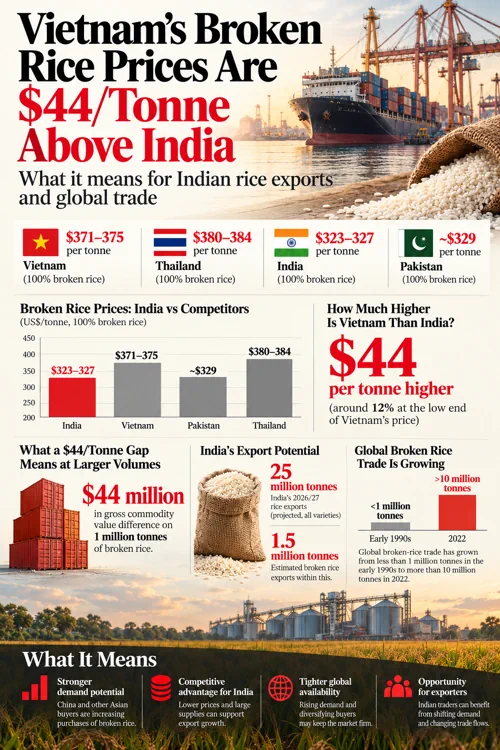
Vietnam is offering 100% broken rice at roughly US$371-375 per tonne . India's range of US$323-327 puts the two markets apart by roughly 12% at the low end of Vietnam's quotation . Pakistan is much closer to India, but Vietnam is still about US$42 per tonne above Pakistan's lowest offer. Thailand is higher again.
For a small shipment, the difference may not transform the economics of a purchase.
For a feed manufacturer buying tens of thousands of tonnes, it becomes a very different calculation.
A US$44-per-tonne difference across one million tonnes represents US$44 million in gross commodity value . The actual saving to an importer will depend on freight, quality, payment terms, port costs and other commercial factors, but the underlying price signal is still difficult to ignore.
And India has something else going for it: supply.
USDA's latest India outlook puts India's 2026/27 rice exports at a potential record 25 million tonnes , including around 1.5 million tonnes of broken rice , assuming continued export demand and large exportable supplies.
That matters because in commodity trade, the cheapest origin is useful only when the origin can actually keep supplying.

China Has Turned Broken Rice Into a Strategic Feed Commodity
Broken rice has traditionally occupied an unusual position in the rice economy.
It is created during milling, sells at a discount to whole grain and can move into food, feed, brewing and industrial applications. USDA research estimates that global broken-rice trade has grown from less than one million tonnes a year in the early 1990s to more than 10 million tonnes in 2022 . China was responsible for much of the growth between 2019 and 2022, when its imports more than tripled to about 3.5 million tonnes. The economics are straightforward.
A feed manufacturer does not necessarily care that a grain has been broken during milling. It cares about the nutrients it delivers relative to alternatives such as corn and other feed grains.
When broken rice becomes cheap enough, it enters the feed formulation.
When the price gap disappears, the buyer has less reason to import it.
China's current market is therefore important for India because Chinese demand is not driven primarily by consumers looking for a particular rice variety. It is being pulled by the economics of animal feed. Recent USDA reporting indicates that broken rice imports are rising again, while the September market assessment cited stronger Chinese demand as one of the factors tightening global availability.
That changes the competitive landscape.
India is not merely competing with Vietnam for a rice-consuming customer. It is competing with Vietnam, Pakistan and Thailand for a feed ingredient whose value is determined partly by the price of alternative grains.
The 2022 Rice Shock Offers a Useful Warning
There is a precedent for what happens when India suddenly disappears from the broken-rice market.
In September 2022, India prohibited broken-rice exports to protect domestic availability for animal feed and ethanol. USDA subsequently recorded the consequences: China was expected to turn to Pakistan, while prices from Thailand and Vietnam rose by about US$20 per tonne within four days of India's export restriction.
That episode is worth remembering because it demonstrates something easily forgotten in today's price comparisons.
India is not simply another supplier in the market.
When Indian supply is available at scale, it puts pressure on competing origins. When that supply disappears, buyers do not necessarily stop buying. They move down the supplier list.
That is precisely what could happen again, although the circumstances today are different.
This time India is not imposing the same broad prohibition on broken rice. Instead, domestic demand from ethanol production is competing with export demand for part of the available supply.
The effect can be subtler.
There may still be plenty of Indian rice in the system, but not necessarily the same amount of broken rice available for export at the same price.

Ethanol Has Become an Unexpected Competitor to China
This is probably the most interesting part of the story.
For decades, a broken grain generated during milling was primarily a question for the food and feed market. Now there is another buyer standing in the same supply chain: the ethanol industry.
India achieved 20% ethanol blending in petrol during ESY 2025-26 , and the government continues to support domestic ethanol production as part of its energy strategy. The commercial consequence is easy to overlook.
A tonne of rice does not know whether it is going to China as feedstock, to a distillery as ethanol feedstock or into another domestic channel. It simply goes towards whichever buyer offers the most attractive combination of price, policy support and logistics.
That creates a domestic opportunity cost for exporters.
If ethanol demand absorbs more rice, the export market has to compete harder for the remaining supply. If export prices rise enough, exporters become more competitive in attracting rice away from domestic uses. Eventually the two markets find a new equilibrium.
This is classic commodity economics, but it has a distinctly Indian twist because government policy is influencing both sides of the equation.
The government is supporting ethanol for energy security while India is simultaneously trying to retain its position as the world's largest rice exporter.
Those two objectives can coexist.
They do, however, create a more complicated price structure for broken rice.
India's Export Advantage Could Actually Become More Valuable
There is an important paradox here.
If Indian broken rice becomes tighter because of ethanol demand, Indian exporters could lose some of their extraordinary price advantage.
But they do not necessarily lose their competitive position.
India is currently offering 100% broken rice at US$323-327 per tonne. Even if domestic demand pushes Indian prices higher, there is considerable room before India reaches Vietnam's current US$371-375 range.
That gives Indian exporters a cushion.
It also gives them a commercial opportunity.
If China continues buying aggressively and India remains the lowest-cost major origin, Indian rice could capture additional demand even without becoming the cheapest by an overwhelming margin. Buyers may be willing to accept a modestly higher Indian price if the alternative is paying substantially more for Vietnamese or Thai material.
This is particularly relevant because India's broader rice export machine is already operating at considerable scale. APEDA records 15.01 million tonnes of non-Basmati rice exports worth US$5.82 billion in 2025-26 , alongside 6.52 million tonnes of Basmati worth US$5.67 billion.
Broken rice is only a small piece of that enormous trade.
But it can influence the economics of the whole milling chain.
The Real Battle May Move From Price to Availability
This is where the market could become particularly interesting over the next few months.
At present, Vietnam has a price problem relative to India. But if Chinese demand continues to pull broken rice into feed, and Philippine buyers also increase their reliance on higher-broken shipments, the market can tighten from the demand side.
The Philippines is expected to import around 5.5 million tonnes of rice in 2026 , while USDA analysis says stronger demand for broken rice in China and the Philippines is beginning to affect traditional West African markets. China is expected to accelerate broken-rice purchases, with the USDA citing a potential 4.1-million-tonne import requirement.
That has a geographical consequence.
If Asian buyers absorb more broken rice, West African buyers may have to compete for fewer exportable tonnes. They may switch origins, accept higher prices or move towards different grades.
The ripple does not stop in China.
A Chinese feed mill buying an additional shipment can ultimately influence the price paid by an importer in West Africa because both are drawing from the same relatively concentrated group of Asian exporters.
That is how commodity markets transmit demand.
Vietnam and Thailand Are Not Out of the Game
It would be a mistake to read the current price spread as evidence that Vietnam and Thailand are becoming irrelevant.
Quite the opposite.
Vietnam's 100% broken rice is still selling despite being considerably more expensive than India's. That tells us price is not the only variable in international rice procurement.
Freight economics, established trading relationships, delivery schedules, quality specifications, port infrastructure and destination preferences all matter.
Vietnam also remains deeply embedded in the Philippines and Chinese markets. Its rice exports reached about 5.02 million tonnes in the first half of 2026 , with demand from China and the Philippines supporting export prices even as total export value declined year on year.
So the market is not heading towards a simple India-versus-Vietnam contest.
It is becoming a more sophisticated contest over origin, price and availability at the same time.
What This Means for Indian Rice Exporters
For Indian exporters, the immediate advantage is obvious: the country is sitting at the low end of the 100% broken-rice market while some competing origins are selling at a substantial premium.
The more important opportunity lies further upstream.
If China remains a major buyer, exporters with access to consistent broken-rice supplies can negotiate from a stronger position. If Philippine demand increases for higher-broken grades, another outlet opens. If West African buyers face higher Asian prices, Indian origin becomes more attractive precisely because of its cost advantage.
But there is a limit.
India cannot treat its broken-rice surplus as infinitely expandable. Ethanol is now a structural domestic demand source, and government policy can alter the quantity available to exporters surprisingly quickly.
The 2022 episode showed what happens when Indian supply is abruptly removed from the international market. The current situation is less dramatic, but the underlying lesson remains: when India changes the availability of broken rice, international prices do not remain indifferent.
The Bigger Story Is About Who Controls the Marginal Tonne
The most interesting part of the current market is therefore not that Vietnamese broken rice is US$44 more expensive than Indian rice.
It is what that spread tells us about the marginal tonne.
China wants more feed-grade broken rice. The Philippines is looking at more higher-broken imports. West African markets are exposed to the same supply pool. Vietnam and Thailand have higher quotations. India has the cheapest offer but also a growing domestic competitor in ethanol.
That is a delicate balance.
If Indian exportable supplies remain abundant, the country's price advantage can continue pulling demand towards Indian origin and keep a lid on competing Asian quotations. If ethanol absorbs more of the available supply, the spread can narrow, lifting prices across the market.
Either way, Indian rice is influencing the global trade equation far beyond the headline export figures.
The next phase of the rice market may not be decided by who produces the most rice. It may be decided by who can spare the next tonne for export.
And right now, that is precisely the question sitting underneath the US$44 gap between Vietnam and India.