India is back in the international grain market. The government just cleared 5 million tonnes of raw wheat and another 1 million tonnes of processed wheat products for export in 2026.
Timing matters here. Chicago Board of Trade (CBOT) wheat futures jumped over 14% in the last month alone. That price rally—paired with shifting trade corridors—gives traders a sharp window to move export wheat in bulk.
Trade analysts point out that this isn't just a temporary policy nudge—it's a deliberate attempt to capture market share while traditional Black Sea and North American exporters face elevated shipping costs and tighter exportable surpluses.
Anyone waiting out the four-year export ban now has a direct shot at high-margin supply deals. But closing these contracts means moving past the headlines to get the actual numbers, freight channels, and policy steps right before booking freight space.
What Drove India's Policy Reversal After Four Years?
India locked down wheat exports in 2022 to protect local supplies against heatwaves and erratic global markets. Reopening trade four years later isn't a random decision. It comes down to back-to-back bumper harvests and overflowing government grain silos.
The national central pool currently holds a massive total wheat reserve of 57.8 million metric tonnes (MMT):
- 22 million tonnes of carry-forward reserves carried over as of April 1, 2026.
- 35.8 million tonnes procured directly from farmers during the 2026–27 Rabi marketing season.
When you weigh those numbers against national welfare requirements, the surplus becomes obvious. The Indian government needs roughly 21 million tonnes annually for the Public Distribution System (PDS) and welfare schemes, alongside 7.5 million tonnes for mandatory buffer norms.
Agriculture economists note that holding grain far above strategic requirements creates heavy holding costs and storage loss risks for state agencies like the FCI (Food Corporation of India). Releasing 6 million total tonnes into international trade channels relieves state storage pressures while giving local aggregators room for fresh crop inflows.

Global Price Rallies and the Bangladesh Parity Advantage
Policy changes don't move cargo on their own—price parity does. The recent 14% spike in CBOT wheat futures reshaped export math fast, making Indian origin grain look attractive across Asia and Africa again.
Surging global wheat demand has buyers hunting for shorter freight routes to hedge against high origin costs out of competing origins.
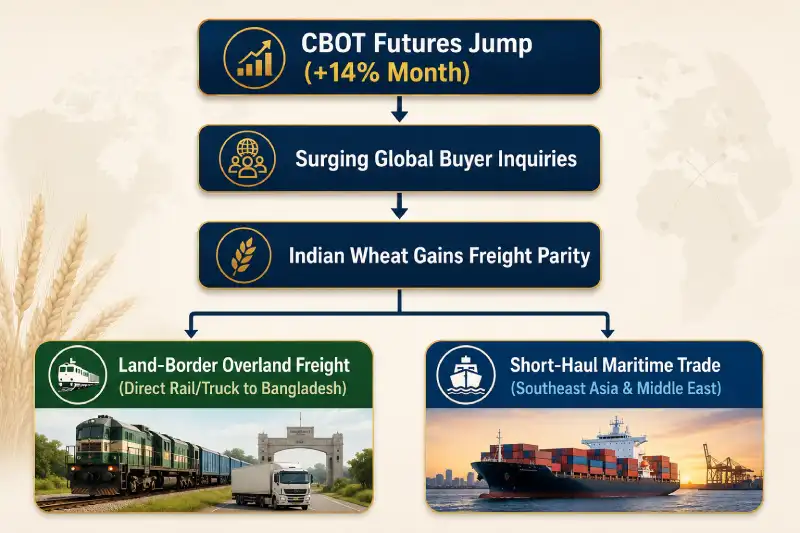
Take Bangladesh. High ocean freight and container tariffs give overland Indian wheat an immediate price edge right across the border.
Bangladeshi millers don't have to wait weeks for deep-sea bulk vessels to cross oceans. They can pull grain straight through land border crossings like Petrapole-Benapole or Gede-Darshana via rail rakes and trucks. That transit speed and freight savings have generated strong buyer interest from flour mills in Dhaka and Chittagong, allowing Indian traders to streamline execution cycles compared to long-haul maritime routes.
Grain strategists view Bangladesh as India's structural backyard in grain logistics—industry estimates suggest land-route proximity gives Indian suppliers roughly a $20 to $30 per tonne freight advantage over Black Sea suppliers shipping by vessel.
Further out, global wheat importers across Southeast Asia, the Middle East, and East Africa are hunting for reliable supply contracts. Short sea runs from western Indian ports like Kandla, Mundra, and Visakhapatnam give Indian sellers a distinct freight advantage over long-haul suppliers.
Target Markets Looking for Indian Bulk Grain
With 5 million tonnes of raw wheat and 1 million tonnes of value-added exports like atta, maida, and suji allocated, focus on markets where freight advantages translate into quick contract signatures.
1. Bangladesh & South Asia
Overland routes make Bangladesh the fastest market to monetize. Mills across Dhaka and Chittagong need consistent high-protein milling grain. Shipping via rail rakes directly from inland Indian storage to Bangladeshi sidings slashes overall transit schedules significantly.
2. Southeast Asia (Indonesia, Vietnam, Philippines)
Southeast Asian flour millers and food processors represent massive long-term volume. Indonesia stands as one of the world's largest individual wheat importers, primarily sourcing grain for its large-scale flour milling industry to feed domestic noodle and bakery manufacturing.
3. Middle East & North Africa (MENA)
Buyers across the UAE, Oman, Yemen, and East Africa track ocean freight metrics aggressively. Western Indian ports give traders a sharp freight advantage over US Gulf or Black Sea routes, making C&F quotes into Gulf ports extremely competitive.
Execution: Turning Quotas into Shipped Cargo
Bulk grain logistics leave zero room for sloppy desk work. Capturing quota allocations and executing clean shipments demands tight control at every stage.

Step 1: Lock Down Paperwork Before Allocations Fill
DGFT controls the pipeline through quantitative quotas and registration windows. Double-check that your IEC is active and APEDA credentials are fully updated today. Monitor allocation releases closely—when DGFT opens the window, quota slots fill up fast.
Step 2: Buy Direct from Mandis and Countryside Aggregators
Middleman markups destroy trade margins fast. Source directly out of primary APMC mandis or verified regional consolidators in core farming pockets—namely Madhya Pradesh, Punjab, Haryana, and Rajasthan.
| Quality Parameter | Standard Milling Grade Spec (Indicative) | Premium/Sharvati Grade Spec (Indicative) |
|---|---|---|
| Protein Content | 11.0% – 12.0% Minimum | 13.0% – 14.0% Minimum |
| Moisture Level | Maximum 12.0% | Maximum 11.5% |
| Foreign Matter | Maximum 1.0% | Maximum 0.5% |
| Test Weight (Hectoliter) | 76 to 78 kg/hl Minimum | 79 to 82 kg/hl Minimum |
| Falling Number | 250 Seconds Minimum | 300 Seconds Minimum |
Lock clear quality floors into your purchase contracts. Note that these are indicative commercial benchmark specifications and may vary based on exact destination buyer requirements: Step 3: Manage Moisture and Storage Dynamics
Grain handling requires strict quality checks during storage and loading. Loading wheat with moisture levels above 12.5% into a sealed vessel hold leads to sweating, heat spots, and insect proliferation during transit.
Insist that your aggregation warehouse uses mechanical cleaning screens, desilting equipment, and proper aluminum phosphide fumigation protocols before cargo reaches port terminals.
Navigating Export Risks and Port Bottlenecks
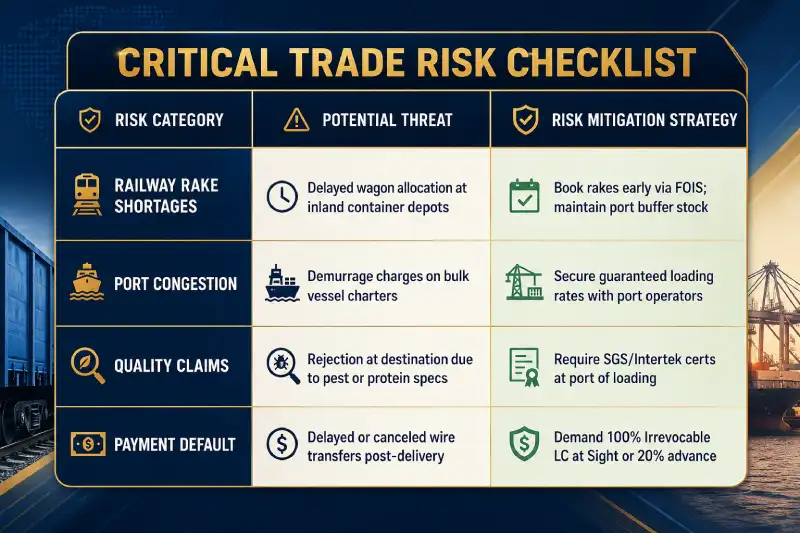
A delayed rail rake will cost you dearly. If grain rakes sit stalled inland while a chartered bulk vessel waits at berth, daily demurrage penalties run anywhere from $10,000 to $25,000. Experienced port operators stage physical buffer stock inside port godowns before the ship docks. That way, loading starts the second hatches open, helping meet laytime deadlines.
Value-Addition: The 1 Million Tonne Flour Opportunity
Raw grain gets all the headlines, but the 1 million tonne processed flour allocation is where strong margins can be built.
Milling wheat into atta, maida, or semolina commands a higher return per ton than exporting raw kernels. Bakeries in the Gulf, retail importers across South Asia, and commercial food processors pay premiums for reliable, high-gluten flour.
Commodity traders often look to processed products to smooth out earnings. While daily CBOT price swings introduce volatility into raw wheat trading, value-added flour products under structured multi-month contracts can offer more stable commercial margins over time.
Plus, shipping flour in standard 20-foot sea containers avoids the massive capital outlay and headache of chartering bulk vessels, making it an accessible route for independent export houses.
Seizing the Reopening Window
A 6-million-tonne export release backed by 57.8 MMT of state reserves doesn't happen often—and it coincides with a sharp global price rally.
Commodity analysts warn this opening won't stay open indefinitely. Late-season crop recoveries elsewhere or sudden domestic price spikes in India could prompt regulators to pull back quotas without much warning.
Making money on this reopening comes down to efficient execution: buying early in high-yield farming belts, securing rail-to-port logistics, and structuring secure payment terms with verified foreign buyers.
Demand is active, freight math favors Indian origins, and state warehouses hold ample stock. Exporters who move fast and keep their supply chains tight will take the lion's share of this trade.



.webp "Beyond the Ban: Why a New \"Urgency Window\" Is Reopening for Indian Wheat Exports")
.webp "Sinking the Costs: How India’s Sea-Route Breakthrough Is Changing the Global Mango Game")