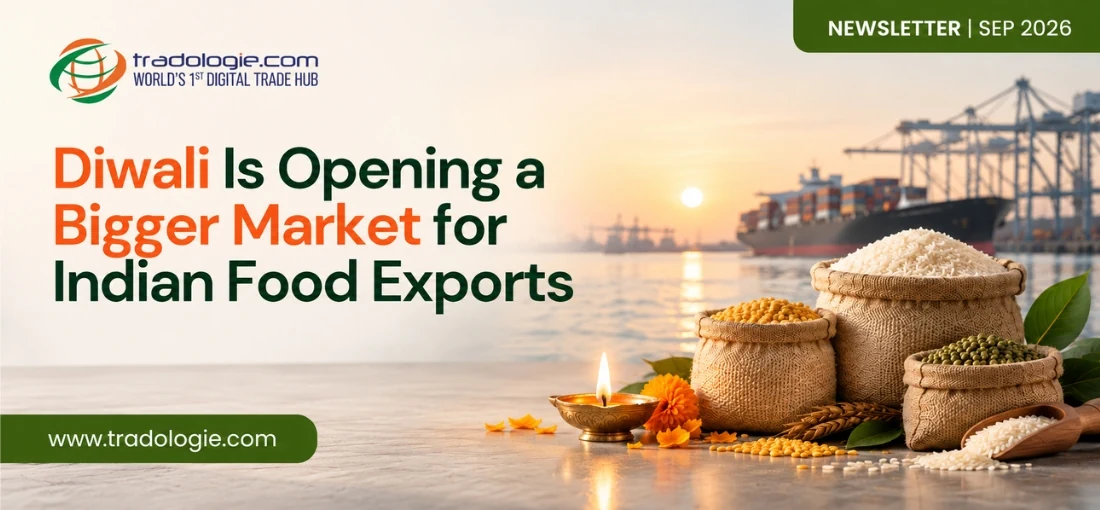
There is a familiar rhythm to the Indian food export business every year before Diwali. Overseas buyers begin stocking up, Indian sweets and savouries move in larger quantities, and distributors across the Gulf prepare their shelves for one of the biggest festive buying periods of the year.
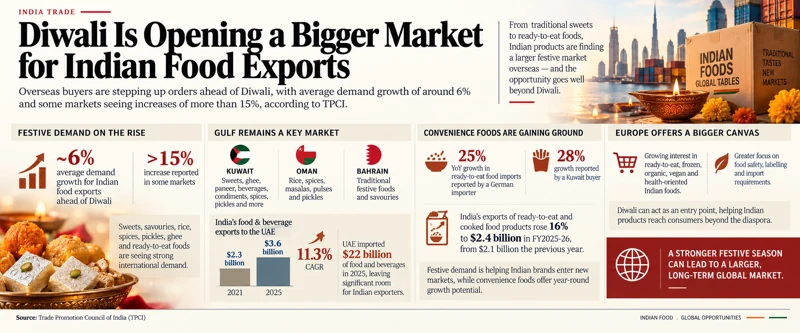
This year, however, there is a little more to the story. The Trade Promotion Council of India says overseas buyers are reporting average demand growth of around 6% ahead of Diwali . While some markets are recording an increase of more than 15%. Traditional products such as sweets, savouries, rice, spices, pickles and ghee remain central to the demand, while ready-to-eat and ready-to-cook foods are showing particularly strong growth.
For Indian exporters, that creates two opportunities at the same time. The first is immediate: a stronger festive order book and higher procurement across established overseas markets. The second is longer term. A buyer who discovers an Indian product during Diwali can become a regular buyer if that product works beyond the festive season.
That is where the current export opportunity becomes particularly interesting.

Diwali Remains a Powerful Buying Season
Festivals create a very specific kind of demand. Millions of consumers buy around the same period, retailers need additional inventory and importers have to prepare well before the festival actually arrives.
Indian food has an advantage because the Diwali basket is unusually broad. Overseas buyers are procuring kaju katli, laddoo, halwa, bhujia, mixture, murukku, dry fruits and nuts, rice, spices, masalas, ghee and pickles.
For exporters already operating in these categories, the opportunity is not about creating demand from scratch. It is about supplying an established market at a time when procurement naturally rises.
And a successful festive shipment can do more than generate one seasonal order. It can give an overseas distributor a reason to test another product, enter another retail channel or continue purchasing after the festival.
The Gulf Is Already a Major Market for Indian Food
The GCC remains the strongest regional centre for Indian festive food demand, with Kuwait, Oman and Bahrain reporting procurement across a wide range of products.
Kuwaiti buyers are sourcing sweets, ghee, paneer, beverages, condiments, spices, pickles, canned foods and dry fruits. Oman is also seeing demand for Indian rice, spices, masalas, pulses and pickles, while Bahrain continues to buy traditional festive foods and savouries.
The scale of the wider opportunity is visible in the UAE. India's food and beverage exports to the country rose from $2.3 billion in 2021 to $3.6 billion in 2025 , an 11.3% CAGR. Yet the UAE imported around $22 billion of food and beverages in 2025 , according to TPCI.
So India's position in the market is already substantial, but the market itself is considerably larger.
That leaves room for both established exporters and newer Indian food brands.
Convenience Foods Are Changing the Export Basket
Traditional foods remain important, but the faster-moving part of the market is increasingly convenience food.
TPCI's survey found a German importer reporting approximately 25% year-on-year growth in ready-to-eat food imports , while a Kuwait buyer reported 28% growth . At the national level, India's exports of ready-to-eat and cooked food products increased 16% to $2.4 billion in FY2025-26 , from $2.1 billion the previous year.
That is significant because these products are not tied to one festival.
A traditional sweet has an obvious Diwali market. A ready-to-eat curry, frozen snack, instant mix or cooked rice can be sold throughout the year.
This gives exporters an opportunity to use festive demand as an entry point into a much larger category. The festival brings the product onto the shelf; consistent quality and convenience determine whether it stays there.

Europe Could Take Indian Food Beyond the Diaspora
The GCC offers an established consumer base. Europe presents a different opportunity: reaching consumers who may have no connection to Indian food through family or community.
TPCI's survey points to growing European interest in ready-to-eat, frozen, organic, vegan and health-oriented Indian foods , alongside greater attention to food safety, labelling and import requirements.
That changes the way exporters have to think about the product.
Packaging has to explain the food to someone who may never have eaten it before. Shelf life needs to work across a longer supply chain. Ingredients and nutritional information need to be clear. The product has to compete on convenience and quality, not simply on its Indian identity.
Diwali can help open that door. Retailers have a natural reason to introduce Indian products during the festive period, and a successful product can then remain on the shelf for everyday consumption.
The Bigger Economic Opportunity Is in Value Addition
This is perhaps the most important development for India's food export industry.
When India exports an agricultural commodity, much of the value lies in the commodity itself. When that same agricultural output is cleaned, processed, formulated, cooked, frozen or packaged into a finished food, more stages of the value chain remain with the exporter.
Rice can become a prepared meal. Spices can become a finished masala. Vegetables can become frozen snacks. Fruit can become pulp or juice.
The raw material has not changed. The economics have.
A processed product gives the exporter more ways to differentiate — through convenience, formulation, packaging, consistency and brand — instead of competing almost entirely on commodity price.
This also explains why the rise in ready-to-eat exports deserves attention alongside the festive numbers. It suggests that India's food export opportunity is gradually expanding from simply moving agricultural products to capturing more value from them.
Repeat Orders Are Where Seasonal Demand Becomes a Market
There is a natural progression in international food trade.
An importer places a festive order. The exporter delivers it successfully. The product performs well in retail. The buyer returns with another order.
At that point, the conversation changes.
It is no longer simply about Diwali procurement. It becomes a question of annual supply, new products, larger volumes and potentially new markets.
That repeat business has real economic value. More predictable orders allow manufacturers to plan production better and spread fixed costs such as machinery, warehousing and quality systems across larger volumes. For buyers, regular supply also makes inventory planning easier.
The festive season can therefore act as a bridge between an occasional transaction and a long-term B2B relationship.
Logistics Will Decide How Much of the Opportunity Is Captured
Demand, however, is only one part of the equation.
TPCI identifies freight and container costs, customs delays, food-safety and import-compliance requirements, limited shelf life and geopolitical instability among the key concerns for exporters and buyers.
For festive food, timing becomes particularly important. A shipment arriving after the main selling period has lost much of its commercial value, even if the product itself is perfectly good.
Exporters therefore need to plan production, inventory and shipping well ahead of the festival. For perishable products, the calculation is even tighter.
A competitive export order is ultimately one that works not only at the factory gate, but at the buyer's warehouse and, eventually, on the retail shelf.
Diwali Could Be the Beginning of a Larger Export Story
The encouraging part of the current outlook is that the immediate festive opportunity and the longer-term market opportunity are moving in the same direction.
The 6% average increase in festive demand points to stronger procurement this season. The much faster growth reported in ready-to-eat categories points towards changing consumer habits. The GCC provides an established market, while Europe offers room to reach a broader international consumer base.
Indian exporters can benefit from both.
The traditional sweets, savouries, Indian rice varieties, spices and desi ghee will continue to have a natural place in the Diwali trade. But at the same time the ready-to-eat meals, frozen foods, instant mixes and other value-added products can help Indian companies build demand that continues well after the festival.
That is the real strength of the opportunity.
Diwali brings buyers to Indian food. Good products, dependable supply and strong distribution can give those buyers a reason to stay.
From Festive Orders to Global Food Brands
India already has the agricultural base, food-processing capability and overseas demand needed to build a much larger food export business.
The next step is not necessarily about choosing between traditional foods and modern convenience products. There is room for both.
A box of kaju katli can introduce an overseas consumer to an Indian brand. A ready-to-eat curry can bring that consumer back a month later. A distributor that begins with festive procurement can eventually become a year-round B2B customer.
That is how international food markets are built — one successful shipment, one repeat order and one new customer at a time.
For Indian exporters, Diwali 2026 is therefore both a seasonal opportunity and a chance to strengthen their position in global food markets.
The festive season can bring Indian food to more tables around the world.
The bigger opportunity is making sure those tables continue to have Indian food on them long after the festival is over.