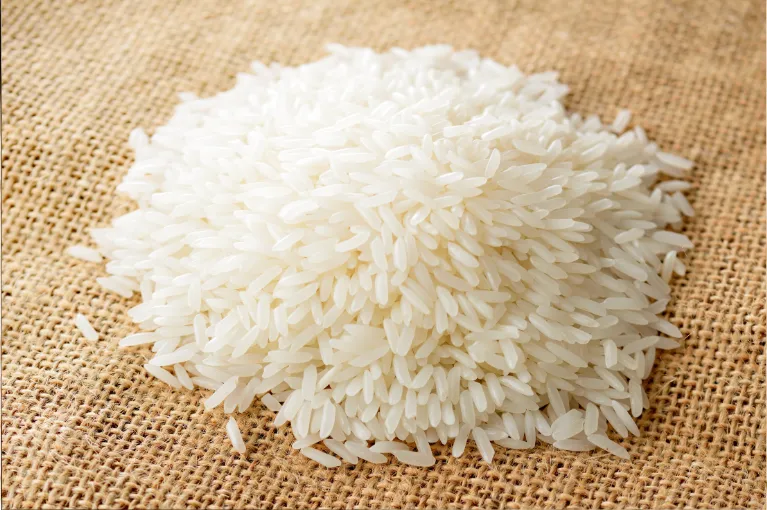
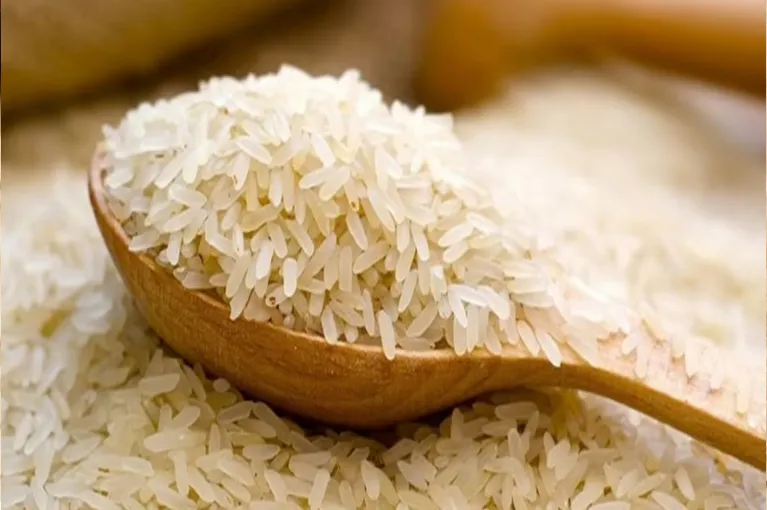
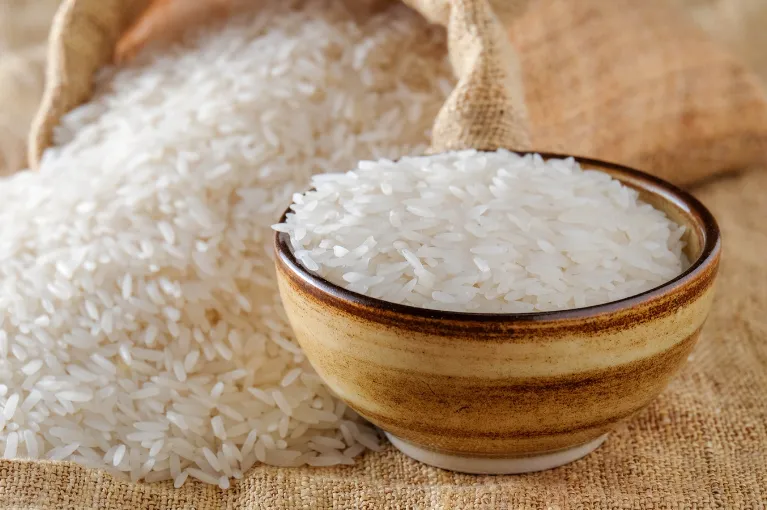
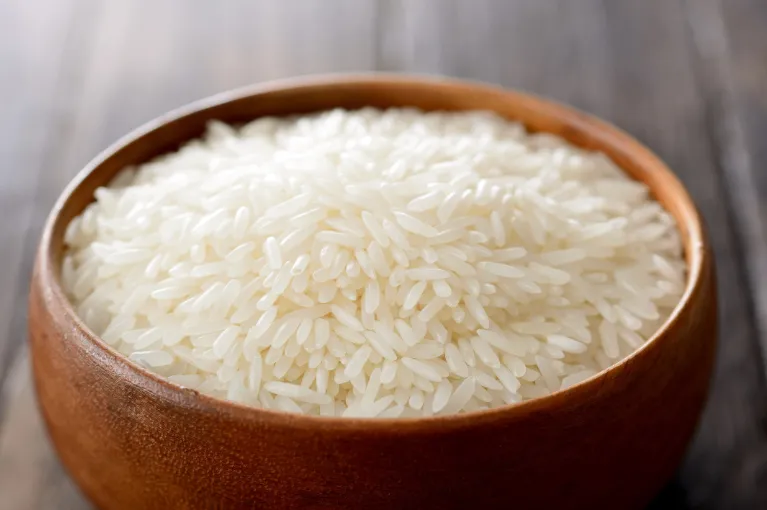
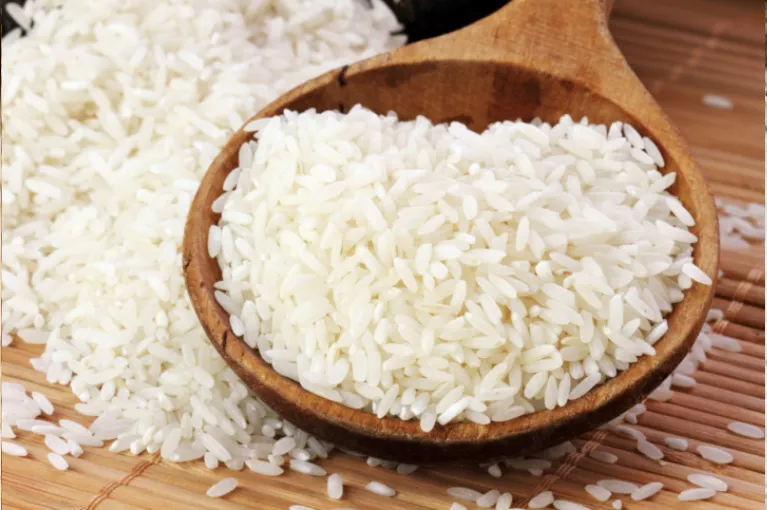
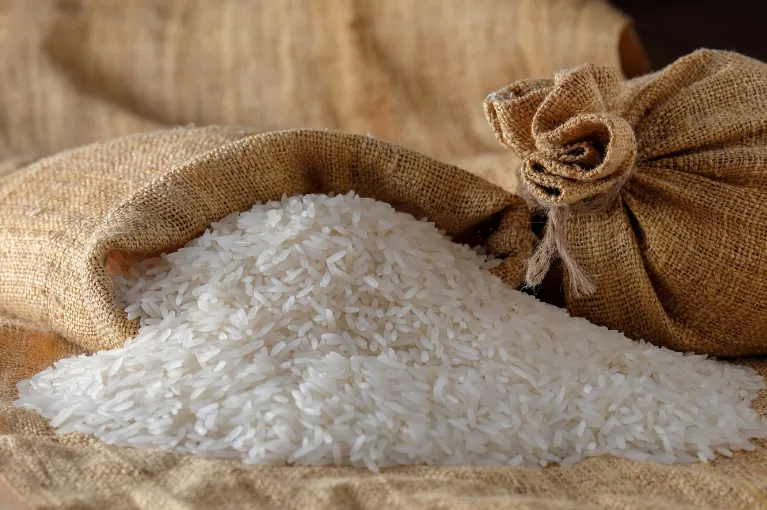
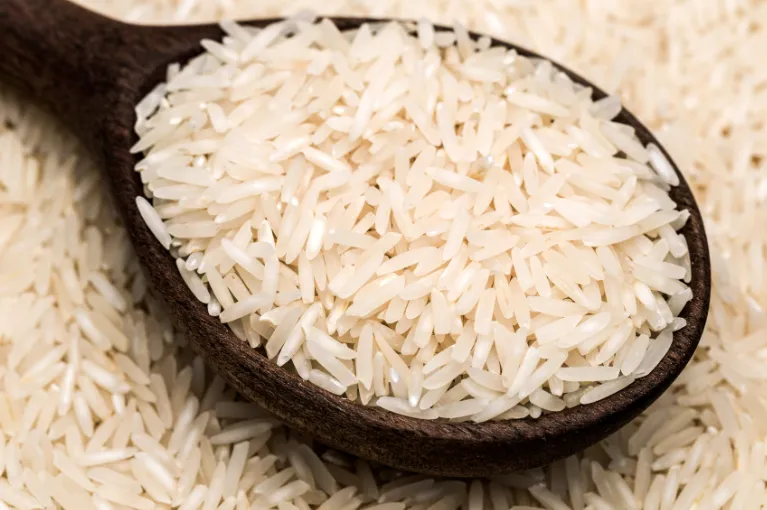
IR-64 is a high-yield, non-aromatic long-grain rice variety widely traded in global non-basmati markets. It is primarily used for food security programs, institutional catering, and bulk commercial supply due to its consistent grain length, strong milling recovery, and cost efficiency.
IR 64 Long Grain Rice is a staple of the global grain trade. The first step in comprehending IR 64 rice is realising that it is a high-yield mega-variety and a premium non-basmati staple. A long, thin grain profile that ranges from 5.8 mm to 6.2 mm is what sets IR 64 rice apart, according to its comprehensive specs
Beyond its physical dimensions, key IR64 rice characteristics include strong milling recovery that appeals directly to commercial processors. As a versatile IR64 rice variety, it will be available in two primary versions:
Raw (White): Known for its airy, fluffy texture and high amylose content.
Parboiled (Sella): Reinforced through hydrothermal treatment. This process gelatinises the starch, resulting in strong golden grains with increased nutrition retention and superior breaking resistance.
Strategic Market Positioning
This variety discreetly supports the affordable international rice economy. In West Africa, Southeast Asia, and the Middle East, IR-64 serves not only as a food grain but also as a food security tool.
How is Indian IR-64 Different from Thai 5% Broken Rice?
Indian IR-64 and Thai 5% Broken occupy the same competitive lane in the global rice trade. Thai 5% Broken is, in practice, IR-64’s closest rival. Both appear in the same government tenders, institutional bids, and mass-import programs, often separated by little more than a line item on a procurement sheet.
Origin sets the baseline: IR-64 flows out of India, the world's largest rice-exporting nation. Thai 5% Broken is sourced and shipped from Thailand. Traders track the difference through the “origin spread”, the price gap between Indian and Thai FOB offers that quietly dictates buying decisions.
Grain profile shows subtle divergence: Both are long-grain, non-basmati categories designed for volume markets. Thai 5% Broken typically presents a slightly thicker grain with a glossier surface, reflecting Thailand's milling style. Indian IR-64, meanwhile, is recognised by industrial kitchens for stronger cooking expansion, translating into higher plate yield per kilogram
Pricing behaviour differs: Indian IR-64 consistently trades at a lower price point. Thailand positions its 5% Broken as a benchmark grade, holding firm on price. When budgets tighten, IR-64 captures contracts; when pricing converges, Thai origin regains ground.
Scale versus reputation: India's advantage lies in capacity. Massive and repeatable volumes make IR-64 the natural choice for large G2G food security deals. Thailand counters with a long-standing reputation for standardisation and reliability that still appeals to legacy buyers.
Buyer decision is purely commercial: Loyalty is thin in this segment. Importers shift between IR-64 and Thai 5% based on the active price spread and end-use economics. Wide spread favours India. Narrow spread revives Thailand.
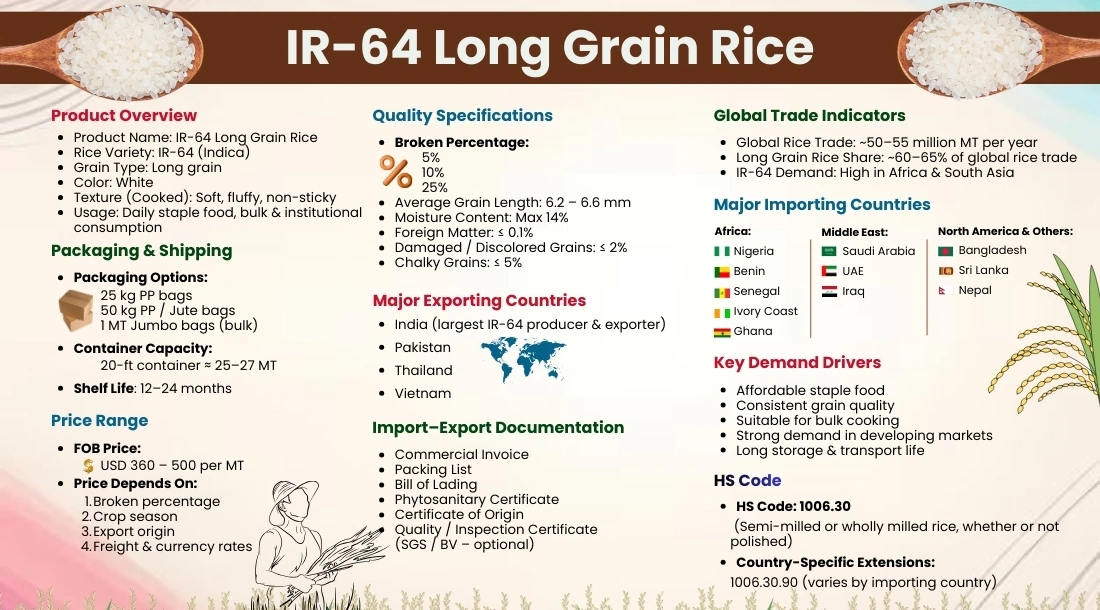
Specifications Of Ir-64 Long Grain Rice
Quality
100% Pure
Sortex
Clean
Brokens
5% Max
Moisture
14% Max
Damaged / Discoloured
1.25% Max
Yellow /Red / Red Streaked Grains
1.25% Max
Foreign Matter Including Paddy
0.25% Max
Black And Black Tipped
0.25% Max
Natural Admixture Of Rice
5% Max
Average Length Of Rice
6.00 mm
Specification Source & Compliance:
Base Standard: Aligned with Codex Alimentarius Standard 198-1995 for Rice.
Verification: Final specifications subject to pre-shipment inspection by SGS / Bureau Veritas / Cotecna.
Grading: As per Indian Standard IS 2814:1978 (Method for Sampling of Cereals and Pulses).
IR-64 Long Grain Rice Commercial Classification
IR-64 Long Grain Rice is commercially classified based on processing method, grain integrity, milling level, and broken percentage. While the fundamental IR 64 paddy variety remains the genetic foundation, market value is determined by processing treatment, finish quality, and physical consistency.
Processing Method
Parboiled (Sella) Rice
Paddy is soaked, steamed, and dried before milling. This hydrothermal treatment hardens the grain, improves breakage resistance, and gives a translucent appearance. It is the primary export form.
Creamy Sella: Light beige tone, commonly used in catering and institutional cooking.
Sella: Extended steaming produces a deep golden colour, higher grain strength, and improved nutrient retention.
Raw (White) Rice
Milled directly from untreated paddy derived from IR 64 paddy seeds. Grains are opaque white, softer, and release more starch during cooking. Preferred for household cooking and batter-based foods.
Steamed Rice
Paddy is lightly steamed without full soaking. Produces white grains with better separation than raw rice and moderate grain strength.
2. Grain Size and Cooking Performance
Average Grain Length: 6.0 mm (Tolerance 5.8 to 6.2 mm)
Elongation on Cooking: 1.5x to 1.7x
Market Positioning: Classified as Long Grain non-basmati; sometimes marketed as Medium-Long in regions where extra-long basmati is the reference standard.
3. Broken Percentage (Quality Grade)
5% Broken: Export-grade standard for retail and premium food service.
25% Broken: Cost-efficient bulk grade for mass markets and food security programs.
100% Broken: Used in flour production, processed foods, brewing, and animal feed.
4. Milling and Finish
Sortex / Silky Cleaned: Colour-sorted and mist-polished for export-grade uniformity.
Double Polished: Extra bran removal for a brighter appearance.
Brown (Unpolished): Bran retained; supplied to health-focused markets.
5. Moisture Content
Standard Export: Maximum 14% moisture for safe shipping.
Aged / Dry Stock: 12-13% moisture from old-crop paddy; priced higher for improved cooking texture.
Market Benchmarks
Most Traded Specification: IR-64 Parboiled 5% Broken (Sortex), heavily sourced from the major IR-64 rice-producing states in India.
Export-Preferred Specification: IR-64 Golden Sella 5% Broken, valued for durability in long supply chains
Applications & End-Use Mapping - IR-64 Long Grain Rice
IR-64 serves as the reliable middle ground between premium aromatics and coarse rations. It fits into markets that demand a balance of specific culinary performance—specifically fluffiness or fermentation capability—and strict cost control.
Every day household dining and retail: In West Africa and Southeast Asia, IR-64 acts as the daily table rice. Unlike generic fillers, its moderate amylose content produces separate, fluffy grains that stand up well to sauces and stews, offering families a premium "mouthfeel" without the premium Basmati price tag.
Mass catering and HORECA operations: Parboiled IR-64 is the workhorse for fried rice, pilafs, and large-batch biryanis in institutional kitchens.
Specialised food processing and fermentation: Raw IR-64 holds a unique position in batter production. It is specifically sought after for wet grinding in the making of idlis, dosas, and rice cakes.
Government stockpiles and food security: For relief tenders and national distribution networks, particularly in East Africa, IR-64 (often in 5% or 25% broken parboiled variants) is the standard. It provides caloric density and withstands the rigours of long transport and storage systems better than more delicate varieties.
Industrial manufacturing and animal nutrition: The supply chain utilises every grade. While whole grains go to tables, 100% broken grades are consistently absorbed by the poultry and cattle feed sectors.
IR-64 isn't selected just for volume; it is selected for versatility. It acts as a functional ingredient for processors requiring specific starch behaviours and a durable staple for caterers requiring visual consistency.
Global Trade Architecture: IR-64 Long Grain Rice
The trade geography of IR-64 is defined by a rigorous "South-South" flow. It features a monocentric supply structure—anchored by India—feeding a fragmented, high-volume demand network across the developing world. The market is driven by calorie-per-dollar efficiency, with flows moving primarily from Asian production centres to West African and Middle Eastern consumption nodes.
1. Primary Origin Markets (Supply)
While multiple nations export long-grain rice, the hierarchy is distinct. India dictates the baseline, while others function as strategic alternatives or premium substitutes.
India (The Global Anchor): The undisputed price-setter. With production exceeding 150 MMT (2025/26), India provides the highest volume and variety (Raw, Parboiled, Steam).
Vietnam (The Competitive Alternative): A critical counterbalance to India. Vietnamese 5% and 25% White Rice frequently displaces Indian supplies in Southeast Asian government tenders (e.g., Indonesia, Philippines) due to logistical proximity.
Pakistan (The Direct Substitute): While renowned for Basmati, Pakistan's IRRI-6 and IRRI-9 varieties serve as direct functional substitutes for IR-64. They are particularly competitive in East African markets when Indian export floors rise
Thailand (The Premium Tier): Thailand targets the quality-conscious segment. Its "100% Sortex Parboiled" and Long Grain varieties command a price premium and serve as the "flight-to-quality" option when Indian supply faces policy friction.
2. Strategic Consumption Nodes (Demand)
Demand is bifurcated between food security staples in Africa and institutional catering in the Middle East.
West Africa - The High-Volume Atlantic Corridor
Benin is the world's biggest destination for IR-64 Parboiled, serving as a significant logistics hub, receiving over 43% of shipments for redistribution around the area. Togo serves as a secondary centre, accounting for around 15% of the overall supply to the Sahel region. Senegal and the Ivory Coast are major markets for 100% Broken and Parboiled grades, which are the foundation of local staples like Thieboudienne.
East Africa - The Food Security Belt
Somalia and Djibouti rely significantly on Indian IR-64 to meet their basic caloric needs and humanitarian relief commitments, with Djibouti acting as a critical naval route for landlocked Ethiopia. Kenya is a rapidly emerging market that is importing Raw IR-64 and blended grains to suit rising domestic demand.
Middle East (GCC) - The Institutional Market
UAE and Saudi Arabia drive demand primarily through the catering and re-export sector. Large volumes of Creamy Sella and Raw rice are imported to supply labour camps and undergo value-added processing, serving both local consumption and redistribution across smaller regional markets.
Southeast Asia - The Strategic Reserve
Indonesia and the Philippines act as “swing buyers,” periodically issuing large government-to-government tenders (e.g., via BULOG) to stabilise domestic rice prices. These interventions create sudden surges in global IR-64 demand, shaping short-term trade flows and influencing pricing dynamics.
3. Market Hegemony: The Indian Factor
India does not just participate in the market; it defines it.
The Floor Price Controller: With government stocks holding 30 MMT above buffer norms (2026), India effectively sets the global floor price for non-basmati rice.
The Global Swing Producer: Market liquidity is directly correlated to New Delhi's policy decisions. When export restrictions (MEP or bans) are active, global trade freezes; when eased, India instantly reclaims over 40% of the trade volume.
4. Transhipment & Re-Distribution Gateways
These hubs serve as the arbitrage points of the global rice trade, breaking bulk vessels into containerised or truck-sized parcels.
Lomé (Togo) & Cotonou (Benin): Also known as the "Grey Channel" giants. These ports are important entry points for products headed for Nigeria (which has no direct import restrictions) and the landlocked Sahel countries (Burkina Faso, Niger, and Mali).
Dubai (UAE): The Value-Add Hub. Dubai specialises in processing rougher bulk imports into polished, private-label consumer brands for re-export to Africa and niche Middle Eastern markets.
Singapore: The Financial Switchboard. While physical handling is lower compared to African hubs, Singapore remains the command centre for trade financing and paper trading for Southeast Asian flows.
Strategic Market Intelligence: Global Landscape
IR-64 Long Grain Rice operates as the backbone of the broader global non-basmati rice market. The sector's dynamics are structural rather than speculative, driven fundamentally by food security mandates, demographic expansion in import-dependent nations, and the supply-side stability guaranteed by Indian production.
1. Current Valuation & Volume Metrics
Global Valuation: The market for rice as a whole was estimated to be worth $293.8 billion in 2022, and growth is anticipated.
Export Volume: India's non-basmati exports alone totalled about 11.1 million tonnes, or more than $4.5 billion USD, in FY 2023-2024.
Trend Line: As export limitations are gradually relaxed and international trade channels normalise, these quantities are expected to grow significantly.
2. Strategic Horizon & Growth Trajectory
Forecast Window: Market research shows that the prognosis for 2025-2030 will be stable.
Growth Rate: The non-basmati rice business as a whole is expected to grow at a CAGR of approximately 4.12%. The commodity's status as a non-discretionary staple is evidenced by its constant increase.
3. Commodity Scope & Classification
Processing Spectrum: Market data aggregates both Raw (White) and Processed (Parboiled/Sella) variants. While Parboiled rice dominates trade volumes due to its durability in transit and storage, all forms are consolidated under non-basmati long grain data.
Grading Matrix: The scope encompasses the full quality spectrum, segmented primarily by breakage percentage (e.g., Premium 5% Broken vs. Standard 25% Broken).
IR-64 Long Grain Rice: Core Demand Drivers
Government and Institutional Buyers Lead the Market
The IR-64 Long Grain rice market operates at the intersection of food security policy and evolving consumer preferences. Governments across West Africa and Southeast Asia drive the largest volumes through state-backed procurement programs, with countries like Benin, Senegal, the Philippines, and Indonesia issuing substantial G2G tenders to stabilise inflation and maintain staple food reserves through Public Distribution Systems (PDS).
Beyond government stockpiles, institutional buyers favour IR-64 Parboiled for its exceptional economics. Industrial kitchens, school feeding programs, hospitals, and labour camps capitalise on its high swelling capacity—maximising servings per kilogram and reducing daily feeding costs. Meanwhile, the food processing sector utilises 100% broken IR-64 as starch feedstock for rice noodles, gluten-free flour, and distilled spirits, where chemical purity matters more than grain integrity.
The Urban Shift: Changing Diets in Growing Cities
West Africa's growing urbanisation is changing nutritional norms. In major marketplaces like Lagos and Dakar, rice currently outnumbers root crops in daily consumption. Parboiled IR-64 is the most popular cultivar due to its convenience and climate tolerance. Its cost-effectiveness drives up demand during times of economic uncertainty.
Health Trends and Value-Added Innovation
Health awareness is also driving demand. Parboiled IR-64's nutrient retention and lower Glycemic Index make it increasingly attractive for diabetes management and government health initiatives. This has opened doors to value-added applications—fortified rice kernels (FRK) enriched with iron, folic acid, and B12 are now embedded in long-term policy programs, while industrial processors leverage IR-64's starch resilience for ready-to-eat formats and microwaveable pouches that withstand high-heat sterilisation.
Production & Supply Dynamics: IR-64 Long Grain Rice
A Market Controlled by One Country
The global IR-64 supply chain reveals a precarious dependency on a single origin. India commands approximately 40% of global rice exports and 28% of total production—exceeding 150 million MT in 2025/26—effectively creating a monopoly for affordable parboiled rice.
The "India Risk" and Logistical Bottlenecks
Supply concentration is the source of the "India Risk," as markets refer to it. Global IR-64 stocks were severely depleted by export restrictions and India's MEP in 2023-2024, forcing customers to choose far more expensive alternatives.
Market adjustment is ongoing. Intensive farming in Punjab and Haryana has lowered groundwater levels by 80-200 feet, raising concerns over the sustainability of low-cost, large-scale production. These supply-side pressures quickly transmit into food price inflation in import-dependent regions, particularly West Africa.
Market Adaptation: New Varieties and Import Substitution
To navigate these challenges, supply chains adjust. Indonesia's new rice varieties, Ciherang and Inpari, reduce the chances of perishability more effectively than IR-64 and match its grain profile—largely for domestic markets. Nigeria and Senegal invest resources in local rice output to curb import reliance, even if short of full demand.
Things like climate-smart farming and IR-64's quick growth cycle help a bit, but the global market stays vulnerable to India's sudden export policy changes. Those often spark panic buying and price swings that have little to do with real supply and demand.
IR-64 Long Grain Rice: Export & Import Trend Snapshot
Pricing & Export Value
Margins are stabilising, shifting from volume-driven lows to consistent pricing, effectively establishing a more predictable IR 64 rice price trend. The current IR 64 rice wholesale price levels are broken down as follows:
Parboiled (5% broken): $380-$520/MT
Raw/White (5% broken): $350-$390/MT
100% Broken (Feed/Industrial): $280-$320/MT
African buyers are now accepting $400+ ranges, signalling a new pricing norm. Since India is a key supplier, the IR 64 rice price in India has a direct impact on these global benchmarks.
Disclaimer: The IR64 rice price today is indicative and subject to change based on global demand, supply fluctuations, and policy shifts.
Import Market Insights
Demand remains steady but price-sensitive, shifting with local harvests
Primary Hubs: Benin, Togo, Ivory Coast (~68% of bulk shipments)
Secondary Hubs: Southeast Asia & East Africa; seasonal demand spikes during harvest failures
Bulk Export Price & Cost Indicators - IR 64 Long Grain Rice
(The following price ranges reflect typical bulk export benchmarks and vary based on origin, grade, volume, and shipment terms.)
Indicative Bulk Export Prices (FOB India, Q1 2026) The following indicative rates are typical of those currently offered by major long grain rice exporters in India.
Grade
Indicative FOB Price (USD/MT)
IR-64 Parboiled (5% Broken)
$480 - $520
IR-64 White/Raw (5% Broken)
$370 - $395
IR-64 100% Broken (Industrial)
$290 - $320
IR-64 prices are not purely demand-driven—they respond to policy, crop cycles, and freight. Here's what typically moves the numbers:
Broken Percentage & Grade: Cleaner, lower-broken grades command a premium. Most bulk trade happens in the 5-25% broken range, keeping prices competitive yet value-driven.
Crop Cycle & Stock Levels: Post-harvest periods see softer prices; stocks thinning mid-season firm them up. Timing of purchase matters more than haggling.
Origin Costs: Paddy rates, milling yields, and energy costs feed directly into FOB offers from IR 64 parboiled rice exporters in India.
Packaging Format: Standard 50 kg PP bags are cost-efficient. Smaller packs or custom formats add incremental cost.
Freight & Delivery Terms: Ocean freight, container availability, and insurance often influence landed cost more than minor FOB variations to IR64 parboiled rice exporters.
Regional Price Variations (Indicative CIF/Landed)
West Africa (Benin, Togo, Ivory Coast): $540 - $600/MT for parboiled, which also includes freight and duties.
Southeast Asia (Philippines, Indonesia): $400 - $440/MT for white/raw prices are either seasonally driven or based on tenderness.
Middle East & East Africa: $500 - $550/MT for moderate volumes and factoring in for quality compliance.
Note: Prices are subject to change. Variations in pricing can be attributed to grade, volume, origin, compliance, packaging, and logistics differences. Final contractual pricing requires a quote from IR 64 parboiled rice exporters in India based on current market conditions and agreed-upon Incoterms.
HS/HSN Codes for IR-64 Long Grain Rice
All rice is classed under the general worldwide HS code 1006, with subheadings used to differentiate cultivars and processing methods. In India, these subheadings are known as HSN codes or ITC-HS codes, which are sometimes extended to eight digits for national tax and trade purposes.
Logistics, Packaging & Incoterms - IR-64 Long Grain Rice
Packaging
IR-64 typically moves in 25 kg and 50 kg PP bags, which remain the industry standard for bulk shipments. While retail packs (5 kg to 20 kg BOPP) are available for supermarket shelves, the volume trade is dominated by heavy-tested 20ft containers carrying 26-27 MT of rice.
Storage & handling
Parboiled rice has a shelf life of 18-24 months, while raw white rice has about 12-18 months in shelf life. Warehousing must be cool and ventilated. For transit, fumigation and desiccants are standard measures to prevent moisture buildup or "container rain."
Incoterms FOB
It is the go-to for established traders where the buyer handles ocean freight. CIF is preferred by buyers in Africa and the Middle East who want a comprehensive price including insurance. CFR is an option when the buyer prefers to manage their own insurance.
Certifications & Compliance - IR-64 Long Grain Rice
APEDA and Phytosanitary: Compliance with these regulations begins here. While APEDA registration is the legal standard for Indian agricultural exports, a Phytosanitary Certificate is required to demonstrate that the shipment is free of pests.
Certificate of Origin: In order to obtain customs clearance at the destination, a standard verification certificate is needed to verify the rice's Indian origin.
Verification of quality: Third-party inspection is frequently used to certify weight and quality attributes.
Rules for safety: The standards for overseeing food safety are HACCP and ISO 22000. Halal certification is practically necessary for marketplaces in the Middle East and Southeast Asia.
Region-specific compliance: Location-specific documentation is used. The EU and UK have strict pesticide residue regulations (MRLs), whereas West African markets frequently demand a Certificate of Conformity (CoC).
For IR-64 trade, the focus is on meeting regulatory baselines while adapting specific certifications to the target market's entry requirements.
Future Outlook & Opportunities - IR-64 Long Grain Rice
(HS Code 1006 / 100630 context)
Staple-grade anchor in global food security: IR-64 sits at the heart of HS 100630 non-basmati trade, serving food security programs and mass-consumption markets where affordability and volume matter more than branding.
West Africa keeps the engine running: Benin, Togo, and the Ivory Coast remain the demand backbone, supported by population growth and government distribution systems. East Africa and select Middle East markets add incremental upside.
Institutional and industrial demand adds stability: Government procurement, school feeding programs, hospitals, and catering contracts provide predictable off-take. Broken IR-64 for feed and brewing creates a steady secondary market.
Value addition comes through processing, not premiums: Exporters may go beyond simple bulk exports without abandoning the HS 100630 environment thanks to fortified rice blends, pre-cooked convenience formats, and gluten-free rice flour.
Logistics efficiency, consistent specifications, and policy stability matter more than product differentiation. In a high-volume HS 1006 trade lane, reliability wins repeat business.
Why source IR 64 Long Grain Rice through Tradologie?
If you're in the bulk rice trade , you know the struggle: endless scrolling through outdated listings, dealing with layers of brokers, and wondering if the price you see is actually the price you'll get.
Tradologie flips that dynamic. Here's how we make the process work for you:
Built for bulk trading, not listings : You don't scroll through products. You post an actual requirement, and providers respond to it. That is how serious buying occurs.
Direct to the source : Verified millers are speaking with you directly. No "he-said-she-said," no middlemen, and no secret profits.
Real-time, real prices : The market changes every hour. Our platform lets you negotiate live, based on volume and specs, ensuring you’re paying the true market rate, not a static list price.
No surprises : We lock in the specs—breakage, moisture, packing—before the deal is signed. You get exactly what you negotiated.
Zero cost to you : It is completely free for buyers. We support the coordination, but you hold the decision-making power.
Transparency & Disclaimer
Based on current APEDA and DGFT trade trends, market data and price indicators ($370-$520/MT) for IR-64 rice in 2026 are presented. Due to crop yields, government export taxes, and real-time market volatility, these numbers are highly variable. Before completing commercial contracts, traders must confirm current compliance standards and obtain a formal quotation from a verified supplier because technical specifications, phytosanitary requirements, and international pesticide residue (MRL) standards are subject to sudden changes.
Sources: APEDA, S&P Global Commodity Insights, Oryza.com, The Rice Trader
The HS Code is 1006.30 (more precisely, 1006.30.90 for semi/wholly milled non-basmati). Pricing is determined by the market and varies according to international supply and Indian minimum export price (MEP) regulations.
Usually around 26 MT, which equates to one fully loaded 20ft container. While bulk break-bulk vessels are used for massive government tenders (10,000+ MT), standard B2B trade rarely occurs below a single container load due to logistics costs.
Register on Tradologie as a buyer (it’s free), post your specific inquiry for IR-64 Rice, and negotiate directly with verified exporters based on live, real-time quotes. Once specifications and price are aligned, the order is finalised without phone calls or emails.
Most international trades are conducted via Letter of Credit (LC) at sight to ensure security for both parties. In some specific supplier relationships, a partial advance (TT) with the balance against scanned shipping documents is negotiated, but LC remains the industry standard.
The platform is cost-free for buyers and enables direct negotiation with multiple verified millers simultaneously. Throughout the procurement process, you may access real-time market pricing, avoid middleman margins, and retain complete openness regarding final procurement.
Shipment typically takes around 30 days from order confirmation. However, actual delivery timelines depend on the destination port, vessel availability, and the speed of payment confirmation (LC opening). Loading from the origin port usually occurs within 10–14 days of contract finalisation.
We use cookies to enhance site functionality, improve user experience, analyze website performance, and deliver relevant content in accordance with our Cookie Policy.
We use cookies
Essential Cookies
Essential cookies are strictly necessary for Tradologie.com to operate properly. They enable core functionalities such as security, session management, network stability, and cookie consent preferences. These cookies do not collect personal data and cannot be disabled.
Name
Vendor / Service
Purpose
Expiry
Privacy Policy
ASP.NET_SessionId
Tradologie.com / ASP.NET
Maintains secure user session across pages.
Session
https://privacy.microsoft.com/
__RequestVerificationToken
Tradologie.com
CSRF protection for forms.
Session
https://www.tradologie.com/privacy-policy/
cookie_consent
Tradologie.com
Stores consent preferences so the banner does not reappear.
We use analytics cookies to gather anonymous, aggregated information about how visitors interact with Tradologie.com. This helps us improve the site, measure the success of content and services, and prioritize performance fixes.
Functional cookies allow the website to provide enhanced usability and personalization. They store preferences such as language, region, chat settings, and login details for a smoother browsing experience. Disabling these cookies may limit certain features.
Name
Vendor / Service
Purpose
Expiry
Privacy Policy
user_lang / lang
Tradologie.com
Remembers chosen language.
1 year
https://www.tradologie.com/privacy-policy/
timezone_pref
Tradologie.com
Stores timezone preference for display.
6 months
https://www.tradologie.com/privacy-policy/
remember_user
Tradologie.com
Keeps logged-in state when chosen.
30 days
https://www.tradologie.com/privacy-policy/
livechat_session
Tawk.to
Maintains chat session state.
Session
https://www.tawk.to/privacy-policy/
Marketing
Marketing cookies are used to deliver advertising that is relevant to you and to measure the effectiveness of our marketing campaigns across platforms such as Google, LinkedIn, Meta and Microsoft. These cookies are set only with your consent.