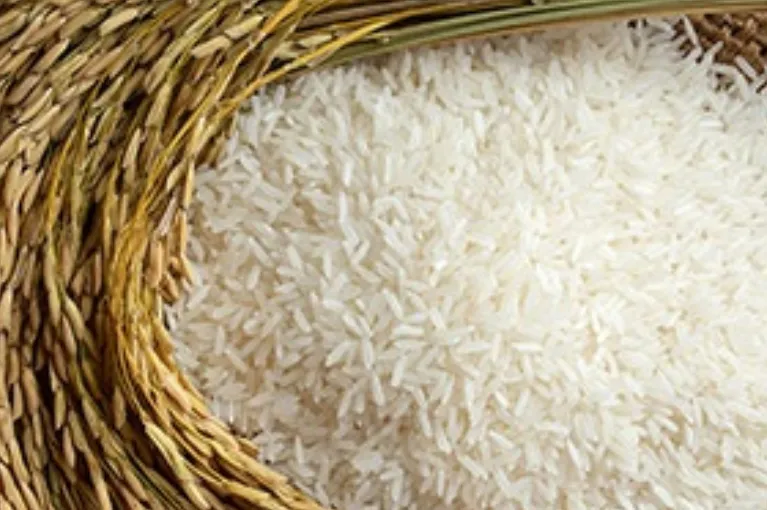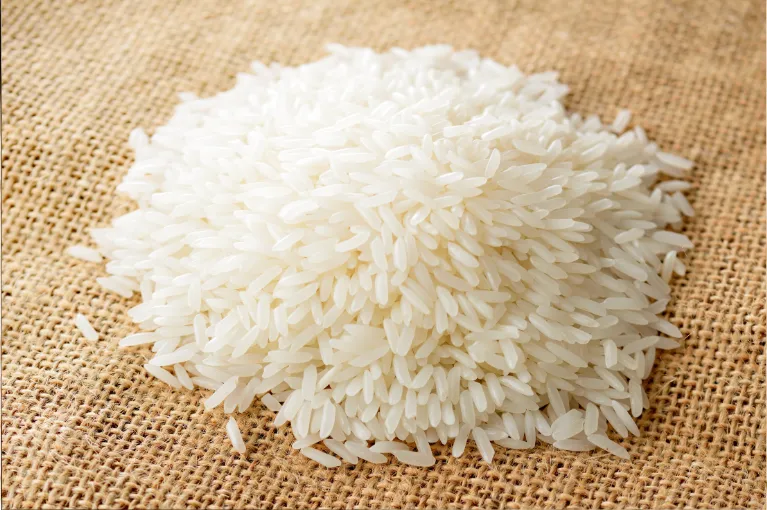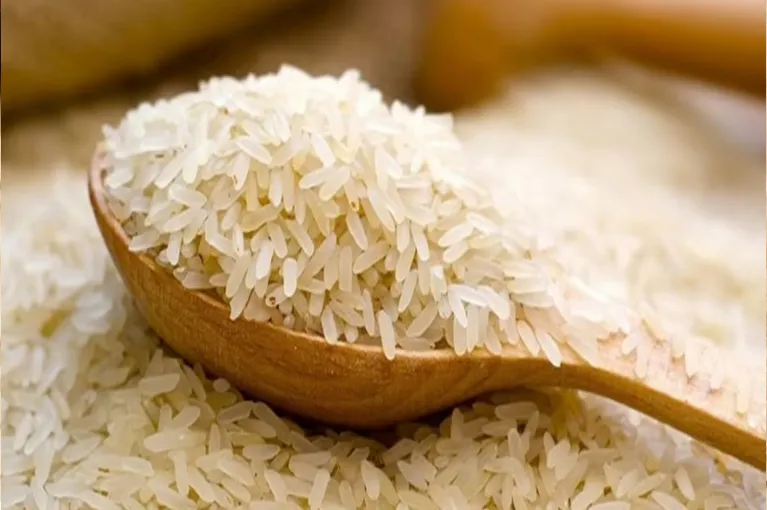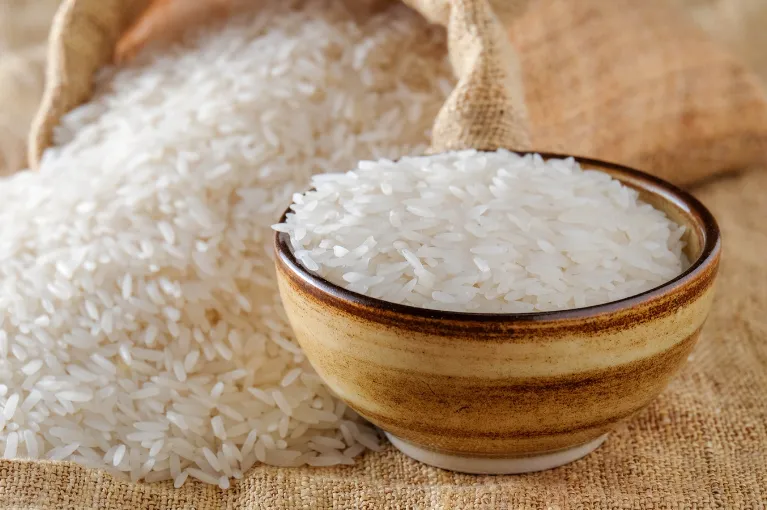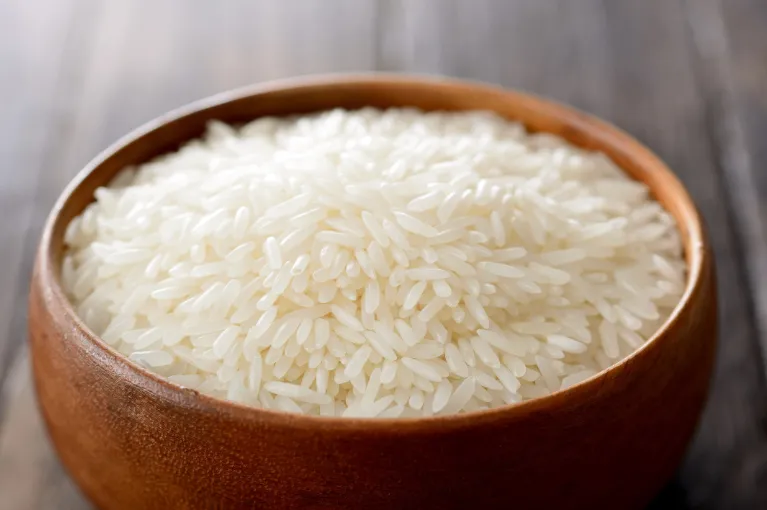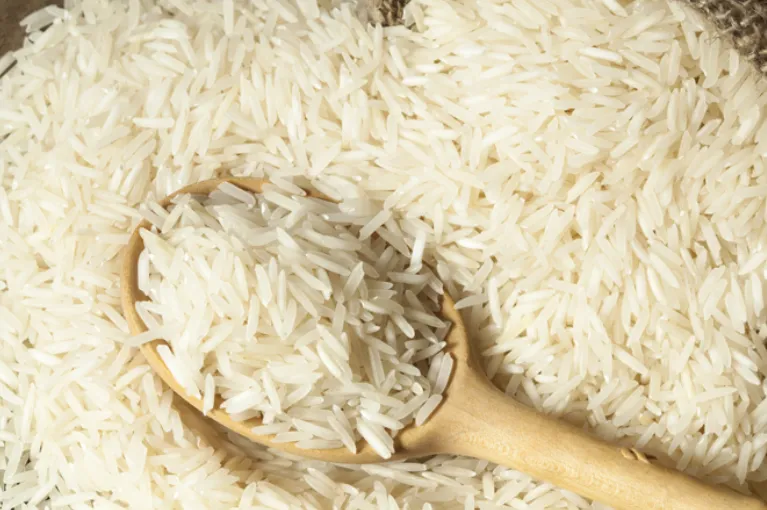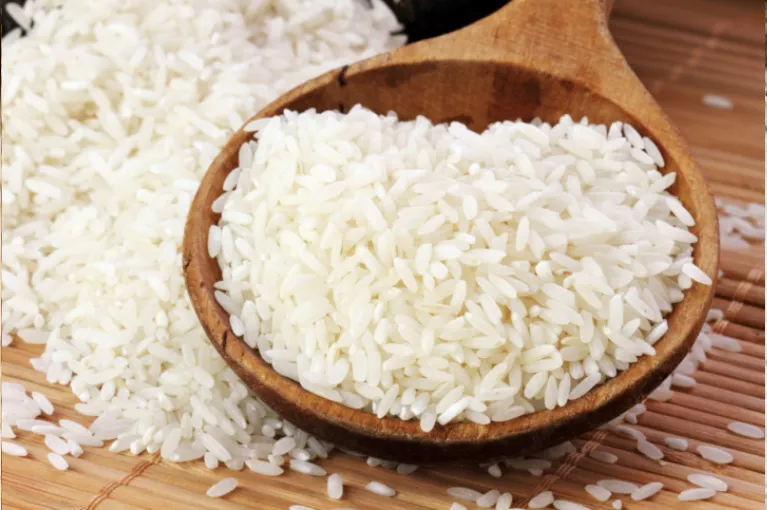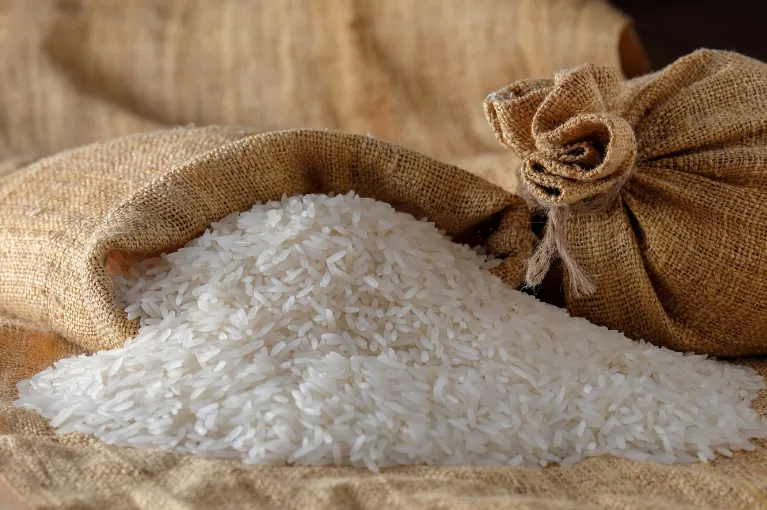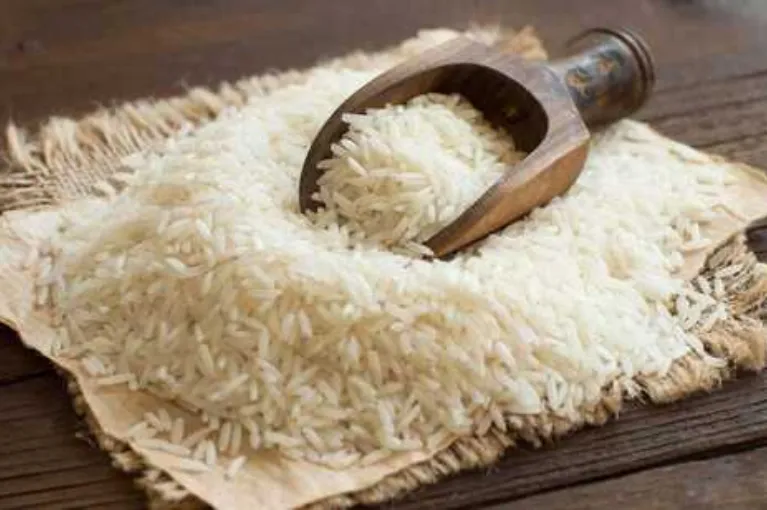
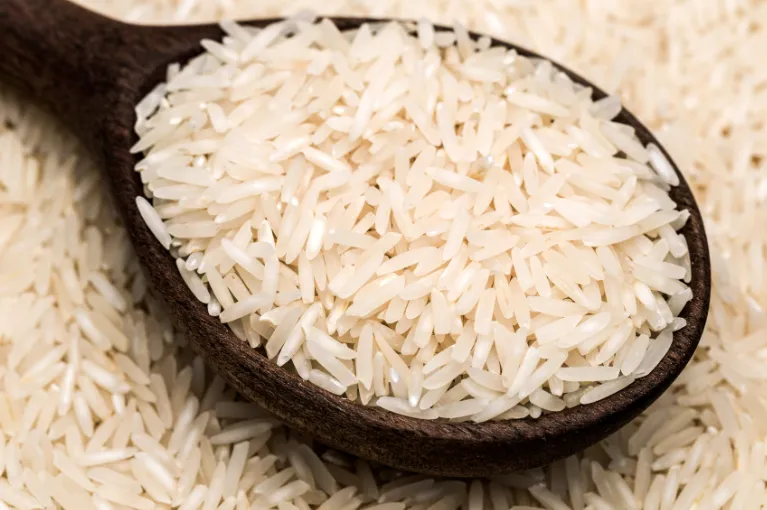
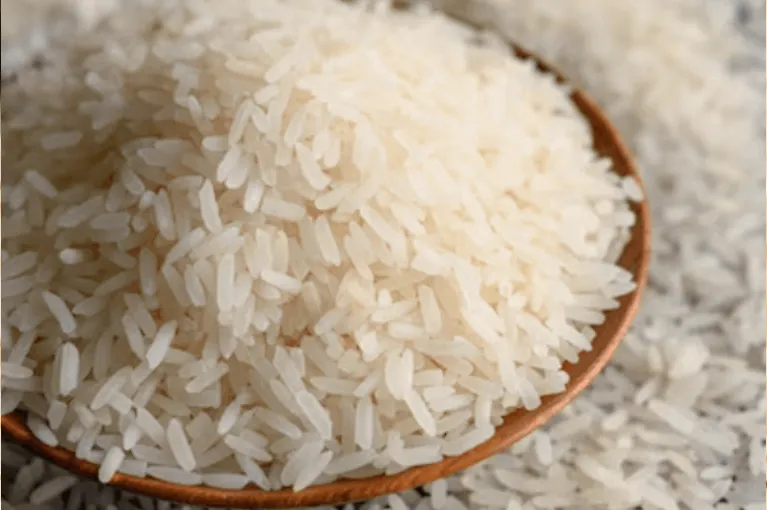
IR-36 is a high-yield, long-grain non-basmati rice variety primarily cultivated in India. It is widely traded in bulk export markets due to its consistent grain performance, stable cooking behavior, and suitability for large-scale distribution rather than premium retail use.
And since it is packed in nutrition to the brim, the Indian rice IR 36 non-Basmati Rice has been a trusted choice for ages.
How is IR-36 Long Grain Rice different from other rice?
IR-36 is commonly traded in bulk shipments for institutional and mass-consumption markets.
Buyers prioritize uniform cooking performance over aroma or grain elongation.
The variety maintains grain integrity during storage, transport, and high-volume handling.
Pricing is positioned for cost-controlled food programs and everyday consumption.
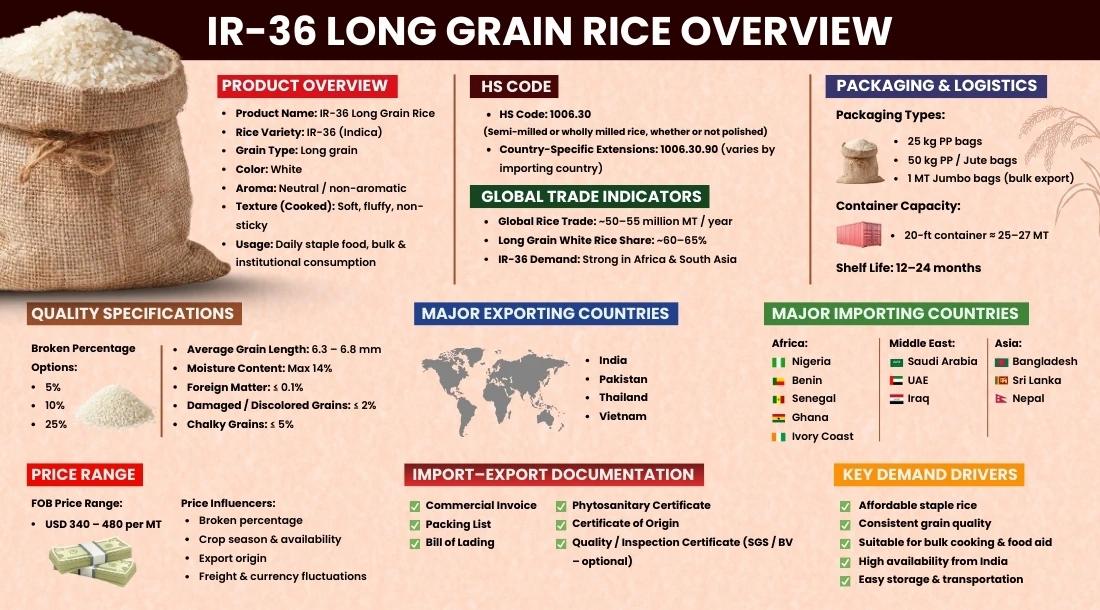
IR 36 Long Grain Rice Specifications
Quality
100% Pure
Sortex
Clean
Grain Length
5.80 mm To 6 mm
Moisture
14% Max
Damaged / Discoloured Grains
2%
Broken Ratio
5%
Black Matter
NIL
Foreign Matter
NIL
Purity
92%
Admixture
7%
Color
White
Types, Grades & Variants - IR-36 Long Grain Rice
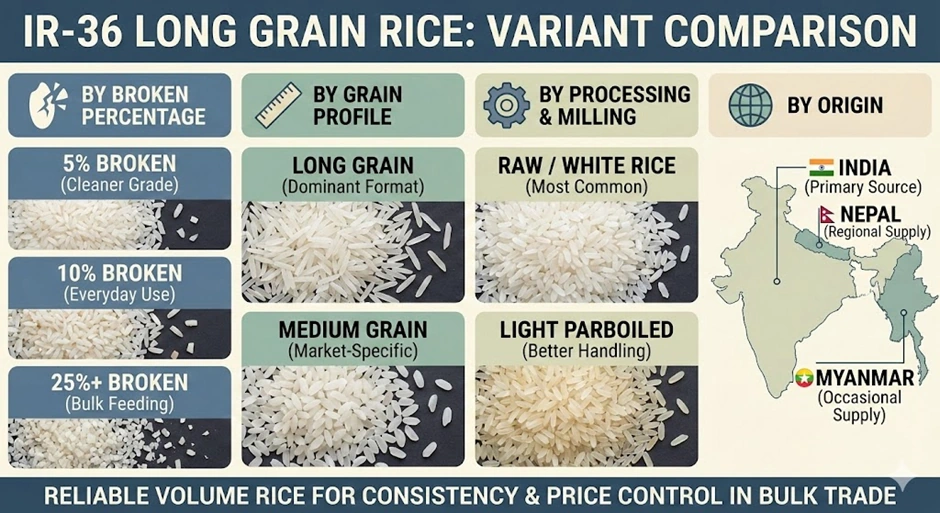
This section outlines how IR-36 is classified in global trade based on broken percentage, grain profile, and milling standards.
By Broken Percentage
5% broken - cleaner grade, often reserved for organised retail, institutions, or better-paying tenders
10% broken - widely traded for everyday consumption, where the balance between yield and price matters
15-25% broken - common in open markets and redistribution trade
25%+ broken - price-sensitive segment, typically for bulk feeding or processing use
By Grain Profile
Long grain IR-36 - dominant and most demanded format
Medium grain variants - seen occasionally, market-specific
Light parboiled - used in select markets for better handling and cooking control
Well-milled vs reasonably well-milled - chosen based on price tolerance and buyer expectation
By Origin
India - primary source; large volumes and flexible grading
Nepal - regional supply for nearby markets
Myanmar - occasional supply in price-driven segments
In practice, 10-25% broken, long-grain, white IR-36 forms the backbone of most bulk trade. Lower broken grades exist, but they're typically pulled into structured programs rather than open, price-sensitive markets.
Applications & End-Use Mapping - IR-36 Long Grain Rice
Demand for IR 36 rice sits squarely inside distribution systems, not branding exercises. It's chosen because it behaves predictably when cooked in large volumes and moved across long supply chains through non basmati rice manufacturers and suppliers.
Public food distribution programs rely on IR-36 for its steady cooking results and easy handling across mass feeding operations. It is readily used in institutional kitchens, which matters when scale is involved.
Institutional kitchens—canteens, hostels, worksite caterers—prefer it because it cooks evenly, holds texture, and can be prepared repeatedly without major quality drop-offs.
Wholesale traders and market redistributors use IR-36 as a . It's easy to move, easy to re-pack, and fits price bands that local markets can absorb.
Food processors and bulk handlers also use IR-36 for blending and secondary processing, where uniformity matters more than visual appeal.
Most IR-36 demand is volume-driven and price-sensitive, making it a regular, repeat-trade commodity rather than a one-time, opportunity buy.
Supply & Demand Countries - IR-36 Long Grain Rice
IR-36 trade follows a fairly straightforward pattern. Supply comes from origins that can push out large, consistent volumes, while demand sits in markets where rice is consumed daily, and price stability matters more than varietal branding.
Major Supplying Countries
India - The dominant supplier by a wide margin. IR-36 is grown at scale, milled in bulk in huge rice mills, and exported across multiple broken ranges depending on buyer needs.
Nepal - Regional supplier, mainly servicing nearby markets with smaller but steady volumes.
Myanmar - Appears in price-driven trades, especially when buyers are looking for alternatives to Indian supply.
Suppliers compete mainly on availability, grading flexibility, and shipment timing, not on origin storytelling.
Major Importing / Demand Countries
Nigeria - Strong demand for affordable long-grain rice across open markets and mass consumption channels.
Benin - Acts as both a consumption and redistribution hub for regional trade.
Togo - Import-reliant market where price plays a central role in buying decisions.
Ghana - Demand leans toward cleaner-milled and mid-range broken grades.
Senegal - Regular imports for everyday food supply programs.
Trade Pattern Insight
IR-36 rice largely flows from South Asia to West and Central Africa.
Deals are driven by broken percentage, milling quality, and price, not by brand or varietal premium.
10-25% broken long-grain IR-36 makes up most shipment volumes.
During price-sensitive periods, higher broken grades gain traction quickly.
Overall, IR-36 remains a steady-volume, consumption-led trade, shaped more by affordability and reliability than by market cycles or seasonal spikes.
Global Market Overview - IR-36 Long Grain Rice
IR-36 doesn't sit in a flashy market segment, and that's exactly why it keeps moving. It operates inside the core of the global rice trade, where volumes matter more than differentiation and demand doesn't depend on trends.
Globally, long-grain non-basmati rice makes up a large share of traded rice volumes, especially in regions where rice is a daily staple rather than a lifestyle product. IR-36 fits neatly into this flow. It's part of the rice that actually feeds populations, not the rice that gets marketed.
In value terms, IR-36 rides along with the broader non-basmati export market, which runs into tens of billions of dollars annually. Growth here isn't dramatic or speculative. It's steady, consumption-led, and tied closely to population growth, urbanisation, and food security needs.
What keeps IR-36 relevant is its position in the middle of the market. It's not the cheapest option available, but it offers enough consistency and yield to justify repeat buying. For many importing countries, it becomes a default choice when budgets need control but supply can't slip.
IR-36 isn't chasing market share through branding. It stays in demand because it works, ships easily, and fits into a global trade system that values reliability over reinvention.
Key Demand Drivers - IR-36 Long Grain Rice
Everyday consumption base IR-36 is eaten daily in many importing markets. That alone keeps demand regular. It's not festival-driven or trend-led — it's part of the food routine.
Price control without supply risk Buyers use IR-36 to manage costs without dropping into unstable or inconsistent grades. It sits in a comfortable middle ground.
Reliable exporting origins Large-scale producers, especially India, keep IR-36 available through most of the year, which reduces supply anxiety for importers.
Spec-led buying behavior Purchases are decided on broken %, milling quality, and moisture limits. Stories don't sell IR-36 — specifications do.
Production & Supply Dynamics - IR-36 Long Grain Rice
Exporter-led supply base IR-36 is grown and supplied at scale, with India forming the backbone of global availability. High-yield cultivation and widespread milling capacity make it easy for exporters to adjust volumes and broken percentages based on market demand.
Climate and crop sensitivity Like most mass-market rice, IR-36 is tied closely to monsoon patterns. Weather disruptions don’t usually wipe supply out, but they can tighten availability or shift pricing quickly when yields slip.
Policy and trade controls Export duties, minimum export prices, or sudden policy changes—especially from major supplying countries—can influence IR-36 flows almost overnight. Buyers watch these signals closely.
Origin concentration risk Heavy dependence on a single origin exposes importers to policy or logistics shocks. When India tightens exports, buyers often feel it immediately.
Alternative and secondary origins Nepal and Myanmar step in during price-sensitive windows or when buyers look to spread risk. Volumes are smaller, but they act as useful buffers rather than full replacements.
Indicative bulk export price: USD 380-580 per metric tonne (FOB)
Ir36 rice price per kg or per metric tonne stays firmly in the value-driven segment. It moves with crop size, export policy, and freight more than with short-term demand spikes.
Pricing typically varies based on:
Broken percentage and milling quality
Origin and port of loading
Packaging format (25 kg vs 50 kg bags, PP quality)
Volume commitment and shipment frequency
Freight rates and delivery terms
Prices quoted for IR-36 are always indicative, not fixed. Market movement, seasonal arrivals, policy changes, and logistics conditions can shift numbers quickly, especially during peak export windows.
HS Code & Classification - IR-36 Long Grain Rice
IR-36 Long Grain Rice falls under HS Code 1006, which covers rice in semi-milled, wholly milled, and parboiled forms.
In bulk export trade, IR-36 is most commonly declared under HS 100630 for semi-milled or wholly milled rice, depending on processing and destination-country customs practice.
Final classification can vary slightly by importing country, so exporters typically align HS declaration with buyer requirements and local customs interpretation before shipment.
Buyer Expectations & Trade Requirements - IR-36 Long Grain Rice
Importers usually keep things straightforward with IR-36. They're not chasing extras — they want the basics done right, every time.
Most buyers prioritize:
Consistent broken percentages across shipments
Moisture levels kept within agreed limits
Clean milling and uniform grain appearance
Independent pre-shipment inspection, especially on repeat contracts
On-time shipment execution without last-minute changes
In IR-36 trade, reliability matters more than marginal price cuts. A supplier who delivers the same quality shipment after shipment often wins more business than one offering a slightly cheaper, inconsistent lot.
Logistics, Packaging & Incoterms - IR-36 Long Grain Rice
Packaging
IR-36 is typically packed in 5Kg or 10KG or 25 kg or 50 kg PP bags, suitable for bulk handling and port-side movement. Bag strength and stitching quality matter, especially for longer transit routes.
Storage & shelf life
When stored in dry, well-ventilated conditions, IR-36 generally maintains quality for 12-24 months. It handles long storage cycles reasonably well, which is one reason it's widely traded.
Incoterms
Most IR-36 trades are concluded on FOB or CIF terms. EXW is used in select cases, usually when buyers have their own logistics arrangements in place.
Export documentation
Shipments commonly move with a Certificate of Origin, phytosanitary certificate, and inspection report, along with standard shipping documents. Documentation expectations can vary slightly by destination, so alignment before shipment is key.
Certifications & Compliance - IR-36 Long Grain Rice
Phytosanitary certificate is mandatory and forms the base of most IR-36 shipments.
Certificate of Origin is issued with the shipment and is required by importing customs to confirm the source country.
FSSAI compliance applies for exports from India and is commonly included as part of the food safety clearance process.
Lab testing reports are usually shared, covering moisture, broken percentage, and basic quality parameters. Buyers expect this, even when it's not formally demanded.
Additional certifications like ISO or HACCP come into play mainly for institutional buyers or large repeat contracts.
Country-specific compliance varies by destination. What clears smoothly at one port may need extra documentation at another, so exporters typically confirm requirements before finalising shipments.
Future Outlook & Opportunities - IR-36 Long Grain Rice
Demand is expected to stay steady, not explosive. IR-36 sits in the everyday consumption bracket. As long as rice remains a staple in importing markets, volumes keep moving.
Population growth keeps the base intact. Urban growth and rising food requirements in import-dependent regions continue to support regular buying, not one-off spikes.
India's role remains central. Indian supply will continue to shape availability and pricing. Exporters who can hold specs steady are more likely to see repeat orders.
Price sensitivity keeps IR-36 relevant. Small price movements influence buying decisions quickly. When rates soften, trade activity usually picks up without delay.
Opportunities lie in consistency, not premiumisation. Buyers are more inclined to lock longer contracts with suppliers who deliver the same broken %, moisture, and packing across shipments.
Logistics and timing are becoming differentiators. Freight volatility and port congestion are pushing buyers toward exporters who plan shipments better and align with inventory cycles.
Why You Should Buy IR 36 Non Basmati Rice Through Tradologie.com?
With all the leading IR 36 Rice exporters and over 500 rice millers directly enrolled with us, we have been constantly meeting the demands emerging from all across the globe.
It is a matter of absolute honour that currently we are a brand of trust to millions of importers from Europe, the USA, the Middle East, Asia and South Africa.
Such a stature in the global market is the result of our relentless efforts to provide our buyers with deal-closing,an unparalleled quality, and a secure platform solely devoted to customer satisfaction.
According to our customers, Tradologie's transparent yet robustly secure trade process is simply the icing on the cake.
Tradologie is built for volume trade, not brochure selling. If you're sourcing from non basmati rice manufacturers, it keeps the process practical, transparent, and grounded in real market conditions. We have the largest network of non basmati rice suppliers in India.
Transparency & Disclaimer
All prices, specifications, and trade-related information shared here are indicative in nature. Market conditions, crop cycles, origin policies, logistics, and compliance requirements can change without notice.
Buyers and sellers are advised to verify specifications, pricing, and documentation before entering into any binding agreement. Final trade terms should always be confirmed directly between the transacting parties prior to shipment or contract execution.
Sources: FAO, USDA, APEDA, World Customs Organization, FSSAI, Tradeimex, Dataintelo
There isn’t a single fixed price. Rates usually depend on broken percentage, origin, volume, packing, and delivery terms. Prices also move with crop availability, policy changes, and freight costs.
Long-grain IR-36 with 10% to 25% broken is most commonly traded. Lower broken grades exist but are usually tied to structured or institutional programs.
IR-36 mainly moves into West and Central African markets, where affordable long-grain rice is part of everyday consumption.
Yes. Buyers can source IR-36 online through platforms like Tradologie.com by registering as verified buyers and sharing their bulk requirements.
Most buyers clarify broken percentage, moisture limits, packing size, shipment volume, and destination port upfront. Clear specs help avoid delays later.
IR-36 trade is volume-driven. Most shipments move at container level or higher, though quantities can vary based on buyer needs and market conditions.
Shipments typically include a phytosanitary certificate, Certificate of Origin, lab testing report, and standard shipping documents. Additional documents may be required depending on destination.
Not always. Basic food safety and export compliance are usually sufficient. Certifications like ISO or HACCP are more common for institutional or repeat contracts.
When stored in dry and ventilated conditions, IR-36 generally holds quality for 12 to 24 months.
Enquiries typically come in when pricing, specifications, and shipment readiness align. From there, discussions move forward based on availability and delivery timelines.
We use cookies to enhance site functionality, improve user experience, analyze website performance, and deliver relevant content in accordance with our Cookie Policy.
We use cookies
Essential Cookies
Essential cookies are strictly necessary for Tradologie.com to operate properly. They enable core functionalities such as security, session management, network stability, and cookie consent preferences. These cookies do not collect personal data and cannot be disabled.
Name
Vendor / Service
Purpose
Expiry
Privacy Policy
ASP.NET_SessionId
Tradologie.com / ASP.NET
Maintains secure user session across pages.
Session
https://privacy.microsoft.com/
__RequestVerificationToken
Tradologie.com
CSRF protection for forms.
Session
https://www.tradologie.com/privacy-policy/
cookie_consent
Tradologie.com
Stores consent preferences so the banner does not reappear.
We use analytics cookies to gather anonymous, aggregated information about how visitors interact with Tradologie.com. This helps us improve the site, measure the success of content and services, and prioritize performance fixes.
Functional cookies allow the website to provide enhanced usability and personalization. They store preferences such as language, region, chat settings, and login details for a smoother browsing experience. Disabling these cookies may limit certain features.
Name
Vendor / Service
Purpose
Expiry
Privacy Policy
user_lang / lang
Tradologie.com
Remembers chosen language.
1 year
https://www.tradologie.com/privacy-policy/
timezone_pref
Tradologie.com
Stores timezone preference for display.
6 months
https://www.tradologie.com/privacy-policy/
remember_user
Tradologie.com
Keeps logged-in state when chosen.
30 days
https://www.tradologie.com/privacy-policy/
livechat_session
Tawk.to
Maintains chat session state.
Session
https://www.tawk.to/privacy-policy/
Marketing
Marketing cookies are used to deliver advertising that is relevant to you and to measure the effectiveness of our marketing campaigns across platforms such as Google, LinkedIn, Meta and Microsoft. These cookies are set only with your consent.