
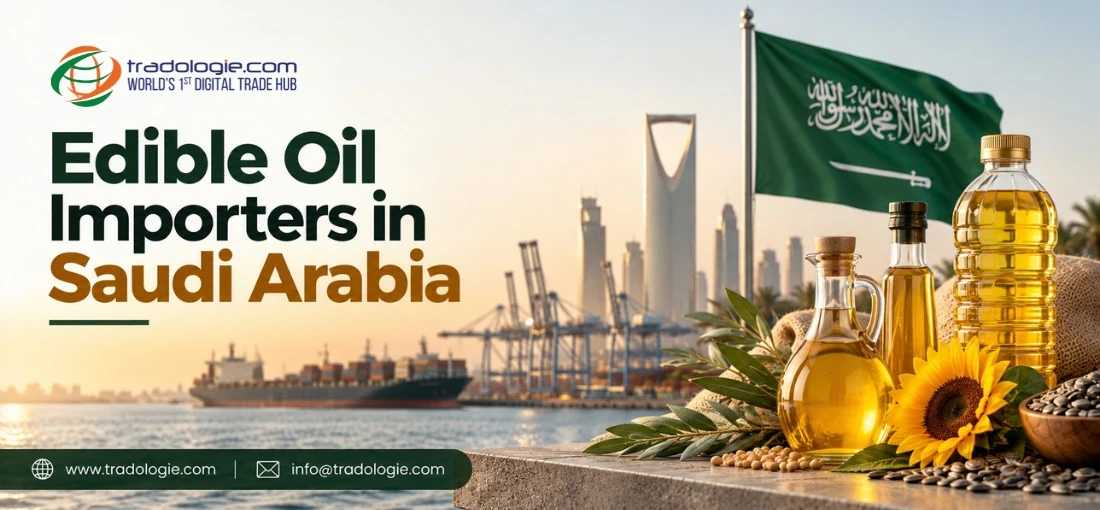
Saudi Arabia has a large edible-oil market, but the interesting part is not simply how much cooking oil the country consumes. It is how the oil enters the market. A sizable share comes in as crude vegetable oil and then moves into refining, processing and packaging inside the Kingdom. The rest comes through refined oils for food manufacturers, distributors, traders and various other types of bulk edible oil buyers in Saudi Arabia.
That distinction matters when looking for edible oil importers in Saudi Arabia. A supplier offering crude palm oil will be dealing with a very different buying market from one selling refined sunflower or soybean oil.

Palm oil sits at the centre of Saudi Arabia's bulk edible-oil trade.
The Kingdom imported 601.69 million kg of crude palm oil in 2024 which was valued at $591.87 million. Indonesia accounted for $366.39 million and Malaysia for $224.84 million. Together, they supplied almost the entire recorded import value for the year.
The refined side of the palm-oil trade was also substantial. Saudi Arabia imported another 198.8 million kg of non-crude palm oil which was worth $224.32 million. Indonesia supplied $130.65 million, Oman $69.43 million and Malaysia $22.14 million.
Sunflower oil gives the market another sizable stream. Imports of crude sunflower and safflower oil reached 197.24 million kg which was worth $205.63 million in the year 2024. Ukraine supplied $97.71 million, Russia $85.93 million and Turkey $20.70 million. Refined sunflower and safflower oil added another $41.62 million , or 31.31 million kg.
Soybean oil is smaller, but by no means insignificant. Saudi Arabia imported 29.73 million kg worth $34.57 million in 2024. Egypt, Ukraine and Turkey were among the main origins.
Taken together, crude and refined palm oil, sunflower oil and soybean oil alone account for more than $1.09 billion of imports.
What stands out is the structure of the trade. Palm oil is overwhelmingly the largest bulk requirement, while sunflower oil has developed its own sizeable import market. Soybean and other oils make up smaller but still commercially relevant segments.
Saudi Arabia's climate and agricultural base do not allow domestic vegetable-oil production to meet the requirements of its food industry. Imports therefore have a straightforward role to play.
There is another side to it, though.
The Kingdom has its own refining, food-processing and packaging capacity. Imported crude oil can therefore become an input for domestic production rather than simply arriving as a finished consumer product.
This is why the market is worth looking at beyond retail cooking oil. Vegetable oil importers in Saudi Arabia can be refiners, processors, food manufacturers or trading companies, and each one can have a very different specification and buying pattern.
For an exporter, that distinction can matter more than the headline size of the market. The right buyer is the one whose existing supply chain matches the oil, origin, quality and quantity being offered.

| HS Code | Product | 2024 Saudi Import Value |
|---|---|---|
| 151110 | Crude palm oil | $591.87 million |
| 151190 | Palm oil excluding crude | $224.32 million |
| 151211 | Crude sunflower/safflower oil | $205.63 million |
| 151219 | Refined/non-crude sunflower/safflower oil | $41.62 million |
| 1507 | Soybean oil | $34.57 million |
| 151410 | Crude rapeseed/colza/mustard oil | $7.04 million |
Rapeseed and mustard oil are much smaller compared with palm and sunflower. But it is worth nothing that there is still an identifiable import trade. Saudi Arabia brought in 5.12 million kg of crude rapeseed, colza or mustard oil in 2024, with Spain, the UAE and Ukraine among the leading suppliers.
This is where shipment data is more useful than a generic list of large Saudi food companies.
Recent records show Basateen Foods Saudi Arabia Co Ltd as the leading buyer in the combined vegetable-oil/sunflower-oil category, with 50 shipments. Dar Zaytoun Arabian Company followed with 31 shipments, while Food Aroma Trading Co. Ltd. recorded 30 shipments.
The sunflower-oil data tells a similar story. Basateen Foods recorded 36 shipments, Food Aroma 30 and Dar Zaytoun 23 in recent records covering 1,900 Saudi shipments.
Basateen becomes even more prominent when the search is narrowed to refined sunflower-seed oil: Volza records 36 shipments , giving it a 26% share of that dataset. Dar Zaytoun recorded 20 shipments and another related Dar Zaytoun company entry recorded 18.
There is also a useful geographical split. In the refined sunflower-oil records, Jeddah accounted for 44 shipments, Riyadh for 30 and Yanbu for 38.
These names should be treated as shipment-backed buyer leads , not as a permanent ranking of Saudi importers. Import requirements change, and a company importing sunflower oil today may be buying a different grade, origin or volume six months later.
That is particularly important for exporters searching for vegetable oil buyers in Saudi Arabia. The product actually being imported matters more than the size of the company.
| Buyer | Relevant Product/Category | Recorded Shipments | What the Data Indicates |
|---|---|---|---|
| Basateen Foods Saudi Arabia Co Ltd | Vegetable / sunflower oil | 50 | Leading buyer in the combined vegetable-oil/sunflower-oil dataset |
| Dar Zaytoun Arabian Company | Vegetable / sunflower oil | 31 | One of the more active buyers in the category |
| Food Aroma Trading Co. Ltd. | Vegetable / sunflower oil | 30 | Consistent presence in Saudi sunflower-oil imports |
| Basateen Foods Saudi Arabia Co Ltd | Sunflower oil | 36 | Leading buyer in the sunflower-oil dataset |
| Food Aroma Trading Co. Ltd. | Sunflower oil | 30 | Significant activity in recent sunflower-oil shipments |
| Dar Zaytoun Arabian Company | Sunflower oil | 23 | Active importer in the same dataset |
| Basateen Foods Saudi Arabia Co Ltd | Refined sunflower-seed oil | 36 | Around 26% of the recorded shipments in this dataset |
| Dar Zaytoun Arabian Company | Refined sunflower-seed oil | 20 | One of the leading buyers under the narrower product category |
| Dar Zaytoun-related company entry | Refined sunflower-seed oil | 18 | Separate company-name entry appearing in shipment records |
Jeddah Islamic Port is the most important gateway on the Red Sea. Saudi government information says it receives around 75% of imports handled through Saudi ports. It is therefore a natural point of focus for exporters looking for vegetable oil importers in Jeddah.
On the Arabian Gulf, King Abdulaziz Port in Dammam serves the Eastern and Central regions. Its railway connection with Riyadh's dry port makes it particularly relevant when cargo is ultimately going to buyers in the capital.
That logistics link is worth keeping in mind when approaching Edible Oil Importers in Riyadh . Riyadh is inland, so the commercial calculation doesn't end with the ocean freight. Inland movement from Dammam or another gateway becomes part of the landed cost.
Yanbu Commercial Port is another relevant Red Sea gateway and also appears in recent sunflower-oil buyer records.
Saudi Arabia's food imports are regulated by the Saudi Food and Drug Authority (SFDA) , which maintains specific requirements for importing and clearing food products.
1. Get the importer and product registration right.
The Saudi importer needs to complete the applicable registration and food-clearance procedures before the shipment arrives.
2. Confirm the HS classification before quoting.
Crude palm oil or refined palm oil or crude sunflower oil or refined sunflower oil or soybean oil are not interchangeable at any cost from a customs perspective. The product specification needs to match the correct classification.
3. Keep the shipment documentation in order.
Saudi customs requires core documents including the commercial invoice, bill of lading and certificate of origin where applicable. Additional documents may be required depending on the product.
4. Meet the applicable food requirements.
SFDA's clearance process covers imported food and can involve documentary, inspection and analytical checks. The product specification therefore needs to be settled before shipment rather than left to the clearance stage.
5. Complete Fasah procedures on time.
ZATCA requires importers to submit the necessary customs documentation and declaration through Fasah at least 48 hours before the shipment arrives at the port.
6. Work out the landed economics, not just the FOB price.
For bulk oil, origin, crude or refined status, quality parameters, quantity, discharge port, freight and inland transportation can all change the final number. A cheaper offer at origin does not automatically mean a cheaper shipment for the Saudi buyer.
For exporters looking to connect with edible oil buyers in Saudi Arabia , Tradologie offers a direct B2B route through live negotiation. Suppliers can negotiate one-to-one with buyers on quantity, specification and price rather than depending only on conventional enquiry exchanges.
Payment structures can include Letter of Credit or advance payment with the balance against proof of dispatch , depending on the terms agreed between the buyer and supplier. Tradologie also provides end-to-end transactional support through the commercial stages of the deal.
For a bulk supplier, that is ultimately the important part of entering Saudi Arabia. The market is large, but the best opportunity is not necessarily the biggest importer. It is the buyer whose requirement fits the oil being offered — and whose quantity, destination and commercial terms make the shipment work.
This content is for general informational purposes and is based on WITS/UN Comtrade and shipment data cited in the source material. Shipment-based buyer names and rankings are potential leads, not guarantees of current purchasing requirements. Exporters should independently verify buyer demand, HS classification, SFDA requirements, documentation and commercial terms before shipment.
Palm oil is the largest bulk category. Saudi Arabia imported 601.69 million kg of crude palm oil worth $591.87 million in 2024.
Saudi Arabia imported $205.63 million of crude sunflower/safflower oil and another $41.62 million of refined/non-crude sunflower/safflower oil in 2024.
Shipment data identifies Basateen Foods Saudi Arabia Co Ltd, Dar Zaytoun Arabian Company and Food Aroma Trading Co. Ltd. as active buyer leads.
Jeddah Islamic Port, King Abdulaziz Port in Dammam and Yanbu Commercial Port are important gateways for edible-oil trade.
Exporters should confirm the correct HS classification, importer and product registration, required documents, SFDA food requirements and applicable customs procedures before shipment.
The landed cost depends on origin, oil type, quality, quantity, discharge port, freight and inland transportation—not just the FOB price.