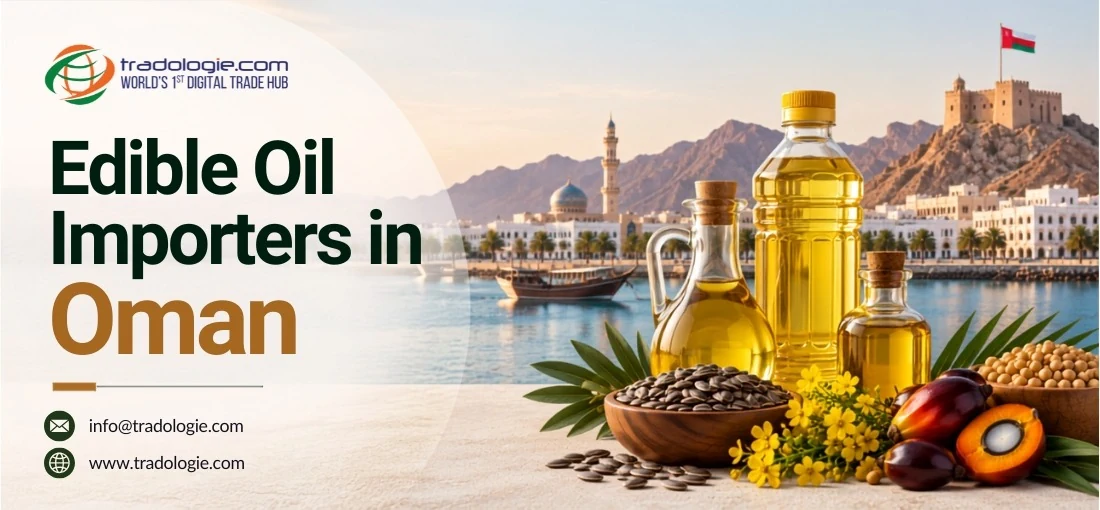
Oman has a well-established mass market for imported edible oils which is supported by household consumption, restaurants, hotels, food manufacturers and all such related HORECA industries. The country's location also gives it an important position within Gulf trade, with established supply links to India, the UAE, Saudi Arabia, Southeast Asia, Europe and other major producing regions. For exporters who are looking for bulk edible oil importers in Oman , it is important to look beyond the phrase “edible oil imports”. Oman does not import all edible oils under one HS code. Soybean, groundnut, palm, sunflower, coconut, mustard, olive and other vegetable oils are classified under different headings.

The trade data shows that this is a sizable and diversified market.
Oman imported around $258.39 million worth of non-crude palm oil and its liquid fractions under HS 151190 in 2024 according to World Bank WITS data. Indonesia accounted for the largest share in this. Under HS 1512 that covers sunflower, safflower and cottonseed oils, Oman's imports were approximately $57.52 million, while HS 1507 soybean oil imports stood at about $19.70 million.
There is also a more specialised market. Oman imported around $11.15 million under HS 1515, which covers fixed vegetable oils and fats not chemically modified, including a range of oils outside the more specific headings.
This gives exporters a useful starting point: Oman is not simply an “edible oil market”; it is a collection of different oil markets, each with its own buyers, specifications and competitive landscape.
The basic reason is straightforward: domestic production cannot meet the country's complete requirement for vegetable oils.
Edible oil is a daily-consumption product, but the demand comes from more than households. Oman imports oils for:
The scale differs considerably by oil.
Palm oil, for instance, represents a particularly large import stream. In 2024, Oman imported approximately 250 million kg of non-crude palm oil and liquid fractions , worth $258.39 million. Indonesia supplied more than $211 million of this trade, while Malaysia contributed around $32.1 million.
Sunflower oil is another important segment. Under HS 1512, Oman imported approximately 45.45 million kg worth $57.52 million in 2024 . Argentina, Romania, Ukraine, the UAE and Turkey were among the major suppliers.
Soybean oil also has a meaningful market. Oman's 2024 imports under HS 1507 were approximately 15.67 million kg worth $19.70 million , with the UAE supplying more than $12.3 million. India supplied about $734,540 worth.
The pattern tells an exporter something important.
Oman already has established international suppliers, so entering the market is not simply about finding demand. It is about offering a commercially convincing alternative.
That could mean a better price, reliable supply, a particular grade, suitable packaging, shorter delivery times or an oil specification that fits the buyer's requirements.

For anyone researching edible oil buyers in Oman , using the correct HS classification is essential. Looking only at HS 1515 would significantly understate the market.
| HS Code | Product Category | Relevance to Oman's Edible-Oil Market |
|---|---|---|
| 1507 | Soybean oil and fractions | Significant import segment; Oman imported about $19.70 million in 2024. |
| 1508 | Groundnut/peanut oil | Smaller but relevant specialty edible-oil category. |
| 1509 | Olive oil and fractions | Important premium/retail segment. |
| 1510 | Other olive oils and blends | Smaller category alongside conventional olive oil. |
| 1511 | Palm oil and fractions | One of the largest edible-oil import categories; non-crude palm oil imports under 151190 reached about $258.39 million in 2024. |
| 1512 | Sunflower, safflower and cottonseed oil | Major market, with imports of about $57.52 million in 2024. |
| 1513 | Coconut, palm-kernel and babassu oils | Relevant for food manufacturing, retail and specialty applications. |
| 1514 | Rapeseed, colza and mustard oil | Smaller but established market; Oman imported about $1.53 million of non-crude products in 2024. |
| 1515 | Other fixed vegetable oils and fractions | Useful category for specialty and other vegetable oils; imports were about $11.15 million in 2024. |
| 1516 | Hydrogenated/interesterified vegetable fats and oils | Relevant mainly to processed fats and food-manufacturing applications. |
| 1517 | Margarine and edible mixtures of fats/oils | Relevant where the buyer is purchasing prepared edible-fat products rather than a single oil. |
The figures above show why HS-code research should be done product by product . For example, Oman imported approximately $1.53 million of non-crude rapeseed, colza and mustard oil under HS 151490 in 2024, with Bangladesh and India among the leading suppliers.
Similarly, Oman imported about $11.64 million of virgin olive oil under HS 150910 , mainly from Tunisia, Spain, the UAE, Lebanon and Turkey.
In other words, there are opportunities at very different price points—from large-volume commodity oils to smaller premium categories.
There is no single public database that can reliably rank every Oman edible oil importer across all product categories. A company buying palm oil in bulk may have little relevance to an exporter selling premium bottled olive or coconut oil. Shipment-level trade data nevertheless provides a useful picture of active buyers.
But some of the top dible oil importer in Oman that generally are significant in the market are as follows:
LuLu Muscat Hypermarket LLC is relevant to exporters looking at the retail side of Oman's edible-oil market . Shipment-level trade data shows the company appearing in imports of products such as sunflower oil and coconut oil. For suppliers of packaged edible oils, private-label products or consumer-oriented formats, a buyer with a large retail distribution network can be particularly relevant.
Al Misbah Al Ahmar Foodstuff Trading is one of the active buyers appearing in Oman's sunflower-oil shipment data. Volza's recent records place the company among the leading buyers in its Oman sunflower-oil dataset. This makes it a name worth investigating for exporters specifically targeting the sunflower-oil segment rather than approaching the broader edible-oil market without a defined product.
Bin Mahfooz Abd Bajabair SFZC LLC appears across shipment records for sunflower and other edible-oil products. Its presence in multiple product-related records makes it relevant for suppliers looking beyond a single oil category. For exporters, the company can be considered when building a prospect list for sunflower oil and related edible-oil products in Oman.
Areej Vegetable Oils & Derivatives SAOC is particularly relevant because its business is directly connected with vegetable oils and their derivatives . Unlike a general food importer that may handle edible oil alongside dozens of unrelated products, Areej operates within the vegetable-oil value chain itself. That makes it a particularly useful company for exporters researching the Omani market for vegetable oils, fats and related food products.
National Distribution Company LLC is another name relevant to the distribution side of Oman's food and edible-oil trade. Customs records include the company in imports involving sunflower and vegetable-oil products. For exporters, its relevance lies in the fact that distribution-focused buyers can provide a route into multiple downstream customers rather than serving only a single end-use segment.
Al Sallan Food Industries Co. SAOC is more closely associated with food manufacturing and industrial applications than a conventional retail importer. Its customs records include vegetable fats and related products, including vegetable shortening. This makes the company more relevant to exporters supplying edible fats and oil-based ingredients for food processing, bakeries and other manufacturing applications.
Prime Trading Co. LLC appears in shipment-level records involving coconut and edible oils . This makes it a potentially relevant prospect for suppliers of coconut oil and other specialty edible oils. For exporters, the important distinction here is that coconut-oil buyers can have very different requirements from large-volume commodity-oil buyers, particularly in terms of packaging, grade and intended application.
Overseas Enterprises also appears in shipment-level records connected with coconut and edible-oil imports into Oman. The company is therefore worth considering when building a buyer list for coconut oil and related products. As with other buyers in this segment, exporters should verify the company's current purchasing requirements, preferred packaging and order volumes before approaching it with a commercial offer.
| Edible Oil Importer / Buyer | Relevant Product Area | Why It Matters |
|---|---|---|
| LuLu Muscat Hypermarket LLC | Retail edible oils, including sunflower and coconut oil | Relevant to packaged and retail-oriented supply. |
| Al Misbah Al Ahmar Foodstuff Trading | Sunflower oil | Appears among active buyers in Oman shipment data. |
| Bin Mahfooz Abd Bajabair SFZC LLC | Sunflower and other edible oils | Appears across edible-oil shipment records. |
| Areej Vegetable Oils & Derivatives SAOC | Vegetable oils and derivatives | Particularly relevant because its business is directly connected with vegetable oils. |
| National Distribution Company LLC | Vegetable and sunflower-related oils | Relevant to distribution and food-product supply chains. |
| Al Sallan Food Industries Co. SAOC | Vegetable fats and food ingredients | More relevant to industrial and food-processing applications. |
| Prime Trading Co. LLC | Coconut and edible oils | Relevant to coconut-oil and specialty-oil suppliers. |
| Overseas Enterprises | Coconut/edible oils | Appears in shipment-level buyer records. |
The important point is not simply to create a list of top edible oil buyers in Oman . The better approach is to match the buyer with the product.
For example:
That distinction can save exporters a great deal of time.
Oman has several ports for food and liquid cargo. The right choice depends on the buyer location, storage, shipping route and total landed cost.
Before selecting a port, confirm storage capacity, terminal availability, handling charges, inland transportation and final delivery location.
The cheapest port on paper is not always the cheapest delivery option.
Getting an order from an edible oil buyer in Oman is only the beginning. The shipment must meet the required commercial and regulatory standards.
Confirm the HS code, oil type, crude/refined status, specifications, packaging and intended use before quoting.
Oman's food-product registration requires the product photograph, label, nutrition facts report, invoice and packing list, laboratory report and health certificate from the country of origin. GSO 1754-1:2025 also covers edible vegetable oil requirements.
Calculate the landed cost , including freight, insurance, port charges, duties/taxes and inland transportation. Also confirm production capacity, lead time, MOQ and ability to maintain consistent specifications.
One attractive shipment is less valuable than a supplier who can deliver the same quality repeatedly.
For exporters, entering Oman is not simply a matter of finding a buyer's contact number. The more difficult part is identifying a commercially suitable buyer, understanding what that buyer actually needs and building a transaction around the right product, quantity, price and delivery terms.
This is where Tradologie can add value to the export process.
Exporters can use Tradologie to:
Want to export or import edible onion bulk globally? Register as a buyer or seller on Tradologie today.
Oman has a diversified edible-oil import market. In 2024, it imported approximately $258.39 million of non-crude palm oil, $57.52 million under HS 1512, and $19.70 million of soybean oil.
Oman's domestic production does not meet its complete requirement for vegetable oils. Imports serve households, supermarkets, restaurants, hotels, food processors, bakeries, institutional kitchens and wholesale distributors.
Major categories include palm, sunflower, soybean, olive, coconut, groundnut, mustard and other vegetable oils. These oils fall under different HS headings rather than a single edible-oil code.
Companies highlighted in shipment-level trade data include LuLu Muscat Hypermarket LLC, Al Misbah Al Ahmar Foodstuff Trading, Bin Mahfooz Abd Bajabair SFZC LLC, Areej Vegetable Oils & Derivatives SAOC, National Distribution Company LLC, Al Sallan Food Industries Co. SAOC, Prime Trading Co. LLC and Overseas Enterprises.
Relevant headings include HS 1507 for soybean oil, 1508 for groundnut oil, 1509 for olive oil, 1511 for palm oil, 1512 for sunflower/safflower/cottonseed oil, 1513 for coconut and palm-kernel oils, 1514 for rapeseed/colza/mustard oil, and 1515 for other fixed vegetable oils
Sohar, Salalah and Duqm are important ports for edible-oil and liquid-cargo movements. The appropriate port depends on the buyer's location, storage facilities, shipping route, handling charges and overall landed cost.
Depending on the product, buyers may check free fatty acid level, moisture and impurities, peroxide value, colour, iodine value, melting or cloud point, fatty-acid profile, shelf life and refining specifications.
Depending on the product and shipment, exporters may need a commercial invoice, packing list, certificate of origin, bill of lading, certificate of analysis, health certificate, product specification sheet and laboratory/test reports. Requirements should be confirmed for the specific HS code and product.
Buyers may require retail bottles, containers, jerry cans, drums, flexitanks or bulk tankers, depending on the product and intended application.
Exporters should identify buyers according to the specific oil category, quantity and application rather than approaching the entire market with a generic offer. Tradologie can help exporters connect with trade participants looking for specific commodities and quantities and negotiate based on actual requirements.