Export-import wide range of agri commodities like rice, wheat, sugar, pulses, spices etc.

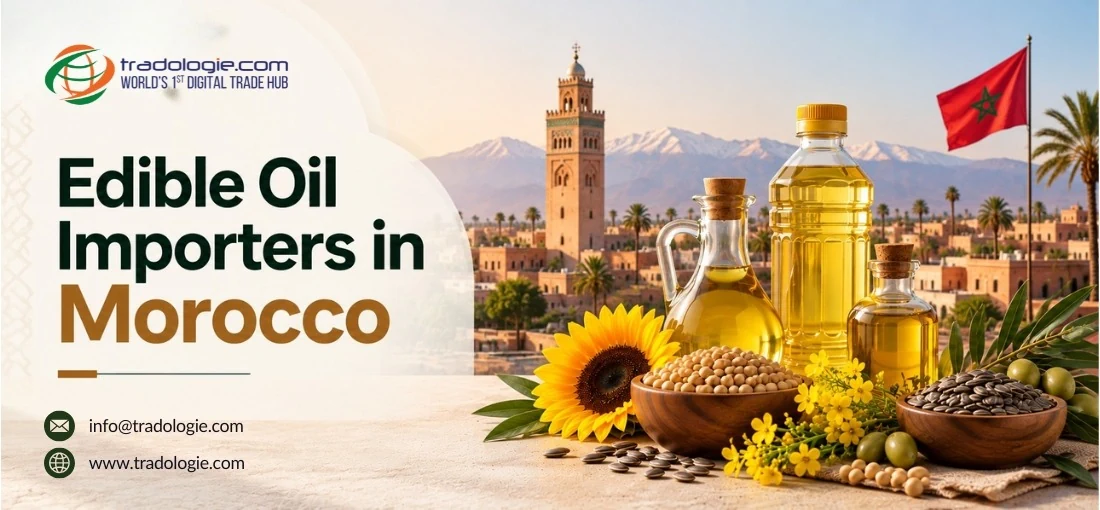
Morocco is heavily dependent on imported vegetable oils. Local oilseed production covers only a small part of the country's requirements, leaving processors and refiners dependent on imported crude oils and other edible-oil products through its wide network of edible oil buyers in Morocco . Recent industry reporting puts the country's import dependence at around 98%.
Soybean oil is particularly important. In 2024, according to WITS, Morocco imported approximately $553.55 million worth of soybean oil under HS 1507, equal to more than 558 million kg. Sunflower, safflower and cottonseed oils under HS 1512 added another $104.24 million, while palm oil under HS 1511 was worth about $62.39 million.
So, if you are looking for edible oil importers in Morocco , there is a substantial market to work with. But the market is not built around one oil or one type of buyer. Soybean oil has a very large industrial base, sunflower oil has an established consumer market, while palm and specialty oils serve other parts of the food industry.

Soybean oil is by far the largest of the major vegetable-oil categories in Morocco's 2024 import data, according to WITS.
| HS Code | Product | Morocco Imports, 2024 |
|---|---|---|
| 1507 | Soybean oil and fractions | $553.55 million |
| 1512 | Sunflower, safflower & cottonseed oils | $104.24 million |
| 1511 | Palm oil and fractions | $62.39 million |
| 1517 | Margarine and edible mixtures | $51.94 million |
| 1515 | Other fixed vegetable oils | $3.37 million |
Morocco's soybean-oil imports came mainly from Spain, Egypt, Argentina, Portugal and France. Sunflower and safflower oil came primarily from Ukraine, Bulgaria, Spain, Russia and Romania, according to WITS.
Palm oil is another sizable industrial category. Morocco imported about $54.55 million of crude palm oil alone in 2024, mainly from Côte d'Ivoire, Liberia, Malaysia and Indonesia, according to WITS.
Morocco has an oilseed sector, but domestic production is nowhere near enough to supply the country's edible-oil industry.
A recent study of Morocco's oilseed sector found that locally produced oilseeds covered only around 2% of national vegetable-oil needs. The country therefore relies heavily on imported crude oils and imported raw materials for refining and processing.
The industry itself reflects this dependence. Lesieur Cristal, one of Morocco's leading edible-oil companies, says soybean oil is imported, while olive, rapeseed and sunflower oils can be produced from local sources or imported depending on availability.
Price is another part of the equation. Moroccan edible-oil companies buy according to international commodity prices, availability and the specifications required by their customers. Lesieur Cristal itself notes that its oil prices follow national and international market conditions.

Anyone researching top edible oil importers in Morocco should begin with the product's HS code. Looking only at "vegetable oil" can miss a large part of the market.
| HS Code | Product Category | Relevance |
|---|---|---|
| 1507 | Soybean oil | Morocco's largest major vegetable-oil import category |
| 1508 | Groundnut/peanut oil | Smaller specialty segment |
| 1509 | Olive oil | Important domestic and premium oil segment |
| 1510 | Other olive oils | Additional olive-oil category |
| 1511 | Palm oil | Important industrial raw material |
| 1512 | Sunflower, safflower & cottonseed oil | Large import category, especially sunflower |
| 1513 | Coconut, palm-kernel & babassu oils | Smaller specialty segment |
| 1514 | Rapeseed, colza & mustard oil | Relevant seed-oil category |
| 1515 | Other fixed vegetable oils | Specialty oils and fats |
| 1516 | Hydrogenated/interesterified fats and oils | Food manufacturing |
| 1517 | Margarine and edible mixtures | Processed edible-fat products |
The numbers show why classification matters. Morocco imported more than 558 million kg of soybean oil in 2024, while its imports under HS 1512 were about 97.25 million kg , according to WITS.
The Moroccan market includes large refiners, food manufacturers, traders and companies buying specific oils. Recent shipment data for sunflower and vegetable oils identifies several buyers worth researching. Below are some of the top edible oil importers in Morocco.
LGMC Mutandis: Appears among the leading sunflower-oil buyers in recent shipment data, accounting for 25% of the shipments in Volza's latest sunflower-oils buyer dataset. Mutandis is a major Moroccan industrial group, with its LGMC business focused on seafood rather than edible oils, so the exact product and shipment should be checked before approaching the company.
Janah Freres Conserve: Recorded four refined sunflower-oil import shipments in the available trade records. The records show imports of refined sunflower oil in December 2023, making the company a relevant name for suppliers researching Moroccan sunflower-oil buyers.
ADM International: Also appears in Moroccan sunflower and crude sunflower-oil shipment data. The available records show three sunflower-oil shipments, while crude sunflower-oil data gives the company a 20% share of the recorded shipments in that dataset.
Sona Oils Pte: Appears in the same crude sunflower-oil buyer records, with two shipments. It is another name worth checking when researching bulk sunflower-oil trade into Morocco.
Les Huileries du Souss Belhassan (HSB): One of Morocco's established edible-oil businesses. HSB operates vegetable-oil brands including Lousra and Lio and sunflower-oil brand Zohor. It is therefore relevant to suppliers looking at the country's oil-processing and packaged-oil market.
Lesieur Cristal: Another major name to know. The company operates across oilseed crushing, refining and edible oils and works with industrial customers as well as the retail market. Its B2B business supplies refined oils according to customer specifications.
| Buyer/Company | Relevant Oil Segment | What to Check |
|---|---|---|
| LGMC Mutandis | Sunflower oil records | Exact product requirement |
| Janah Freres Conserve | Refined sunflower oil | Bulk quantity and packaging |
| ADM International | Sunflower/crude sunflower oil | Current sourcing requirement |
| Sona Oils Pte | Crude sunflower oil | Product and shipment specification |
| HSB | Vegetable & sunflower oil | Industrial/retail requirements |
| Lesieur Cristal | Soy, sunflower, rapeseed & other oils | B2B oil requirements |
The companies above are useful names for buyer research, but an exporter should still verify the current product requirement, quantity and buying cycle before sending a commercial offer.
For bulk edible oil, the port is closely tied to the buyer's refinery, storage tank or warehouse.
Port of Casablanca is one of the most obvious gateways for suppliers targeting the country's largest commercial and industrial centre. Casablanca is also home to major edible-oil companies and has established food and industrial logistics infrastructure.
Jorf Lasfar is another important port to consider, particularly for bulk cargoes and industrial commodities. ONSSA lists Jorf Lasfar among Morocco's border inspection posts for imported food products.
Agadir is relevant for buyers and processors in southern Morocco. ONSSA also operates quality-control structures in Agadir and lists the city among its import-control locations.
Tangier Med can also be considered when the buyer's inland destination and shipping route make northern Morocco more economical.
Before fixing the port, an exporter should check:
A slightly cheaper ocean freight quotation does not necessarily mean a cheaper shipment once the cargo reaches Morocco.
Morocco has its own food-safety and import-control requirements. ONSSA, the country's food-safety authority, oversees imported food products and checks compliance with Moroccan food-safety legislation.
A few things need to be sorted out before shipment:
1. Confirm the HS classification.
The exact classification depends on the oil, whether it is crude or refined and whether it has been blended or otherwise modified.
2. Check ONSSA requirements.
Imported food products subject to sanitary controls must comply with applicable regulations and be accompanied by the required official health documentation.
3. Agree the specification with the buyer.
Parameters may include free fatty acids, moisture, impurities, peroxide value, iodine value, acidity, shelf life and other product-specific requirements.
4. Keep testing documents ready.
A certificate of analysis and relevant laboratory reports should match the agreed specification.
5. Get the packaging right.
Depending on the product and buyer, edible oil can move in drums, IBCs, flexitanks, tank containers or bulk tankers.
6. Keep the import documents in order.
ONSSA's import-control procedure refers to documents including the commercial invoice, packing list, transport document and applicable health certificates.
7. Calculate the landed cost before quoting.
FOB price + freight + insurance + applicable duties/taxes + port charges + customs clearance + inland freight + storage or handling.
8. Be ready for repeat supply.
Moroccan processors and distributors buying in bulk need reliable volumes and consistent specifications.
Finding edible oil buyers in Morocco is one part of the process. Finding a buyer that needs the particular oil you supply, in the quantity you can offer and at the specification you can maintain is another.
Exporters can use Tradologie to:
Morocco is a market where imported edible oils already form a large part of the supply chain. Soybean oil stands out by volume, while sunflower and palm oil also have established import markets. For Indian suppliers, the starting point is therefore not to offer every oil available, but to identify the product and buyer segment where the commercial fit is strongest.
Want to export or import edible oil to Morocco and other global markets in bulk? Register as a buyer or seller on tradologie.com today.

Export-import wide range of agri commodities like rice, wheat, sugar, pulses, spices etc.
Export-import wide range of agri commodities like rice, wheat, sugar, pulses, spices etc.

Get bulk construction materials like cement, AAC blocks, TMT bars to your construction site.

Procure steel-based items & raw materials like steel billets, ingots, bars and more.

Buy critical industrial consumables and hardware like bearings, V-belts and fasteners.
Morocco's edible-oil market is heavily dependent on imports. In 2024, the country imported approximately $553.55 million of soybean oil, $104.24 million of sunflower/safflower/cottonseed oils and $62.39 million of palm oil.
Soybean oil is the largest major vegetable-oil import category, with imports exceeding 558 million kg in 2024.
Domestic oilseed production covers only a small portion of Morocco's vegetable-oil requirements. The country's processors and refiners therefore rely heavily on imported crude oils and raw materials.
Important categories include HS 1507 for soybean oil, 1511 for palm oil, 1512 for sunflower/safflower/cottonseed oils, 1514 for rapeseed/colza/mustard oil and 1517 for margarine and edible mixtures.
The blog highlights LGMC Mutandis, Janah Freres Conserve, ADM International, Sona Oils Pte, Les Huileries du Souss Belhassan (HSB) and Lesieur Cristal as companies worth researching.
Important ports include Casablanca, Jorf Lasfar, Agadir and Tangier Med. The right port depends on the buyer's refinery, warehouse, storage facilities, inland transportation and total landed cost.
Morocco's food-safety authority, ONSSA, oversees imported food products and applicable sanitary requirements. Exporters should confirm the required health documentation and compliance requirements before shipment.
Depending on the product, specifications can include free fatty acids, moisture, impurities, peroxide value, iodine value, acidity and shelf life.
Depending on the product and buyer, oils can be shipped in drums, IBCs, flexitanks, tank containers or bulk tankers.
Exporters should match their specific oil, quantity, specifications and commercial terms with the right buyer segment. Tradologie can help suppliers connect with buyers seeking particular varieties and quantities and negotiate around product and delivery requirements.