
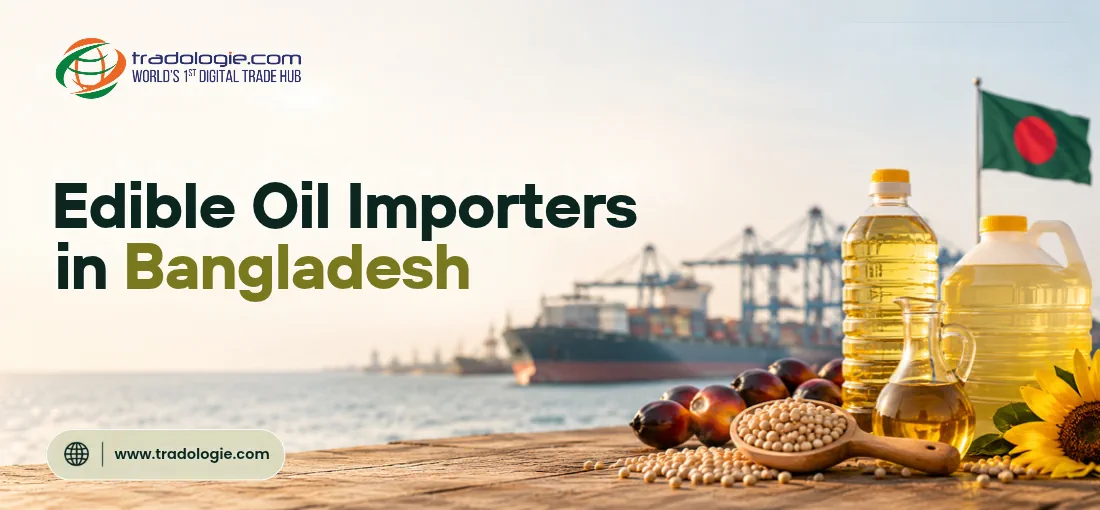
Bangladesh buys a lot of edible oil. But if you are looking at the market from the supply side, the more interesting part is what happens before that oil reaches a household. Large quantities arrive as crude or semi-processed material through a network of edible oil importers in Bangladesh. They go into refineries, storage tanks and food-manufacturing operations, and only later become the packaged cooking oil sold across the country.
The import figures give a fairly good picture of the scale. In 2024, Indonesia shipped more than 1.02 billion kg of non-crude palm oil to Bangladesh, worth about US$954.94 million. Malaysia followed with another 398.15 million kg. On the soybean side, Argentina alone supplied about 441.23 million kg of crude soybean oil, with Brazil and Paraguay some distance behind.
So there isn't one single edible-oil supply chain in Bangladesh. Palm oil has one set of suppliers. Soybean oil has another. And sitting between the imported raw material and the final consumer are some very large Bangladeshi food companies.
Bangladesh grows oilseeds, especially mustard. That domestic production, however, is nowhere near enough to satisfy the country's overall requirement for edible oil.
Palm oil is the easiest part to understand. Bangladesh has no comparable domestic palm-oil industry, so the material has to come in from abroad. Indonesia and Malaysia naturally dominate this trade.
The soybean story has another layer to it.
Crude soybean oil can be brought into Bangladesh and refined locally. Soybeans themselves are also imported for crushing, producing oil as well as soybean meal for the feed industry. This is why edible oil is tied into a much wider food and agricultural supply chain in the country.
The 2024 trade figures are quite revealing here. Argentina's crude soybean oil shipments to Bangladesh were worth around US$419.49 million, followed by Brazil at about US132.39million and Paraguay at US73.71 million.
Compare that with palm oil, where Indonesia and Malaysia are the names that immediately stand out.
For someone sitting outside Bangladesh and trying to sell into the country, these origins are not just numbers in a trade database. They tell you where Bangladeshi refiners have already built their procurement relationships.

The names become more interesting once you look beyond the word “importer”.
Some of Bangladesh's biggest edible-oil businesses are parts of much larger food groups. City Group, Meghna Group, T.K. Group, Bangladesh Edible Oil Ltd. and Bashundhara are all important names in this space.
| Buyer / Company | Main Oil Business | What Makes the Company Relevant |
|---|---|---|
| City Group | Soybean oil, palm olein, sunflower, mustard and other oils | Large food and manufacturing group with refining and established consumer brands |
| Meghna Group of Industries | Soybean, vegetable, sunflower and mustard oils | Imports crude oil and operates its own refining and food businesses |
| T.K. Group | Soybean oil, palmolein and mustard oil | Diversified commodity and manufacturing group; PUSTI is its major consumer brand |
| Bangladesh Edible Oil Ltd. | Soybean and palm-based consumer oils | Producer of Rupchanda, Fortune, King's, Meizan, Veola and Lucky |
| Bashundhara Group | Fortified soybean oil and palm olein | Large food business with an expanding edible-oil operation |
Walk through the edible-oil shelves in Bangladesh and TEER is one of the names you will come across when it comes to top edible oil importers in Bangladesh. The business behind that brand is much larger than the consumer product suggests.
City Group has been refining soybean oil for decades. Its current oil portfolio includes soybean, sunflower, canola and mustard oils, along with palm-based products. It also sells products in bulk formats, so the company sits at several points of the supply chain rather than only at the retail end.
For a supplier, that makes the company interesting for a simple reason: the requirement can be for raw material as well as for a finished product, depending on the business and the procurement cycle.
Meghna is another name that comes up quickly.
The group's edible-oil portfolio includes Fresh Soybean Oil, Fresh Vegetable Oil, Prime Fresh Mustard Oil and Sinola Sunflower Oil. More importantly for bulk suppliers, the company says it imports crude oil from international sources and refines it in Bangladesh.
That gives crude-oil suppliers a much more obvious point of entry than a company that is only distributing packaged cooking oil.
T.K. Group has been involved in Bangladesh's commodity business for decades and has interests well beyond edible oil. Its PUSTI brand is the consumer-facing name most closely associated with its edible-oil business.
The group operates edible-oil refineries that are decently big and sells products that include fortified soybean oil and mustard oil. Its wider business interests include commodities, manufacturing and food products.

Bangladesh Edible Oil Ltd. has been around since 1993. The names Rupchanda, Fortune, King's, Meizan, Veola and Lucky all sit under its portfolio.
This is a useful company to know when researching the packaged-oil side of Bangladesh's market. Rupchanda, in particular, has a long-established presence in the country's cooking-oil business.
Bashundhara's food division has its own place in the market, with Fortified Soybean Oil and Maharaja Super Fine Fortified Palm Olein among its products.
The group is also moving further into the upstream side of the business, including plans around soybean processing. That makes it worth watching if your business supplies raw material rather than only finished edible oil.
These are not the only buyers in Bangladesh. They are, however, among the larger names around which much of the country's edible-oil procurement and consumer market is organised.
Soybean and palm oil account for most of the large-volume business, although the product list is broader.
Crude soybean oil is particularly important for local refiners. Palm oil and palm olein form another enormous and part of the market that witness and consistent demand. Sunflower oil, mustard oil, rice bran oil and other vegetable oils are also a part of the market, but occupy smaller segments. While at the same time the hydrogenated and modified vegetable fats are used in food manufacturing.
The distinction between crude and refined material is something which is worth keeping in mind when approaching a buyer. A refinery may be interested in thousands of tonnes of crude soybean oil, while another company may have no use for it and instead want ready-to-sell refined oil.
| HS Code | Product |
|---|---|
| 150710 | Crude soybean oil |
| 150790 | Soybean oil other than crude and its fractions |
| 151110 | Crude palm oil |
| 151190 | Palm oil other than crude and its fractions |
| 151211 | Crude sunflower or safflower oil |
| 151219 | Sunflower or safflower oil other than crude |
| 151590 | Other fixed vegetable oils and fats |
| 151620 | Hydrogenated or otherwise modified vegetable fats and oils |
The final eight-digit classification should be checked against the actual product before shipment. Refining, fractionation and other processing can change the applicable classification.
There is one name you will repeatedly see when tracing Bangladesh's import logistics: Chattogram Port
The port handles more than 90% of Bangladesh's international trade volume and around 98% of its container traffic, according to the World Bank.
Edible oil is only a small part of everything moving through Chattogram. But for importers dealing in bulk oil, the port is important because this is where the overseas cargo enters the country's wider distribution and processing network.
The refinery or storage facility receiving that cargo may be somewhere inland. So the port of discharge and the buyer's actual delivery point are two different things that should not be mixed together while negotiating a shipment.
Mongla Port is the other major seaport, although its share of Bangladesh's overall international trade is much smaller than Chattogram's.
Edible oil is a food product, so Bangladesh's import process does not stop with customs paperwork.
The importer may need documents including the Bill of Entry, commercial invoice, bill of lading, packing list, certificate of origin and other supporting papers. Food products can also be subject to testing during clearance.
Then there is the country's requirement around Vitamin A fortification.
BSTI's oils and fats laboratory lists fortified soybean oil, fortified palm oil, fortified palm olein, sunflower oil and several other products for testing. Parameters include acid value, peroxide value, iodine value, Vitamin A and other quality characteristics.
Bangladesh Customs also specifically refers to Vitamin A fortification testing for applicable edible vegetable oils, along with a fit-for-human-consumption certificate where required. Import registration has its own requirements as well. The Bangladesh Food Safety Authority's current system asks for details such as the importer's
For an overseas supplier, these things are best settled with the buyer before the cargo is booked. It is considerably easier to correct a documentation question before loading than after the oil has reached the port.
The first question will probably be the price. It will not be the last one.
For crude soybean oil or crude palm oil, a serious buyer will want the specification, origin, quantity, loading port, shipment schedule and delivery terms. Quality parameters will be checked against the buyer's own requirements, particularly where the oil is going into a refinery.
Palm olein is another example. Saying that you supply palm oil is not enough. The buyer will want to know exactly which product and grade you are offering.
Large Bangladeshi buyers also need regularity. A refinery that is planning production around imported crude oil cannot keep changing its specifications from one shipment to the next.
This is where an exporter with a consistent product and dependable shipment schedule has an advantage over someone simply offering the lowest number on a quotation sheet.
India is next door, has a large edible-oil industry and would seem, at first glance, like an obvious supplier to Bangladesh.
The 2024 numbers tell a more complicated story.
India supplied only 29,625 kg of non-crude palm oil to Bangladesh, worth about US$71,700. Indonesia's shipments in the same category were above one billion kg.
That gap is substantial.
It does not mean Indian suppliers have no place in Bangladesh. Shorter transit distances can be useful, and products such as mustard oil, specialty oils and certain refined products may have a different commercial equation from bulk palm oil.
But if the conversation is about very large volumes of palm oil or crude soybean oil, the existing relationships with Indonesia, Malaysia, Argentina, Brazil and Paraguay are hard to overlook.
The useful question is not simply “Who imports edible oil in Bangladesh?”
It is more specific: who buys the particular oil you have, in the quantity you can supply, and for what purpose?
A refinery looking for crude soybean oil and a distributor looking for finished retail packs are both edible-oil buyers, but there is very little similarity between their procurement requirements.
That is why product specification, quantity and intended use should come before the buyer search.
Tradologie can facilitate B2B discussions between edible-oil buyers and suppliers around product specifications, quantities, pricing, packaging and delivery requirements.
It is the leading Ai powered trade solution that can connect you with the best edible oil importers in Bangladesh and help you negotiate prices live in real time.
This content is for general informational purposes and is based on the trade, company and regulatory information provided in the source material. Import volumes are historical and do not necessarily represent current purchasing requirements. Buyers and exporters should independently verify current demand, specifications, applicable food-safety requirements, documentation and commercial terms before shipment.
Indonesia supplied more than 1.02 billion kg of non-crude palm oil to Bangladesh in 2024, worth around US$954.94 million. Malaysia supplied another 398.15 million kg. Edible Oil Importers in Banglad…
Argentina supplied around 441.23 million kg of crude soybean oil in 2024, followed by Brazil and Paraguay. Edible Oil Importers in Banglad…
The source highlights City Group, Meghna Group of Industries, T.K. Group, Bangladesh Edible Oil Ltd. and Bashundhara Group among the major companies in the market. Edible Oil Importers in Banglad…
The major categories include crude soybean oil, palm oil and palm olein, along with sunflower oil, mustard oil, rice bran oil and other vegetable oils and fats. Edible Oil Importers in Banglad…
Chattogram Port is the country's main international trade gateway and is particularly important for imported bulk oil entering Bangladesh's processing and distribution network. Mongla is another major seaport. Edible Oil Importers in Banglad…
Importers may need customs and commercial documents, food-safety documentation and applicable testing. Vitamin A fortification is particularly important, with BSTI testing covering parameters such as acid value, peroxide value, iodine value and Vitamin A.