Key Highlights
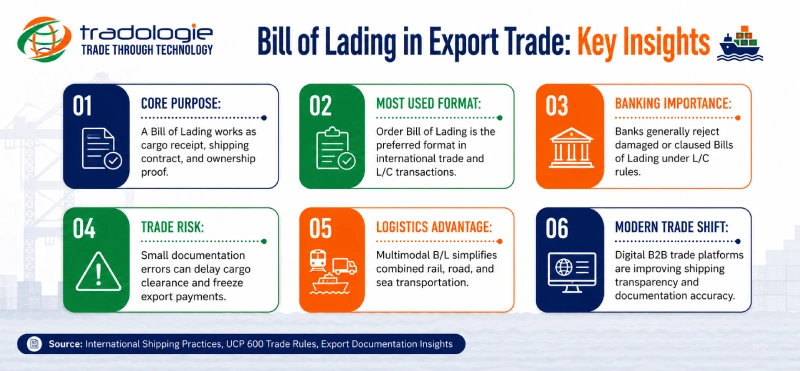
- Bill of Lading acts as cargo receipt, transport contract, and ownership document.
- Order Bill of Lading is widely preferred for Letter of Credit transactions.
- Clean Bills of Lading are critical for banking and payment approval.
- Documentation errors can cause cargo delays and financial losses.
- Multimodal B/L supports combined rail, road, and ocean cargo movement.
- Master B/L is generally preferred over House B/L in global trade.
- Telex Release speeds up cargo release without physical paperwork.
- Accurate shipping documentation is critical in agro commodity exports.
Introduction:
Picture this: your containers are completely packed, customs has finally greenlit the documentation, and the vessel clears port. Then, three weeks later, a notification lands from destination customs. The entire shipment has been rejected over a minor visual or chemical deviation. In international agriculture trade, a scenario like this is the absolute ultimate disaster.
Avoidance of this specific disaster is exactly why pre-shipment inspection export setups exist. Think of this process as your final, non-negotiable insurance policy executed before the goods ever meet the container ship's rail.
Managing a thorough pre-shipment quality check is far more than a simple compliance box to cross off for local authorities. It is your primary commercial safeguard. When cargo crosses borders, a single sub-standard lot can result in ruinous financial penalties, abandonment surcharges, and a completely destroyed corporate reputation. This detailed manual breaks down the operational steps, mandatory certificates, and real-world execution of pre-shipment inspections (PSI) from a practical trade perspective.
What is Pre-Shipment Inspection (PSI)?
You have to look past the casual concept of a basic warehouse quality check to understand the actual function of a pre-shipment inspection. It is a highly formalized, legal procedure. Essentially, a PSI requires a detailed physical examination of a batch of goods, conducted right at the tail end of production before they get packed into containers.

An independent, certified third party must carry out this verification. The inspector’s primary objective is simple: confirm that the cargo exactly matches the metrics laid down in your commercial invoice, purchase order, and—critically—the terms of your Letter of Credit (L/C). This is very important in agriculture trade as they are most prone to quality issues and contaminations. They calculate total volume, evaluate packaging durability, check manufacturing consistency, and verify that the shipment aligns perfectly with the destination country’s legal and safety codes.
The Core Importance of a PSI Certificate in India
Forgetting or failing to secure a valid export inspection certificate India draft is the single fastest way to completely freeze your revenue chain. In modern global trade, this document performs three vital functions.
1. The Regulatory Gatekeeper
Many developing economies—specifically across parts of Africa, Latin America, and the Middle East—make pre-shipment inspections a legal prerequisite for entry. Governments use this to combat fraud, prevent tax evasion through undervaluation, and stop sub-standard products from hitting their local markets. Lacking an approved certificate means destination customs will simply turn your containers away at the border.
2. Disarming Letter of Credit (L/C) Traps
When a transaction is backed by a Letter of Credit, the issuing bank analyzes your presented paperwork with absolute precision. If the credit terms demand an independent, clean quality report, and you fail to present that exact document, the bank will spot a discrepancy immediately. Your funds will be locked down, and your cash flow will stall.
3. Protection Against Post-Delivery Claims
Once a container crosses the ocean and lands in a foreign port, handling an argument over broken items or off-spec dimensions becomes incredibly messy and expensive. Having an independent agency verify that your lot was pristine, correctly boxed, and perfectly counted at your factory gate completely shields you. It stops a buyer from making false quality claims down the line just to force a discount after delivery.
Who Conducts the Inspection? Independent and Third-Party Systems
Exporters cannot simply self-certify their shipments and expect global customs agents or international banks to take their word for it. The check must be entirely neutral.
Third-Party Inspection Export India
Exporters routinely hire independent, globally recognized testing bodies to handle their cargo verifications. Choosing a third party inspection export India agency gives you access to specialized engineers and food scientists who understand local port requirements. These agencies use strict, randomized sampling methods—usually following international standards like ISO 2859-1—to ensure that checking a small percentage of your boxes gives an accurate picture of the entire multi-ton shipment.

SGS Inspection Export India
Among the major names in the logistics sector, SGS inspection export India services operate as a primary industry benchmark. Using a global giant like SGS or Bureau Veritas gives foreign buyers immediate peace of mind because their lab reports and security stamps are recognized by almost every customs authority on Earth. Their inspectors will physically enter your stuffing yard or container, in case of inspection at port, verify reefer temperatures for perishables, check barcode positions, and even film the entire container loading process just to ensure no tampering happens after they leave.
Critical Checkpoints During a Pre-Shipment Quality Check
An inspector does not just wander into your facility and glance at a few pallets. They follow a highly structured check routine that tests five critical areas of your cargo.
1. Quantity Verification
The inspector will perform an exact physical count of the master cartons, bags, or bulk crates. They match this count directly against your packing list. If your invoice states 2,000 cartons of basmati rice but the physical stack only yields 1,998, the inspection fails immediately until the discrepancy is resolved.
2. Workmanship and Visual Defects
The inspector opens a specific number of boxes by using standard randomized sampling charts. This is done to check for manufacturing flaws, surface damage, incorrect coloring, cosmetic issues, or any signs of moisture. They will actively look for insect infestation or torn inner linings that could compromise food safety during transit in case of agro exports.
3. Functional and Field Testing
If you are moving processed foods or consumer goods, the inspector will run practical on-site tests. This can typically include drop tests for master cartons to see if the packaging holds up under rough port handling. They can even weigh individual packs on calibrated digital scales to ensure that it complies with the net weight laws.
4. Packaging, Labeling, and Barcoding
An incredibly common reason for cargos getting rejected at international borders is faulty labeling. The inspector’s duty is to carefully check that the country of origin is clearly printed, the batch numbers match production records, the shipping marks are clearly visible, and the barcodes are scanning perfectly. They also verify that mandatory ingredient descriptions and allergen warnings comply with local consumer protection laws for items going to markets like Europe or the US.
5. Container Stuffing Supervision
The job isn't finished once the quality is approved. The inspector will frequently stay on-site to watch the actual loading of the container. They ensure the boxes are stacked correctly to prevent crushing, check that the container floor is completely dry and free of odors, and record the exact serial number of the heavy-duty bullet seal applied to the container doors.
Step-by-Step Process to Secure your PSI Certificate
Navigating the PSI certificate India application loop requires a disciplined, proactive timeline. Waiting until the last minute will cause you to miss your shipping vessel's cutoff time.
| Phase of Operation | Action Checklist for Exporters | Operational Risks & Impact |
|---|---|---|
| 1. Request Booking | Submit invoices, packing lists, specifications, and L/C rules to the agency at least 5–7 days before loading. | Missing the vessel's cut-off window due to delayed submission flags. |
| 2. Randomized Sampling | The inspector arrives at your yard; selects sample packages using strict, international AQL tables. | The entire multi-ton batch gets rejected if sample flaws exceed mathematical limits. |
| 3. Evaluation & Testing | Execution of dimension counts, visual flaw tallies, package stress tests, and chemical residue collection. | Essential step for food products to verify absence of illegal pesticide traces. |
| 4. Finding Verification | Review of the agency's provisional report draft within 24 hours to address immediate compliance errors. | Gives a short window to fix sorting or packing glitches before final log entry. |
| 5. Document Release | Issuance of the secure, barcoded Clean Report of Findings (CRF) for bank and customs presentation. | Your core key to unlocking international customs entry and securing Letter of Credit funds. |
B2B Operational Challenges: Managing Real-World Risks
Running a smooth inspection pipeline requires a deep understanding of the practical friction points that occur at the factory gate.
Navigating the AQL Trap
Many new exporters fail their inspections because they do not understand the math behind standard AQL tables. If your contract specifies an AQL limit of 2.5 for minor defects, and the inspector finds one single broken seal beyond that mathematical threshold, the entire multi-million rupee lot gets rejected. Exporters must run their own internal quality checks before the third-party inspector ever sets foot in the facility.
Supply Chain Digital Integration
Managing the logistics of physical certificates across multiple international offices can frequently slow down your payment cycles. To eliminate this friction, many advanced trade operators and bulk agricultural suppliers lean on integrated B2B networks like Tradologie.com. Utilizing these digital channels helps streamline your end-to-end procurement and quality verification steps, matching your real-time shipping parameters directly with vetted global buyers while reducing the standard delays and manual errors that occur during traditional paper handling.
Summary Verdict for Global Traders
In the fast-moving arena of international commerce, your pre-shipment inspection export protocol functions as your strongest operational safeguard. Treating it like an administrative afterthought is a critical business mistake that can leave you facing expensive payment disputes, port fees, or total cargo rejections at foreign borders.
Whether you are coordinating shipments of premium textiles, technical equipment, or sensitive agricultural commodities, true security always comes down to process precision. Always align your internal quality thresholds with your buyer's exact regulatory environment, choose globally recognized testing partners like SGS or reputable third-party agencies, and secure your final verification certificates before handing your cargo over to the international maritime supply chain.
Disclaimer
The inspection procedures, compliance requirements, and certification guidelines mentioned are for informational purposes only and may vary depending on destination country regulations, buyer agreements, shipping terms, and inspection agency standards. Exporters should verify all requirements directly with inspection agencies, customs authorities, and buyers before shipment.





-export-from-india.webp "Corn (Maize) Export from India: Capitalizing on India's Non-GMO Edge, Pricing, HS Codes, and Key Destination Markets")