.webp "Understanding FDA Prior Notice")
Key Highlights
- USDA APHIS and FDA regulate different aspects of agricultural imports into the US.
- APHIS focuses on pest, disease, and invasive species risks.
- FDA focuses on food safety, contamination, and consumer health risks.
- A clearance from one agency does not guarantee approval from the other.
- Phytosanitary Certificates and FDA Prior Notice filings are often mandatory.
- Compliance requirements vary depending on whether products are raw, dried, or processed.
Introduction:
If you try to drop a container of whole vanilla beans, fresh ginger, or raw spice lots into a US port without mapping out the exact legal boundaries of the federal agencies involved, your shipment is going to hit a wall. When you plan to import agricultural products to USA processing pipelines, it is easy to assume the government acts as a single gatekeeper. In reality, you are dealing with a dual-agency setup.
Getting your cargo through requires knowing the distinct mandates of USDA APHIS vs FDA. Both of these bodies screen incoming agricultural imports USA runs, but they look for completely different risks. One stops environmental threats from destroying American crops, while the other steps in to make sure the item won't make a human consumer sick. Let's break down where the legal lines are drawn so your container doesn't end up locked in a terminal storage yard.

The Operational Divide: Biosecurity vs. Consumer Safety
The core confusion for trade desks stems from the overlapping definitions of what constitutes an "agricultural product." The easiest way to keep your paperwork sorted is to apply this rule: USDA APHIS regulations police the raw environmental and ecological risk of the commodity, while the FDA checks the biological and chemical safety of the product as a consumable.
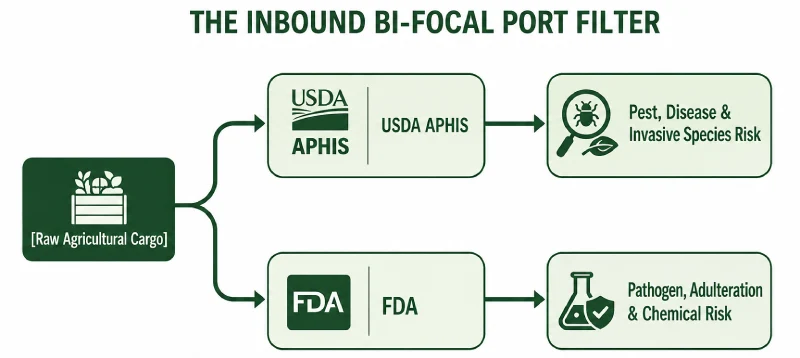
The sections highlighted in image_acbc6e.png show exactly where automated text checkers flag text that follows too neat of an academic pattern. To state it plainly for a logistics desk: a clean bill of health from one agency means absolutely nothing to the other.
1. USDA APHIS: The Ecological Shield
The Animal and Plant Health Inspection Service (APHIS) handles biosecurity. Their sole focus under current USDA APHIS regulations is preventing foreign bugs, invasive weeds, and crop diseases from slipping into the domestic farming ecosystem.
As highlighted in the text analysis inside image_acbc4e.png, the agency's inspection priorities are purely environmental:
- What They Hunt For: APHIS officers don't care if your spice bags have minor aesthetic tears or labeling typos. They are checking the container for live beetles, inspecting the wooden pallets for boring larvae, and looking for foreign soil caked onto the roots.
- The Baseline Paperwork: Meeting USDA APHIS import requirements means securing a valid electronic Import Permit through the eFile portal alongside an original Phytosanitary Certificate issued by the exporting nation's agricultural department before the vessel leaves the dock.
2. The FDA: The Consumer Shield
Once APHIS satisfies its pest screening protocols, your shipment must immediately pass FDA food import requirements. The FDA’s job under the Food Safety Modernization Act (FSMA) is to police human health risks.
- What They Hunt For: They look for microscopic contamination. This means active Salmonella testing, checking for unapproved chemical residues, or flagging filth like rodent hair introduced during origin milling.
- The Baseline Paperwork: To satisfy FDA import regulations, your custom broker must submit a flawless Prior Notice through the automated ACE/ITDS data exchange before the vessel anchors, backed by a valid, biennially renewed Food Facility Registration (FFR) number for the foreign processing floor.
Sourcing Realities: How Processing Alters Jurisdiction
The physical state of your crop determines which agency holds the balance of power at the border. The basic breakdown matches the logistics matrix highlighted in image_acbc2d.png: as a commodity undergoes more industrial processing, the regulatory burden shifts away from APHIS and lands heavily on the FDA.
Sourcing Pipeline: Raw vs. Processed
- Raw, Fresh Produce: If you are bringing in unpeeled ginger or fresh mangoes, expect maximum APHIS scrutiny. These lots face strict pest risk analyses, mandatory port-of-entry fumigations, or specialized cold-treatment protocols. The FDA acts as a secondary filter checking for pesticide residues.
- Dried, Whole Spices: Raw black peppercorns or dried turmeric roots sit right in the middle. APHIS checks for storage beetles and dirt contamination, while the FDA enforces strict pathogen reduction steps (like validated steam sterilization).
- Milled Powders: Once a spice is ground into a consumer-ready retail powder, the high-heat milling process usually eliminates the risk of live plant pests. Because the ecological risk drops, APHIS often waives the need for plant health permits. The weight shifts entirely to the FDA, which demands character-matching labels, strict allergen declarations, and verifiable Foreign Supplier Verification Program (FSVP) records.

Step-by-Step Port Strategy: Clearing Both Hurdles
To successfully navigate agricultural imports USA runs without accruing massive terminal demurrage fees, your customs broker has to file a synchronized multi-agency entry profile.
First, do not rely blindly on an exporter’s word that their facility registries are active. Have your document control team manually verify the foreign factory's code in the FDA FURLS database. At the same time, double-check that the exact botanical name of your crop matches the allowance lines on your active USDA permits.
Second, understand your automated filing windows. While hitting the minimum advance notification timelines is mandatory under FDA import regulations, entering your data early gives the automated risk models time to clear your cargo. If your broker submits a unified electronic entry through the ACE system and there is a single character mismatch between the USDA phytosanitary certificate and the FDA prior notice manifest—like an abbreviation error in the shipper's name—the system will trigger an automated flag and pull the box for a manual document hold.
Third, align your origin processing steps to clear both hurdles simultaneously. For example, if you are moving organic items to meet USDA APHIS import requirements, standard chemical fumigations required to kill regional pests might completely invalidate your NOP organic status. In those scenarios, your supply chain has to utilize validated heat or steam treatments at the origin facility that satisfy the FDA's pathogen rules while preserving the ecological standards required by the USDA.
Summary
Successfully importing agricultural products to USA markets comes down to recognizing that a clearance from one agency does not grant an automatic pass from the other. The structural division between USDA APHIS vs FDA exists to handle separate vulnerabilities in the supply chain. By treating plant biosecurity and consumer food safety as two distinct, non-negotiable compliance workflows, you keep your logistics moving seamlessly and insulate your transaction capital from unexpected port holds.
Disclaimer
The information provided is for educational and informational purposes only. USDA APHIS regulations, FDA requirements, import permit rules, phytosanitary standards, and food safety regulations may change over time. Importers should verify all compliance obligations with USDA APHIS, FDA, customs brokers, and relevant regulatory authorities before importing agricultural products into the United States.




-export-from-india-process--markets-2026.webp "India's Chickpea (Kabuli Chana) Exports: 2026 Market Guide")