Key Highlights
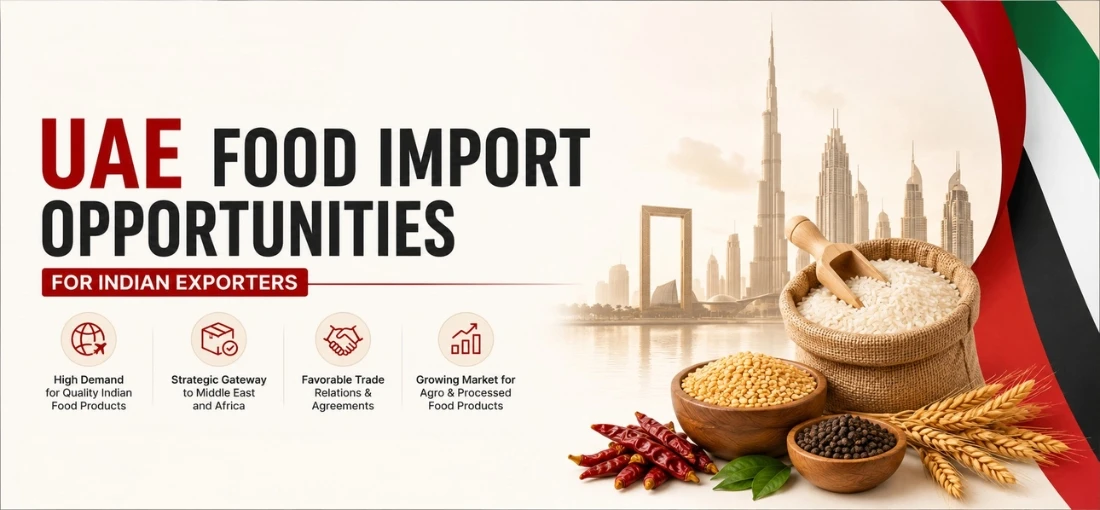
- The UAE imports 80–90% of its food requirements, creating strong opportunities for Indian exporters.
- India exported agricultural products worth USD 3.54 billion to the UAE, making it one of India's largest food export destinations.
- Basmati rice, spices, buffalo meat, cereals, and oil meals dominate export demand.
- UAE buyers are increasingly shifting towards premium, traceable, and certified food products.
- Compliance, packaging quality, and supply consistency are becoming key differentiators for exporters.
- Direct relationships with distributors and retail chains often deliver better margins than broker-led trade.
The Gulf cooperation region has quietly re-engineered how global grocery networks operate. At the absolute center of this change sits the United Arab Emirates. Long gone are the days when Dubai functioned merely as a regional trading post; today, the country stands as an aggressive, high-velocity distribution engine and an elite culinary ecosystem.

For the modern network of Indian food exporters looking to export Basmati and non-basmati rice, spices (like cardamom, turmeric, and saffron), buffalo meat, cereals, oil meals, cashews, dairy products, and fresh seasonal fruits to this country is no longer just a convenient near-market outlet. It has grown into a highly sophisticated, high-margin consumption block that acts as a clearinghouse for food products distributed across North Africa, the Levant, and Central Asia. Succeeding in this landscape requires trading houses to step away from old-school, speculative broker deals and dive straight into the hard, structural data governing the UAE food industry.
So keep reading this informative piece of blog if you are looking for food exports to UAE . This writeup will provide you vital information on the same.
Market Sourcing Architecture and Sector Valuation
The underlying macroeconomics of the Emirates present an incredibly lucrative canvas. According to comprehensive market data compiled by Grand View Research, the UAE food industry size reached a staggering valuation of USD 40.22 Billion, with food acting as the single largest revenue-generating product category. Backed by a booming hospitality sector, an affluent expat demographic, and a rapidly expanding tech-driven cloud kitchen network, the market is primed for sustained value acceleration.
Because the country relies heavily on international supply chains for over 80% to 90% of its domestic food requirements, agricultural trade desks maintain a massive natural edge. Recent annual trade ledgers from the Agricultural and Processed Food Products Export Development Authority (APEDA) paint a vivid picture of where this bilateral capital is concentrated.
India’s total agricultural export footprint to the UAE reached a substantial milestone, settling at a valuation of USD 3.54 Billion (approximately INR 30,057 Crore) while clearing a massive volumetric load of over 3.01 Million Metric Tons. This positioning firmly establishes the UAE as India’s second-largest agricultural destination port globally, capturing a 6.67% share of our entire outbound farming value registry.
High-Value Core Commodities and Segment Breakdown
When you peel back the top-line numbers and look at the itemized export sheets from APEDA, you see that the shipping lines are anchored by a few critical commodity categories. If your desk is trying to map out a clear path for how to export food products to UAE channels safely, these core divisions define the wholesale demand:

Major Indian Agricultural Products Exported to the UAE
| Commodity Classification | Volumetric Export Weight (Metric Tons) | Total Financial Valuation (USD Millions) | Market Share Layer within Country Intake | Primary Commercial Destination |
|---|---|---|---|---|
| Basmati Rice | 364,550 | USD 364.55 | 10.27% | Premium retail supermarket placement and high-end hospitality chains. |
| Spices | 335,070 | USD 335.07 | 9.44% | Industrial blending houses, spice grinding mills, and commercial re-exporters. |
| Buffalo Meat | 312,040 | USD 312.04 | 8.79% | Wholesale food service distributors, quick-service restaurants, and institutional catering. |
| Other Cereals | 241,040 | USD 241.04 | 6.79% | Processing hubs for bakery products and industrial snack manufacturing lines. |
| Oil Meals | 187,700 | USD 187.70 | 5.29% | Large-scale feed supply networks and agricultural compound processing units. |
Shifting Buyer Trends: Transitioning to the Premium Space
If you talk to any high-volume procurement manager operating out of the Jebel Ali Free Zone, they will tell you that competing strictly on the lowest price per metric ton is a fast race to the bottom. The modern retail landscape in Abu Dhabi and Dubai has integrated deeply with premium international quality standards. Food importers in UAE networks now pass down strict operational requirements that Indian exporters must fulfill to avoid customs delays.
The single most significant transition is the massive retail pull toward traceable, certified health and wellness categories. The old method of shipping generic bulk bags is being rapidly replaced by automated sorting lines that produce uniform, clean-label outputs.
Furthermore, Emirates customs gates have significantly tightened their microbiological screenings. Shipments of ground spices, grains, and frozen meat must clear rigorous pre-shipment laboratory assays to verify exact chemical residue tolerances and moisture caps. Ensuring your cargo matches these strict biosecurity expectations is the absolute baseline for protecting your commercial contracts from sudden port rejections.
Operational Fixes to Maximize Export Profitability
To convert these high-volume UAE food import opportunities in UAE corridors into sustainable company profits, your trading desk needs to professionalize its logistics and ditch outdated legacy habits.
First, secure your container timelines by cutting out speculative brokers. Build direct commercial partnerships with established supermarket category managers or major industrial distributors. Presenting them with a direct, comprehensive onboarding package—including verified factory videos, automated cleaning metrics, and pre-cleared pesticide reports—makes you a highly transparent and predictable supply chain partner.
Second, eliminate terminal penalty hazards by locking in long-term service agreements with your shipping lines. Never accept standard three-day gate allotments at busy hubs like Mundra or JNPT. Insist on a minimum 14-day factory-to-dock free-time window. This gives you a critical cushion against unexpected local transport strikes or custom audit hold-ups, ensuring your margins don't get devoured by sudden port demurrage or container detention fees.
Third, optimize your packaging mechanics. Get packaging engineers to look at your master cartons to eliminate dead air pockets entirely, ensuring every cubic inch of your 20-foot or 40-foot box is directly generating revenue. Line your pallets in heavy-duty shrink wrap and place clay desiccants along the container walls. This simple step shields your basmati cargo, spices, or convenience foods from tropical container sweat and stops transit damage claims before they can dent your cash flow.
Conclusion
Building a thriving trade desk inside the food exports to UAE corridor doesn't require a logistical miracle; it requires a strict commitment to operational discipline. By protecting your margins side-to-side through tight freight agreements, maximizing your container space, and ensuring your quality certifications are completely airtight, you stop the minor capital leaks that ruin underprepared traders. Moving into this high-volume Gulf network with an integrated, risk-shielded strategy is the most effective way to turn an ambitious trade operation into a highly predictable, maximum-profit international business.
Want to export food commodities to the UAE in bulk? Connect with ready-to-purchase buyers on Tradologie today.


-in-agro-trade-how-it-works-types--tips.webp "Letter of Credit (LC) in Agro Trade: How It Works, Types & Tips")