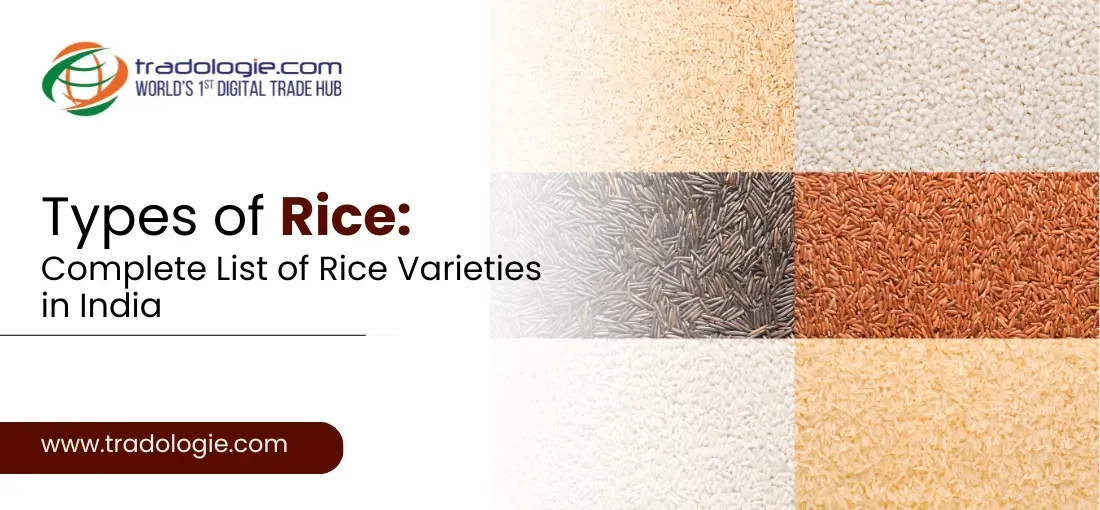
There is no doubt that rice is among the most staple grains when it comes to the global dietary habits. While the non-basmati varieties of rice form a very important part of food security in the African countries, basmati rice varieties of India are an essential export commodity that are exported to the premium markets in Gulf countries and European countries.
If we go by the credible source Grandview Research data, the global rice market size was estimated at $1.0531.8 million in 2025. This market is projected to grow massively to $391,819.2 million by the year 2033. This makes it grow massively at a CAGR of 3% from 2026 to 2033.
Keep reading this informative piece of blog. It will provide you with the best information on top rice varieties in India.

How Many Types of Rice Are There?: Rice Categories (Rice Classification)
There are roughly over 40,000 varieties of rice that are grown across different countries. India being a top country as both the largest cultivator and supplier of rice globally, alone has a massive more than 6,000 different varieties of rice. But how are these varieties categorised and differentiated from one another? Well, they are categorised on the basis of their diverse appearances, unique tastes, distinct aroma, and predictable cooking properties that are peculiar to that variety of rice.
Rice varieties are commonly classified based on several characteristics:
- Grain Size: Based on the grain size, rice grains are simply categorised into three major categories, which are short grain rice, medium grain rice and long grain rice. The long grain rice generally remains fluffy after cooking. While the short-grain varieties are known to generally remain more softer and sticker after cooking. However, this is just a broad rule with many exceptions as well.
- Aroma: Some varieties of rice are naturally aromatic. Such rice releases a distinct and premium aroma when they are cooked. And the Indian Basmati rice varieties are a classic example of this. They are particularly known for having a unique aroma that enhances the commercial value of the dishes. At the same time, the non-basmati varieties of Indian rice have a slightly milder and neutral fragrance.
- Processing Method: It isn't just about nature. Interestingly, the rice can also be classified according to how it is processed once it is harvested. The common examples of rice that are processed after they are being harvested include raw rice, parboiled rice, brown rice and many other processed varieties of rice. In fact, the processing method can, to a large extent, affect the color of rice, its overall texture, and sometimes even the nutritional profile. Food processors and chefs also consider the cooking time it takes after the processing.
- Cooking Texture: Rice can either be fluffy or separate. It can be soft or tender, or it can even be extremely sticky. All this basically depends on the variety of the rice and the texture it produces after cooking. This is the reason that some varieties of rice are suitable for biryani while others might be suitable just for usual everyday meals.
10 Types of Rice in India (Popular Rice Varieties)
Below is the list of ten types of rice in India that are commonly available. Each variety has its own unique characteristics and cooking purpose.
Basmati Rice: This is India's hallmark rice when it comes to the best varieties of rice. It has long grains, non-sticky texture, and holds a high command in the premium dishes that are cooked in the Gulf countries.
Sona Masoori: This variety of Indian rice is considered to be lightweight, with medium grain length and aromatic with white color which has considerably low starch content. This rice is ideal for everyday staples across South India and different countries.
Gobindobhog (West Bengal): It's a short-grain rice which is considered to have a sweet, buttery aroma. It is often used in dishes that require a that is slightly towards sweet and buttery.
Ponni Rice (Tamil Nadu): This medium-grain rice is cultivated along the Kaveri delta which is situated in Kerala. It is most commonly available under the parboiled category of rice. It has a soft and fluffy texture that is ideal for everyday meals and some casual dishes that don't need exact long grains and perfection.
Matta Rice / Palakkadan Matta (Kerala): This rice is a type of bold red grain that retains its outer bran layer which is nutrient rich. It is known for its earthy flavor and firm bite and is widely consumed with seafood.
Seeraga Samba (Tamil Nadu): it is a tiny grain that is ovular shaped and resembles cumin seeds quite closely. It absorbs marinades and fats quite easily and serves as the traditional base for Dindigul and Ambur biryanis.
Kalanamak (Eastern Uttar Pradesh): It is an ancient scented heritage variety of rice that features a black husk and white grain. It is also known as Buddha Rice and carries high iron and zinc levels with a distinctive floral aroma.
Chak-Hao / Black Rice (Manipur): It is a glutinous rice that has a dark purple-to-black grain color which is rich in anthocyanin antioxidants. It is popularly cooked into sweet porridges and festive puddings.
Ambemohar (Maharashtra): it is a short-grain rice with an intense aroma that resembles ripe mango blossoms.

Rice Varieties in India for Export: Most Commonly Exported Rice From India
India is the world's largest rice exporter, supplying both premium aromatic grains and high-volume commercial varieties across the Middle East, Africa, the Americas, and Europe.
The Premium Basmati Stars
- 1121 Basmati: The global heavyweight. This is the extra-long rice you see in high-end restaurant biryanis across the Middle East, the US, and Europe. It expands dramatically after cooking without clumping together.
- 1509 Basmati: The budget-friendly sibling to 1121. It looks and tastes almost as long and slender, but it grows faster for farmers, making it a great value option for everyday international supermarket shelves.
- 1718 Basmati: A tougher, improved version of 1121. It gives the exact same long grain and fluffy texture, but the crop resists bad weather and disease much better.
- Traditional / Dehraduni Basmati: The classic heritage grain. While its grains aren't quite as long as 1121, it carries the richest natural aroma and authentic sweet flavor, making it a favorite for fine dining in Western markets.
Everyday Non-Basmati Workhorses
- IR-64 (White & Parboiled): The true engine of India's rice exports by volume. It is an affordable, durable staple grain shipped in huge bulk orders across Africa and Southeast Asia.
- PR-11 & PR-14 (Parmal): Long-grain non-basmati rice that looks clean and cooks well. It's popular for catering, food courts, and budget biryanis abroad where buyers want good length without paying Basmati prices.
- Sona Masoori: It is light, easy on the stomach, and has low starch. It's massively popular with the Indian diaspora that lives in US, the UK, the Gulf countries, and Australia for everyday dal and different types of curries.
- Sugandha & Sharbati (Basmati Look-alikes): These are long-grain non-basmati rice varieties that are known for relatively slender grains and aromatic characteristics that are mild. Sugandha generally offers longer grains and a more noticeable aroma. But Sharbati is slightly shorter with an aroma that is towards a milder side. Both are positioned as alternatives that are more affordable.
Why India Has So Many Rice Varieties
India has diverse climatic conditions that make it suitable for the cultivation of a diverse variety of rice. Also, every corner of India basically throws different farming challenges at you. Go down south to Kerala’s coast, and the soil is full of seawater—so locals came up with Pokkali, a grain that literally doesn't care about salt. Head up to Assam where monsoon floods wipe out everything, and farmers figured out floating rice with crazy long stems that stretch above the water level. Then go up north, and the cold Himalayan air naturally pulls out that floral smell in Basmati. No single seed could ever survive across the whole country.
On top of that, nobody in India treats rice as an all-purpose ingredient.
You'd never use long Basmati for a Bengali sweet; you need tiny, sticky Gobindobhog because it already smells like ghee. You wouldn't make a south Indian biryani with regular table rice either—you grab Seeraga Samba because it drinks up the meat fat. Throw in unpolished red grains for farm workers who needed heavy meals to last all day, plus old medicinal strains like Navara, and you get thousands of seeds passed down family lines for centuries.
Final Thoughts:
Rice in India is never just food on a plate—it's woven into everyday life, regional pride, and a massive global trade. Instead of relying on a single crop, the country ended up with thousands of unique grains, from royal Basmati shipped worldwide to tiny heirloom varieties tucked away in village kitchens. It all grew out of sheer necessity: surviving wild, unpredictable weather and honoring centuries of stubborn, regional cooking where one grain could never fit all.