Key Highlights
- Pusa Basmati covers several varieties, including 1121, 1509 and 1718.
- Pusa 1121 is known for exceptional grain elongation after cooking.
- Pusa 1509 has a shorter crop cycle and lower water requirement.
- Pusa 1718 combines the 1121 grain profile with bacterial-blight resistance.
- Newer Pusa varieties add disease resistance and herbicide tolerance.
- Pusa rice is available in Raw, Steam, White Sella and Golden Sella forms.
- India exported 6.52 million tonnes of Basmati rice in 2025-26.
- Buyers should compare specifications rather than price alone.
Introduction:
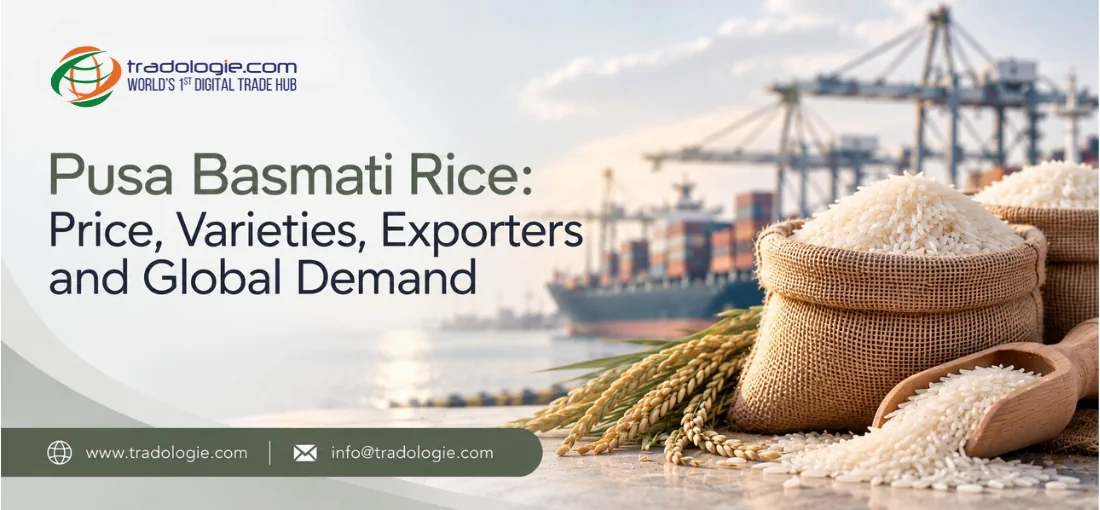
Pusa Basmati is one of the names that has shaped India's modern Basmati trade. Yet it is easy to make the mistake of treating Pusa as though it were a single variety. It isn't. Pusa Basmati 1121 became famous for its extraordinary elongation after cooking. This made a huge demand in the global market and lucrative opportunities for Pusa Basmati rice exporters.
Pusa 1509 took the crop in another direction, maturing earlier and requiring less water. Pusa 1718 brought bacterial-blight resistance into the 1121 background. And newer lines such as 1847, 1885, 1886, 1979 and 1985 are gradually adding disease resistance and other agronomic traits to the picture.
For someone standing in a rice mill, these distinctions are not academic.
They affect procurement, milling, segregation, pricing and eventually what an exporter can offer an overseas buyer.
The Pusa Basmati Rice Price also moves accordingly. A 1121 Sella shipment, a 1509 raw shipment and a residue-compliant Pusa specification are not really the same commercial product, even though all three may appear under the broad Basmati umbrella.

Where Pusa Basmati Came From
The Pusa Name and Its Agricultural Roots
Interestingly, the Pusa name comes from the famous Indian Agricultural Research Institute in New Delhi. In fact, their breeding programme has played a major role in developing Indian Basmati varieties that are significantly improved and premium.
In fact, the Basmati itself has a much older history. APEDA describes it as an aromatic, long-grain rice which is associated with a defined geographical area that covers parts of Punjab, Haryana, Himachal Pradesh, Uttarakhand, Delhi, western Uttar Pradesh and Jammu & Kashmir.
What the Breeding Programme Changed
Its familiar characteristics include slender grains, strong aroma, soft texture and substantial elongation during cooking. The breeding work at IARI added another layer to that traditional rice.
The objective was never simply to make the grain longer. Yield, crop duration, disease resistance, water use and field performance all matter when a variety has to work for farmers as well as exporters.
That is how the Pusa family became so diverse.
Pusa Basmati Rice Varieties
Pusa Basmati 1
Pusa Basmati 1 belongs to the earlier generation of improved Basmati varieties developed through the IARI programme.
Its grain is long and aromatic, although it does not have the spectacular cooked length associated with 1121. Its importance today is partly historical as well: it sits among the varieties that helped establish the modern breeding pathway for India's export-oriented Basmati rice. ICAR lists Pusa Basmati 1 among the export-quality Basmati varieties developed after India's independence.
Pusa Basmati 1121
Then there is 1121.This is the variety that changed the commercial conversation around long-grain Basmati. The raw grain is already quite long, but its real distinction appears in the cooking process. The grain stretches dramatically while retaining its slender form, making it particularly attractive for biryani, pulao and large-scale foodservice.
ICAR describes Pusa Basmati 1121 as one of India's major foreign-exchange-earning Basmati varieties.
Its popularity also created a very recognisable premium segment within the export market. When buyers talk about exceptionally long Basmati, 1121 is often one of the first varieties that comes into the discussion.
Pusa Basmati 1509
1509 is an interesting contrast.
It reaches maturity in about 115 days, roughly 30 days earlier than Pusa Basmati 1121. ICAR says the shorter duration can save three to four irrigations and around 33% water, while giving farmers more time to prepare the field for the following wheat crop.
That matters enormously in northern India's rice-wheat belt.
The variety does not have to compete with 1121 on exactly the same terms. Its attraction comes partly from the production side. Less time in the field, lower irrigation demand and an established Basmati market give farmers a different economic equation.
ICAR's 2026 farmer-training programme at Karnal still describes Pusa Basmati 1509 as a short-duration variety with high market value and strong export demand.
Pusa Basmati 1718
Pusa Basmati 1718 takes 1121 as its starting point but it addresses a very different problem.
What makes this variety particularly interesting is that it was developed as a bacterial-blight-resistant version of Pusa Basmati 1121. ICAR puts its average grain yield at 46.4 quintals per hectare, while the crop takes roughly 135 days to mature. And when it comes to the grain itself, it retains the long, slender character Basmati is known for, with an average length of around 8.10 mm.
For exporters, the significance is fairly straightforward. The variety retains the familiar 1121-type grain profile while bringing disease resistance into cultivation.
That sort of improvement may not be visible on a retail packet. It can nevertheless influence the economics of the crop long before the rice reaches an overseas warehouse.
Newer Pusa Basmati Lines Are Changing the Supply Side
Disease Resistance and New Agronomic Traits
The Pusa story is still moving.
Pusa Basmati 1847, 1885 and 1886 were developed with resistance to major diseases such as bacterial blight and blast. Pusa Basmati 1979 and 1985 take another route, bringing herbicide tolerance into popular Basmati backgrounds to support direct-seeded rice cultivation.
For the export business, this could become increasingly relevant over time.
How Changes in the Field Reach Export Markets
A rice exporter ultimately depends on what farmers grow. If a newer variety gives farmers better disease protection, uses water more efficiently or fits more comfortably into the rice-wheat cycle, its acreage can expand. Once that happens, millers have more of that grain to procure and exporters have another variety to work with.
The change starts in the field.
The export market feels it later.

Raw, Steam and Sella: The Variety Is Only Half the Story
Processing Can Change the Commercial Product
A Pusa Basmati shipment is not defined by variety alone.
The same rice can be sold as raw, steam, white Sella or golden Sella, and the processing route changes the way the grain behaves.
A restaurant supplier serving large volumes of biryani may have very different requirements from a supermarket brand selling household packs. One buyer may prefer the cooking behaviour of Sella; another may want raw or steam rice because aroma and texture are more important to its customers.
What Buyers Actually Compare
This is why commercial specifications usually go well beyond the variety name.
Grain length, broken percentage, moisture, processing method, ageing, polish and packaging all enter the conversation.
Shri Lal Mahal is one example. Its Pusa range includes raw, steam, Sella and golden Sella products, with specifications provided for individual products rather than treating Pusa Basmati as one generic grade.
Pusa Basmati Rice Price Depends on the Specification
Why There Is No Single Market Price
There is no single Pusa Basmati Rice Price.
And there probably should not be.
A quotation changes with variety, crop year, grain length, broken percentage, processing, moisture, residue requirements, packaging, order volume and destination.
Export Quotations Can Vary by Market
Consider a published export quotation from Shri Lal Mahal. Its table lists PUSA pesticide-residue-free raw rice with an average grain length of 7.45 mm at US$890 per tonne FOB Mundra under its EU-norm quotation and US$975 per tonne under its USA-norm quotation for the specified crop. These are supplier quotations for particular specifications, not a universal market price.
That distinction is worth keeping in mind when comparing offers.
Two exporters can quote different numbers for what appears to be the same Pusa rice. One may be supplying a different crop. Another may be working to stricter residue limits. One may be offering raw rice while another is quoting Sella.
The specification usually explains the difference.
Major Pusa Basmati Rice Exporters
The Pusa trade sits inside India's much larger Basmati export industry, so most major exporters handle several varieties rather than building their entire business around Pusa alone.
KRBL
KRBL is no small player in India's Basmati rice trade. Over the years, the company has carved out a formidable position by keeping almost every link in the chain firmly in its own hands — from procurement and milling to ageing, packaging and taking the finished grain to markets overseas. Its portfolio runs across some of India’s best-known varieties, including Pusa 1121, Pusa 1509 and Pusa Basmati 1. But that is only part of the story. With an operation built to cover the journey from farm gate to foreign market, KRBL has its finger on the pulse of the Basmati business. Today, its rice reaches more than 90 countries, giving the company a truly global footprint.
That integrated structure matters in Pusa trade because the commercial value of the rice is shaped at several stages, not simply when the grain is purchased from the farmer.
Shri Lal Mahal
Shri Lal Mahal has a particularly visible Pusa portfolio, including raw, steam, Sella and golden Sella. The company says it supplies more than 44 countries and has processing capacity of around 3,000 MT per day. Its published specifications are also useful for buyers comparing grain length, broken percentage, moisture and processing format.
Chaman Lal Setia Exports
Chaman Lal Setia Exports is another established name in India's Basmati industry, with Pusa Basmati and parboiled Pusa products forming part of its export portfolio.
GRM Overseas
GRM Overseas operates across Basmati and non-Basmati rice and supplies international markets through its export and consumer businesses. Pusa Basmati is among the varieties offered within its broader portfolio.
Major Pusa Basmati Exporters and Suppliers
| Company | Pusa Basmati Relevance | International Presence |
|---|---|---|
| KRBL | Pusa 1121, 1509, Pusa Basmati 1 and other varieties | 90+ countries |
| Shri Lal Mahal | Pusa Raw, Steam, Sella and Golden Sella | Europe, North America, Middle East and other markets |
| Chaman Lal Setia Exports | Pusa Basmati and parboiled Pusa | International Basmati markets |
| GRM Overseas | Pusa within its wider Basmati portfolio | International retail and distribution markets |
These are established businesses involved in the wider Pusa and Basmati trade, rather than a definitive ranking of India's exporters.
Pusa Basmati Rice Export and Global Demand
India's Basmati Export Scale
India's Basmati business is large enough to give Pusa varieties considerable room to move.
In 2025-26, India exported 6.52 million tonnes of Basmati rice worth US$5.67 billion, according to APEDA. Saudi Arabia accounted for 16.6% of exports, followed by Iran at 13.9%, Iraq at 11.2%, the UAE at 8.2%, Yemen at 5.7% and the United States at 5.0%.
Those figures are for Basmati rice as a whole. They should not be presented as Pusa-specific export numbers because India does not publish an equivalent official breakdown for every individual Pusa variety.
Still, the destinations tell us something about the commercial environment in which Pusa rice is being sold.
Middle Eastern Buyers
The Gulf and wider Middle East remain central to India's Basmati business.
Well, if you're in the trade industry, you already know that Saudi Arabia, Iran, Iraq, the UAE, and Yemen are the biggest markets for Indian Basmati rice. If we start naming them, there are probably countless cuisines, meals, and dishes that are intrinsically part of the Middle Eastern countries' dietary habits and the core ingredient is basmati rice. The restaurants, kitchens, and Horika chains simply need them regularly for their cooking.
For a commercial buyer, consistency becomes important very quickly. A restaurant chain cannot easily change the cooking behaviour of its rice from one shipment to the next without affecting the dish it serves.
The US Market
The United States presents a different kind of opportunity.
Basmati moves through ethnic-food distributors, restaurants, specialty retailers, supermarket chains and private-label businesses. That creates several price and positioning points rather than one uniform market.
For one buyer, 1121's exceptional elongation may justify the premium. Another may find 1509 more commercially comfortable.
That is one reason Pusa Basmati remains useful to exporters: there is room within the family for different kinds of demand.
What Do Pusa Basmati Rice Buyers Look For?
Beyond the Headline Price
A Pusa Basmati Rice Buyer will normally ask considerably more than “What is your price?”
The conversation tends to move towards grain length, broken percentage, moisture, chalkiness, aroma, milling quality, processing format and crop year.
Destination-Specific Requirements
Then come the destination-specific requirements.
Pesticide-residue limits can be particularly important for certain export markets. Packaging changes depending on whether the buyer is supplying restaurants, wholesale distributors or retail shelves. Ageing can also influence the cooking and sensory characteristics of Basmati.
KRBL says it ages Basmati for one to two years to develop taste and aroma. (krblrice.com)
So a serious purchase specification might eventually read something like Pusa 1121, Sella, particular grain length, defined broken percentage, moisture range, crop year, residue requirements and packaging format.
Once the specification is written that way, comparing suppliers becomes much easier.
Why Pusa Basmati Still Has Room to Grow
Different Varieties, Different Commercial Roles
Pusa Basmati has become commercially important because the varieties do not all solve the same problem.
1121 offers extraordinary elongation. 1509 brings a shorter crop cycle and lower irrigation requirement. 1718 adds disease resistance. The newer varieties are bringing further improvements into the production system.
That variety gives the trade some flexibility.
From Farmers to Exporters to Importers
Farmers can select varieties according to production conditions. Millers can procure and segregate different grains. Exporters can develop different specifications. Importers can choose a product that makes sense for their own market rather than paying for characteristics they do not necessarily need.
The result is a Basmati category that is becoming more differentiated at both ends of the supply chain.
Pusa Basmati Is More Than a Name on the Bag
From Breeding Programme to Global Trade
Pusa Basmati started as a breeding story. It has become a trade story.
The varieties now carry different combinations of grain length, aroma, crop duration, disease resistance, water requirement and processing characteristics. Those differences may begin with agricultural research, but they eventually show up in procurement contracts and export quotations.
What This Means for Exporters and Buyers
For Pusa Basmati Rice Exporters, the challenge is to match the right variety and specification with the right market.
For Pusa Basmati Rice Buyers , it is to look beyond the name and understand exactly what is being offered.
That is where the real distinction lies. Not every Pusa Basmati shipment is meant to compete at the same price, serve the same kitchen or reach the same customer.
Conclusion
Pusa Basmati has become an important part of India's Basmati trade because its varieties offer different combinations of grain quality, farm economics and export appeal. 1121 built its reputation on exceptional elongation, 1509 brought a shorter crop cycle, while newer lines are adding disease resistance and other agronomic traits. For buyers and exporters, understanding those differences is increasingly important as international rice trade becomes more specific about variety, processing and quality.
Disclaimer
This content is for general informational purposes and is based on the trade, variety, supplier and pricing information provided in the source material. Pusa-specific export figures are not separately published by APEDA, and supplier quotations are specification-specific rather than universal market prices. Buyers should independently verify current prices, product specifications, supplier credentials, documentation and destination-market requirements before placing an order.




.webp "Types of Rice in India’s Export Market: Complete Guide for Global Buyers")