Key Highlights
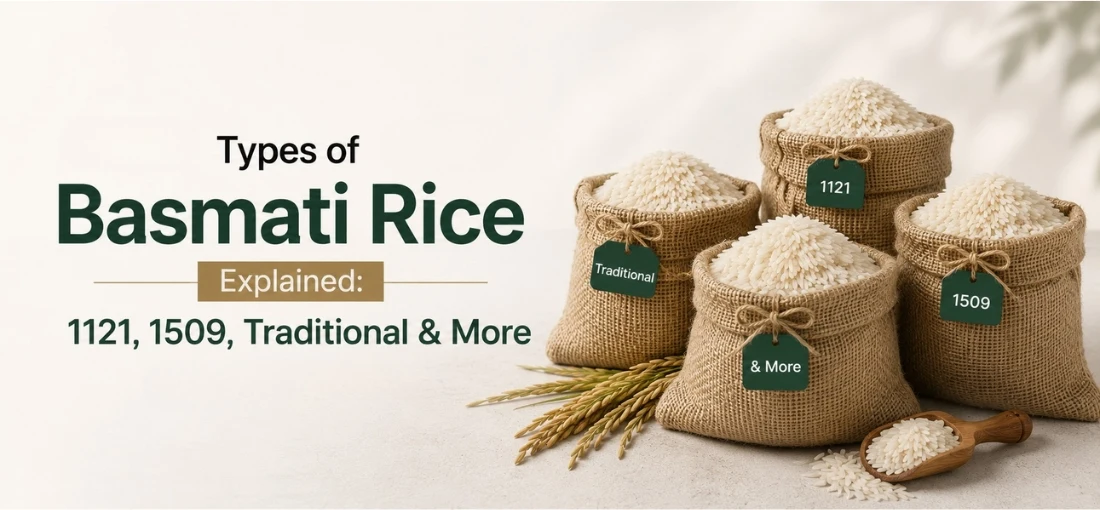
- 1121, 1509, Traditional, 1401, and 1718 are the major Basmati varieties.
- 1121 is known for its extra-long grain and excellent elongation.
- 1509 offers a budget-friendly alternative with similar appearance.
- Traditional Basmati is prized for its rich aroma and flavor.
- Raw, Steam, White Sella, and Golden Sella differ in processing and cooking performance.
- Clear specifications help buyers avoid quality disputes.
Introduction:
When you hear the word Basmati, what usually comes to mind? For most of us, it's that rich aroma filling the kitchen when a fresh pot of biryani or pilaf is being cooked. That long, slender grain that doesn't stick together, looking almost like a work of art on the plate.
But if you dive into the trade or even just look closely at the bags sitting in a wholesale market, you realize Basmati isn't just one single type of rice. It's an entire family.
If you write "Basmati rice" on an export order without specifying the exact grain type or milling method, you're setting yourself up for a pretty expensive mistake. Sourcing 1509 when your buyers expect Traditional Basmati, or shipping Raw when they asked for Golden Sella Basmati, can easily ruin your margins before the ship even lands.
So, how do these varieties actually differ? Keep reading this informative piece of blog as it will provide you with vital information on the types of basmati rice.

The Main Export Varieties: Types of Basmati Rice.
India grows plenty of local aromatic rice, doesn't it? But when it comes to international trade, a few specific names take up almost all the market share.
1121 Basmati Rice
So, what makes 1121 Basmati rice such a big deal in the export market? Honestly, it's all about the length. Indian scientists bred this variety specifically to push raw grain length as far as it could go.
- Raw grain length: Around 8.35 mm to 8.40 mm on average.
- Cooked length: It can stretch up to 20 mm or even more!
When you boil 1121 basmati rice, it elongates without curling up or turning into a sticky mess. That stretch gives cooked dishes massive volume on the plate. It's the main reason why biryani spots, commercial caterers, and big hotels across Saudi Arabia, the UAE, and North America buy it non-stop.
1509 Basmati Rice
Now, what about 1509 Basmati Rice? Farmers started planting 1509 as a faster-growing option compared to 1121. It matures earlier in the season, which means it uses less water and spends fewer days in the field.
Lower farming costs naturally lead to a cheaper price per ton. To the naked eye, raw 1509 looks almost identical to 1121—averaging around 8.30 mm to 8.40 mm. But the real difference shows up when you cook it. It has a slightly milder scent and can break a bit easier if a chef leaves it on high heat for too long. But if your buyers want that extra-long look on a budget, 1509 is a fantastic choice.
Traditional Basmati Rice
Long before modern lab hybrids took over the trade, Traditional Basmati rice grown near the Himalayan foothills was the gold standard.
- Raw grain length: Around 7.30 mm to 7.50 mm.
- The standout feature: An intense, natural fragrance that modern cross-breeds just can't duplicate.
Sure, it runs shorter than 1121. But what it lacks in sheer length, it easily makes up for with its rich smell and flavor. Lower farm yields make it harder to find these days, which is why gourmet stores and specialty European markets pay top dollar for it.

1401 and 1718 Hybrids
There are a couple of other popular options you'll see in trade listings:
- 1401 Basmati: A sturdy variety that elongates really well when cooked. European buyers love it because it consistently passes strict pesticide residue (MRL) tests.
- 1718 Basmati: Think of this as an upgraded version of 1121. It was developed to resist crop diseases while keeping 1121's exact grain length and fragrance, giving farmers a much safer harvest during rough monsoon seasons.
Processing Methods: Raw, Steam, White Sella, and Golden Sella
Picking the variety is only half the battle, isn't it? The way the mill processes the paddy completely changes how the rice behaves on the stove.
Raw Basmati Rice
This is as simple as it gets. The mill just dries, husks, and polishes the grain without using any heat. You get a bright white look and maximum natural aroma, but the grains remain delicate and need careful handling during cooking.
Steam Basmati Rice
Here, the unhusked paddy gets a quick blast of high-pressure steam before milling. That heat sets the starch inside the grain without changing its color. The cooked rice stays firm, separate, and bright white while keeping its natural smell.
White Sella Basmati Rice
White Sella goes through a full parboiling process—meaning it gets soaked, steamed, and dried inside the husk before milling. This hardens the grain into a pale cream shade and practically stops it from breaking, even in massive catering pots.
Golden Sella Basmati Rice
Golden Sella Basmati takes parboiling a step further with an extended steaming cycle. This process forces natural husk nutrients deep into the grain, giving it a distinct golden color. Once cooked, these yellow grains turn into fluffy, bright white strands that won't get mushy even if left on a warm buffet line for hours.
What Numbers Should You Put in Your Contract?
We all know that writing terms like "premium quality" on a contract doesn't protect your money. Specs need real numbers. Here are the basic metrics you should always specify:
- Average Grain Length (AGL): Set a clear raw minimum, like 8.35 mm+ for first-grade 1121.
- Moisture Cap: Keep it capped between 12.0% and 13.0% max so the container doesn't sweat and grow mold at sea.
- Broken Grain Count: Keep broken grains under 1.0% for top-tier shipments.
- Purity Levels: Demand at least 95% varietal purity to make sure lower-grade rice isn't mixed in.
Sourcing Direct Instead of Relying on Brokers
Finding real, honest millers without paying heavy broker commissions can be a bit of a headache, can't it?
Traditional broker setups often tack on a 5% to 15% markup just for passing along a contact. Even worse, unverified middlemen sometimes try to stretch their profits by quietly mixing cheaper 1509 into an order labeled as pure 1121.
This is why so many importers are switching to verified B2B trade platforms.
Instead of taking inflated quotes from agents, you post your exact needs—say, 500 MT of 1121 Golden Sella, 8.35mm length, 12% max moisture—and let verified millers quote on your order directly. Platforms verify supplier credentials, like active APEDA licenses and FSSAI approvals, before sellers can even bid.
And if you run an Indian mill or export house, finishing your B2B seller registration on a recognized trade portal works the same way. Having a completed supplier registration shows overseas buyers that you hold proper licenses and audited plant capacity, making it much easier to close direct bulk deals.
Wrapping It Up
At the end of the day, trading Basmati profitably comes down to simple clarity. When you match the right grain variety with the right milling style, you can deliver exactly what your target market wants.
Clear specifications and direct sourcing from verified mills are all it takes to avoid quality surprises, skip unnecessary middleman fees, and keep your supply line running smoothly
Disclaimer
The information provided in this article is for educational and informational purposes only. Product specifications, export grades, processing methods, and market preferences may vary by supplier and destination country. Buyers should verify quality parameters, certifications, and technical specifications before placing bulk orders.