Key Highlights
- India exported 6.07 million MT of Basmati rice in 2024-25.
- Non-Basmati rice exports reached 14.13 million MT in 2024-25.
- Saudi Arabia was the largest Basmati rice importer from India.
- Benin was the largest Non-Basmati rice importer from India.
- Middle East markets dominate India's Basmati rice exports.
- West Africa accounts for major Non-Basmati rice demand.
Introduction:
Ever wonder where all that rice moving out of Indian ports actually ends up? If you follow agricultural trade at all, you know India acts like a massive food engine for the rest of the world. Cargo ships leave ports in Gujarat, Andhra Pradesh, and Maharashtra every week loaded with grain bound for retail shelves, restaurants, and food factories across dozens of countries.
Whether you are exporting grain out of India or trying to buy Indian rice for an overseas wholesale network, It helps to know who is pulling in the biggest volumes if you work on the trading side of this business.
When you look at trade data, you quickly see two totally distinct markets operating at the same time: aromatic, premium Basmati rice, and high-volume Non-Basmati varieties. They go to different parts of the map, and the buying behavior in each region isn't the same at all.
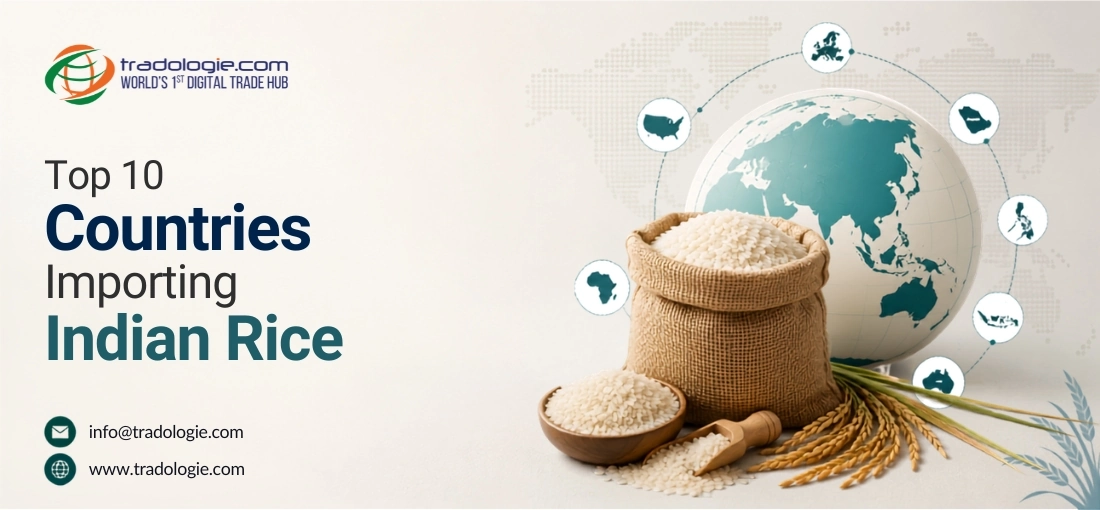
So let's dive into what the latest DGCIS trade figures reveal, look at the main destination countries, and break down the top 10 countries importing Indian rice today across both categories.

Basmati vs Non-Basmati: Comparing the Trade Numbers
Before looking at specific countries, it makes sense to compare the scale of both rice categories side by side.
On the Basmati side, total Indian exports went from 5,242,048.50 metric tons in the 2023-24 financial year up to 6,065,483.45 metric tons in 2024-25. That is a jump of roughly 823,435 tons—or about 15.7% growth year-on-year. In fact, 2024-25 marked the highest Basmati export volume in recorded trade data, beating out the previous high set back in 2023-24.
Now, Non-Basmati exports follow a much wider swing. Back in 2022-23, India shipped an enormous 17,786,092.87 tons of Non-Basmati rice. But when export curbs and duties kicked in, shipments dropped by around 37.5% down to 11,116,534.06 tons in 2023-24. Once those export rules eased up, volume bounced back by roughly 27.1% in 2024-25, reaching 14,128,966.36 tons. Even with that solid recovery, Non-Basmati shipments stayed about 20.6% under their 2022–23 peak levels.
Here is the big takeaway: India exported 14.13 million tons of Non-Basmati rice during 2024-25 compared to 6.07 million tons of Basmati. That means Non-Basmati volume was about 2.33 times larger than Basmati exports during that trade cycle.
India's Basmati & Non-Basmati Rice Exports
| Financial Year | Basmati Rice Exports | Non-Basmati Rice Exports |
|---|---|---|
| 2022-23 | 4,558,972.27 | 17,786,092.87 |
| 2023-24 | 5,242,048.50 | 11,116,534.06 |
| 2024-25 | 6,065,483.45 | 14,128,966.36 |

Top 10 Basmati Rice Importers from India
When it comes to long-grain Basmati rice, Middle Eastern markets dominate the trade, though demand across North America and Europe keeps growing year after year.
According to official DGCIS data for 2024-25, here are the top 10 countries importing Indian Basmati rice:
Saudi Arabia stays right at the top as India's largest Basmati export market, taking in 1,173,833.31 MT in 2024-25, up from 1.098 million tons in 2023-24. As one of the major importers of Indian rice , Saudi buyers rely heavily on aged Basmati for home cooking and their huge food service market.
Iraq saw a big surge in demand over the trade cycle, rising from 824,527.44 tons up to 905,598.90 MT. Iraqi procurement agencies and private traders rank among the top Basmati rice importers from India , purchasing massive bulk shipments of parboiled 1121 and 1509 grades.
Iran recovered strongly after a slower year, bouncing back from 670,781.77 tons to 855,132.87 MT in 2024-25. Iranian buyers have always been major Basmati rice importers , using structured rupee-payment arrangements and state tenders to secure staple grain supplies.
Yemen imported 392,180.74 MT of Basmati rice despite regional shipping disruptions. Yemeni distributors stand out as steady importers of Indian rice , feeding local consumer markets across the country.
The United Arab Emirates brought in 389,148.26 MT during 2024-25. While domestic consumption in the UAE is solid, Dubai also functions as a global transshipment hub, making UAE trading firms key importers of Indian rice who redistribute cargo across North Africa and the wider Middle East.
In North America, the United States saw Basmati imports grow from 234,469.15 tons to 274,213.14 MT in 2024-25. The US has become one of the premier non-Middle Eastern importers of Indian rice , driven by an expanding South Asian diaspora and wider consumer interest in specialty grains.
Over in Europe, the United Kingdom imported 180,951.39 MT of Basmati during 2024-25. British food companies and grocery chains rank among the main European importers of Indian rice , bringing in both retail packs and bulk brown Basmati for local processing.
Kuwait pulled in 175,000.19 MT during the same trade period, remaining one of the most consistent major Basmati rice importers who consistently demand high-end, long-grain aged rice.
Oman brought in 149,148.11 MT in 2024-25. Omani grain merchants are long-standing Basmati rice importers from India , sourcing cargo through short sea routes across the Arabian Sea.
Qatar rounds out the top ten Basmati destinations, taking in 124,557.34 MT. Qatari trade networks act as steady major Basmati rice importers , importing premium grain to supply local retail and hospitality sectors.
Top 10 Importers of Indian Basmati Rice — 2024-25
| Rank | Export Destination | Basmati Rice Exports |
|---|---|---|
| 1 | Saudi Arabia | 1,173,833.31 |
| 2 | Iraq | 905,598.90 |
| 3 | Iran | 855,132.87 |
| 4 | Yemen | 392,180.74 |
| 5 | United Arab Emirates | 389,148.26 |
| 6 | United States | 274,213.14 |
| 7 | United Kingdom | 180,951.39 |
| 8 | Kuwait | 175,000.19 |
| 9 | Oman | 149,148.11 |
| 10 | Qatar | 124,557.34 |
Top 10 Non-Basmati Rice Importers from India
If Basmati trade centers on the Middle East, Non-Basmati rice tells a totally different story. Here, West African countries pull in massive volumes of white rice, broken rice, and parboiled varieties to keep national food prices stable.
Here is where the top 10 Non-Basmati shipments landed in 2024-25 based on DGCIS data:
Benin was the largest buyer overall in the Non-Basmati category, importing a massive 2,248,749.35 MT. Because Cotonou port acts as a maritime trade corridor for landlocked neighbors, Beninese merchants are the single largest Non-Basmati rice importers from India, moving grain across regional borders.
Guinea followed closely as the second largest market, importing 1,133,574.13 MT of Non-Basmati rice. Guinean buyers rank among the top Non-Basmati rice importers from India , relying on full container loads and breakbulk ships of parboiled rice for daily food supplies.
In Cote d'Ivoire, importers brought in 1,121,655.83 MT of grain. Ivorian distributors act as major importers of Indian Non-Basmati rice, using regular vessel arrivals at Abidjan port to balance local grain prices.
Similarly, Togo imported 897,453.63 MT, operating as another primary entry point for West Africa and positioning local firms as prominent Non-Basmati rice importers from India.
Land borders play a huge role in regional trade, where Bangladesh imported 809,793.20 MT of Non-Basmati rice from India in 2024-25. Bangladeshi traders remain critical major importers of Indian Non-Basmati rice , using land customs stations like Benapole for quick truck transport whenever local harvests fall short.
Senegal brought in 660,720.23 MT during the trade year. Senegalese buyers are massive Non-Basmati rice importers from India , specifically buying broken rice varieties that form the base of traditional dishes like Thieboudienne.
To the north, Nepal brought in 606,517.73 MT across open border trade routes. Nepalese grain merchants are long-standing major importers of Indian Non-Basmati rice , sourcing white and parboiled rice daily to supply local markets.
Interestingly, Vietnam imported 494,988.36 MT of Non-Basmati rice in 2024-25. Even though Vietnam is a massive rice exporter itself, Vietnamese feed millers and food processors act as strategic importers of Indian rice , buying affordable 100% broken rice for animal feed and starch manufacturing.
Liberia imported 437,710.41 MT during the 2024-25 period. Liberian importers serve as reliable importers of Indian rice , bringing in parboiled cargo to meet local consumer dietary needs.
Somalia imported 435,682.64 MT of Non-Basmati rice to complete the top ten list. Somali trade networks function as key major importers of Indian rice , depending on direct ocean shipments to secure staple food supplies across local distribution chains.
Top 10 Importers for Indian Non-Basmati Rice — 2024-25
| Rank | Export Destination | Non-Basmati Rice Exports |
|---|---|---|
| 1 | Benin | 2,248,749.35 |
| 2 | Guinea | 1,133,574.13 |
| 3 | Côte d’Ivoire | 1,121,655.83 |
| 4 | Togo | 897,453.63 |
| 5 | Bangladesh | 809,793.20 |
| 6 | Senegal | 660,720.23 |
| 7 | Nepal | 606,517.73 |
| 8 | Vietnam | 494,988.36 |
| 9 | Liberia | 437,710.41 |
| 10 | Somalia | 435,682.64 |
Key Takeaways for Grain Traders
When you look at the top 10 countries importing Indian rice across both categories, clear trade patterns emerge.
If your business focuses on Basmati, your core market sits in the Middle East—where Saudi Arabia, Iraq, and Iran buy up more than half of India's total export volume. On the flip side, if you deal in Non-Basmati, West Africa is where the huge physical volume moves, led by port hubs like Benin, Guinea, and Côte d'Ivoire.
Succeeding as a trader comes down to understanding what each region needs. Keep your shipping paperwork accurate, monitor export policy updates from India's DGFT, and align your product specs with destination market rules. Do that, and your trade operations will stay reliable regardless of global market shifts.
Disclaimer
The information provided in this article is for educational and informational purposes only. Export volumes, destination markets, trade policies, and import requirements may change over time. Traders and exporters should verify the latest DGCIS, DGFT, and destination-country data before making commercial decisions.