Top Black Pepper Producing Countries in the World
Where global supply really comes from — and why a few origins quietly set the tone for the entire spice trade
Black pepper has a way of looking ordinary on a kitchen shelf and strategic inside a trading desk. To the consumer, it is just another seasoning. For top black pepper producing countries, exporters and procurement teams, it is a commodity that can tighten margins or open opportunities depending on the crop year.
Because pepper, unlike many processed foods, still behaves like an agricultural story first.
Rainfall, flowering cycles, and harvest timing still decide prices more than anything a black pepper trader says on a call.
And when you step back and look at global supply, one thing becomes clear: production is concentrated. A handful of countries carry most of the world's tonnage. When one of them stumbles, the entire market feels it.
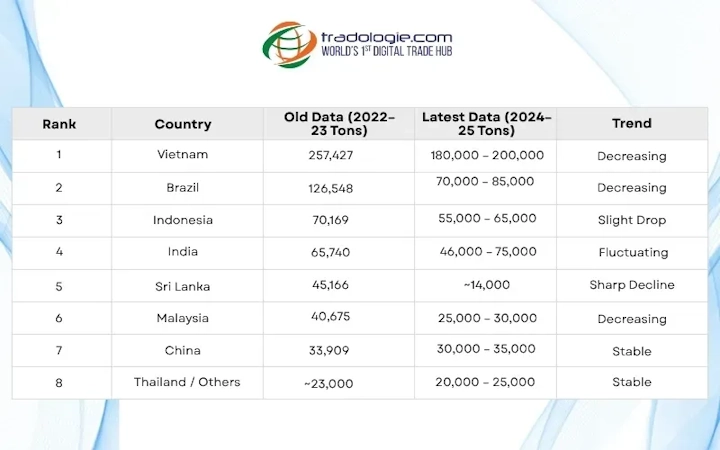
If you look at FAOSTAT's numbers closely, most of the world's pepper still comes from the same familiar set of countries — Vietnam, Brazil, Indonesia, India, and Sri Lanka. Beyond these, production exists, of course, but volumes taper off pretty quickly.
Everything else is secondary.
📌 See complete HSN Code List through HSN Code Finder to identify the correct classification for spices and agro-commodity exports, including black pepper and other bulk trade products.
Vietnam — The Market Anchor
If black pepper had a center of gravity, it would sit somewhere in southern Vietnam. It is the largest exporter of black pepper .
Over the past decade, Vietnam has quietly built a scale that no other origin has matched. Large plantation networks, organized farmer groups, and efficient black pepper export channels have turned the country into the reference price setter for global black pepper trade.
Recent FAOSTAT figures place Vietnam's production at roughly 270,000 metric tonnes annually, which translates to well over one-third of global supply.
That kind of volume gives black pepper exporters leverage.
- Largest single producer globally
- Strong cleaning and grading infrastructure
- Competitive FOB pricing
- Sets benchmark prices for most contracts
For many buyers, “Vietnam price” isn't just an option. It's the starting point of every negotiation.
Brazil — The Steady Challenger
Brazil doesn't usually make headlines in spices the way it does in soy or coffee. But in pepper, it has quietly carved out dependable space and a name among top black pepper producing countries.
With output near 90,000 metric tonnes, Brazil has become the second-largest producer in several recent seasons.
What black pepper buyers appreciate isn't just volume — it's consistency.
Brazilian pepper tends to move with fewer dramatic swings. Harvests are relatively predictable, and logistics through Atlantic ports suit buyers in Europe and the US particularly well.
- Reliable annual crops
- Competitive freight for Western markets
- Growing export professionalism
- Seen as a stable alternative to Asia
In procurement meetings, Brazil often shows up as the “risk-balancing” origin.
Indonesia — The Traditional Player
Indonesia has history on its side when it comes to black pepper exporting countries. Long before modern black pepper trade networks, Indonesian pepper was already crossing oceans.
Today, it still holds a meaningful share, producing around 80,000-85,000 metric tonnes per year according to FAOSTAT.
Volumes may not rival Vietnam, but Indonesian pepper carries its own market identity — especially in specialty and traditional grades.
Some buyers prefer it for blending or specific flavor profiles.
- Established grower base
- Recognized origin reputation
- Strong presence in regional Asian trade
- Useful for diversification strategies
Indonesia may not dominate, but it remains relevant — season after season.
India — The Quality Benchmark
India's relationship with pepper and role among black pepper exporting countries feels almost cultural. After all, the spice trade itself was once built around the Malabar coast.
Today, production sits lower than Vietnam or Brazil — roughly 60,000 metric tonnes annually — but country's strength lies elsewhere when it comes to black pepper export from India.
Quality perception.
Indian pepper is often treated as a benchmark for aroma and density, especially in premium or specialty segments.
Which means Indian black pepper exports don't always compete on the lowest price. They compete on trust.
Preferred for higher-spec buyers
- Strong domestic consumption base
- Premium positioning in some markets
- Well-established inspection and grading practices
In many contracts, India isn't the cheapest. But it's rarely ignored.
Sri Lanka — Small but Strategic
Sri Lanka doesn't really show up in the same league as Vietnam or Brazil when you look at pure tonnage. The crop is smaller — somewhere around twenty thousand tonnes most seasons — so volumes are limited.
Still, black pepper traders don't ignore it. Some bulk black pepper buyers actually ask for Sri Lankan origin specifically, mostly for certain grades or traceability. So it keeps finding its place in shipments, just not in huge lots.
In practice, it's the kind of supply that fills gaps or balances a blend rather than carrying the whole contract.
- Limited but steady supply
- Specialty and value-focused demand
- Often serves premium buyers
- Complements larger origins
Sometimes, small volumes carry surprisingly strong margins.
Why Concentration Matters to Black Pepper Traders
Looking at these five countries together, one thing becomes obvious.
Pepper isn't globally scattered like wheat or maize. It's clustered.
And clustered supply means clustered risk.
A weak Vietnamese crop, heavy rain in Brazil, or logistical delays in Indonesia can tighten availability quickly. Prices react fast. Bulk black pepper buyers scramble. Contracts get rewritten.
Which is why serious importers rarely depend on one origin alone.
Multi-origin sourcing reduces supply shocks
Blended procurement stabilizes pricing
Forward contracts hedge seasonal risk
Diversification becomes standard practice
In the bulk black pepper trade, geography is risk management.
Planning to export or import spices? See Complete IEC Code List to understand the Import Export Code requirements and categories used for international trade registration.
What the Market Quietly Tells Us
When you watch pepper long enough, you notice something.
It doesn't behave like a speculative commodity. It behaves like a weather report.
Good crop years soften prices. Tight harvests firm them up. Buyers adjust. Black pepper sellers adapt. Then the cycle repeats.
Nothing dramatic. Just steady agricultural logic.
And as long as Vietnam anchors volume, Brazil provides stability, and India protects quality perception, the black pepper trade keeps moving — container after container.
Because in spices, reliability often matters more than excitement.
And black pepper, for all its everyday familiarity, remains one of the most strategically watched crops in the global food trade.



.webp "Global Clove Import Demand: Industries Driving Bulk Trade Worldwide")