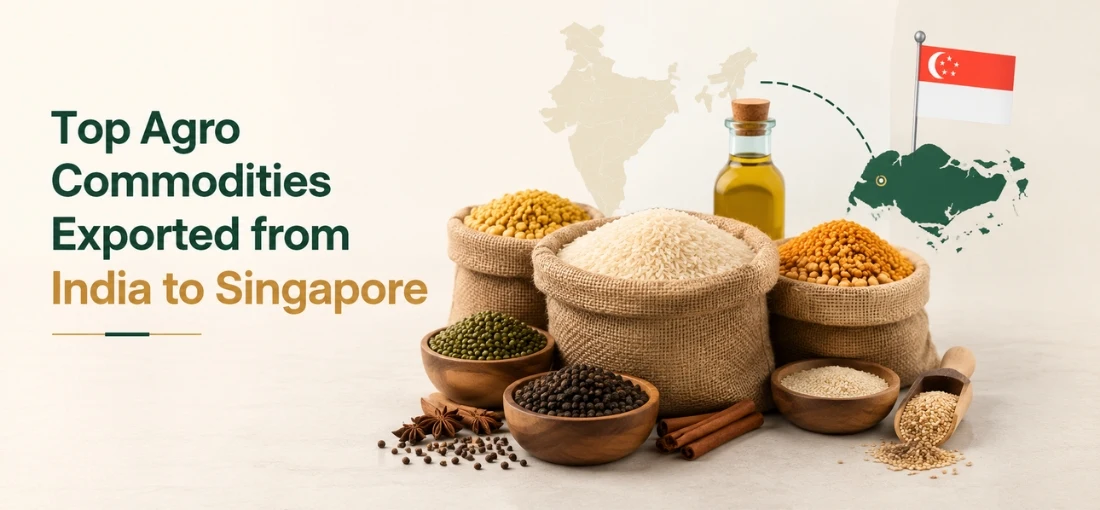
The Singapore Food Import Landscape
Key Highlights
- Singapore imported 4.45 million MT of agricultural products from India in FY 2024–25.
- India's agricultural exports to Singapore were valued at USD 454.54 million.
- Non-Basmati rice is India's largest agricultural export to Singapore by value.
- Spices, oil meals, marine products, and alcoholic beverages are among the leading export categories.
- Singapore depends heavily on imported food, creating steady opportunities for Indian exporters.
- Product quality, food safety, and compliance with Singapore Food Agency (SFA) standards are essential for market access.
Introduction:
Singapore produces almost negligible food locally and buys over 80 to 90% of its food supplies from other countries. Because the city-state has little farming land, it relies heavily on worldwide shipping networks to supply its grocery stores, restaurants, and hotels. The Singapore Food Agency (SFA) runs strict safety checks on every food shipment that comes through its ports. If you want to sell to buyers here, keeping your quality high and your logistics clean is the only way to build a lasting business.
Keep reading this informative piece of blog as it will tell you top agro commodities exported from India to Singapore.

Growth in Indo-Singapore Agri Trade
Within this trade environment, executing an agro products export from India to Singapore strategy has become a highly stable business avenue. India’s diverse crop options fit perfectly into Singapore's food security plans, which aim to mix up import origins to keep supplies steady.
According to official DGCIS trade figures for the FY 2024–25 fiscal year, Indian agricultural exports to Singapore reached an impressive total value of USD 454.54 million—which translates to roughly ₹3,846.63 crore. During this period, India shipped a massive total volume of 4,448.44 thousand metric tonnes (MT) of agricultural commodities to Singapore ports. This performance makes Singapore India's 33rd largest global destination for agricultural exports, taking up a strategic 0.85% share of India's total agricultural export value.
A Diversified Sourcing Basket
Unlike some markets that only buy a single crop, Singapore's import pattern is quite balanced. While food staples and value-added products dominate the trade, the top five export categories together generated USD 236.55 million. This accounts for about 52.04% of India's total agricultural shipments to the country, leaving plenty of room for other products to thrive.
To maintain healthy profit margins and meet Singapore's strict food compliance rules, modern suppliers are moving away from traditional broker channels and using direct digital procurement workflows instead.
The Core Sourcing Channels: The Top Agro Commodities in Demand
Analyzing the definitive performance charts of the leading product categories allows agri-enterprises to easily align their processing capacities with active global buying corridors.
1. Non-Basmati Rice: The Daily Essential
Non-Basmati Rice exports to Singapore stands out as India's largest single agricultural export to this Island country. The grain trade pulled in an export value of USD 89.73 million, contributing a vital 19.74% of India's total agricultural exports to the country during the fiscal cycle.
Singapore imports significant volumes of long and medium non-basmati white grains to supply its everyday retail grocery networks, industrial food manufacturing lines, and extensive hawker center grids. For Indian millers, rice exports to Singapore provides a highly stable pipeline, provided all shipments clear the strict quality and broken-grain limits checked at entry ports.
2. Spices: High-Demand Seasonings
Spices ranked firmly as the second-largest agricultural export category, showing the high European and Asian demand for authentic Indian ingredients. Generating an export value of USD 42.88 million, this segment accounted for a valuable 9.43% of India's agricultural export basket to Singapore.

Buyers in Singapore source varieties like whole black pepper, turmeric, ginger, cardamom, and ground masala mixes. They use these items for packaging grocery retail brands or supplying large restaurant kitchens. To avoid issues with local health inspectors, exporters need to make sure the spices go through proper steam cleaning and carry low moisture levels.
3. Oil Meals: Supporting the Regional Input Chain
Oil Meals emerged as the third-largest export category, pulling in a value of USD 37.84 million and representing 8.32% of the agricultural export layout. For commercial crushing plants, the drive to export oil meals from India to Singapore distribution grids offers highly predictable volume cycles.
Prominent Indian oil meal exporters to Singapore supply high-protein extracts—like soybean meal and rapeseed meal—which are utilized by regional agricultural firms as baseline ingredients for commercial animal feed processing.
4. Marine Products: The Seafood Supply Line
Marine Products ranked fourth on the list, generating an export value of USD 34.72 million and contributing 7.64% of the total export value. The pipeline to export marine products from India to Singapore satisfies a steady consumer demand across Singapore's premium restaurant networks and supermarket cold chains.
To maintain stable volume runs, Indian marine products exporters to Singapore focus on shipping high-spec frozen shrimp, prawns, and specialized fish varieties. Keeping precise temperature logs from the processing plant to the final delivery dock is critical to avoiding any quality issues at destination ports.
5. Alcoholic Beverages: The Value-Added Growth Sector
Completing the top five export categories is the Alcoholic Beverages segment, which recorded USD 31.38 million in exports and accounted for a strategic 6.90% of India's agricultural exports to Singapore.
Singapore operates as a massive regional transit port and hospitality hub, creating a steady market for premium Indian spirits and beers. Indian beverage brands rely on high-capacity bottling plants and standard packaging layouts to supply retail distributors across the island.
The Shift Toward Online Sourcing Channels
Relying entirely on old physical broker setups can hurt your export returns. In the past, companies spent a lot of money visiting international trade shows or buying outdated contact lists full of wrong phone numbers and old customs files. Working through traditional middleman networks can also block your view of the market. Sometimes, these agents hide who the actual buyer is just to protect their commission cut. This leaves you carrying all the financial risk if a payment gets delayed while your cargo is out at sea.
To avoid these problems, global agricultural trade is moving onto direct B2B platforms. Online trade networks are playing a much bigger role in helping exporters find new deals without the usual middleman friction. These websites let sellers link up directly with verified global procurement offices that are ready to import bulk cargo.
By talking directly with buyers online, you can handle your own deals and see true market pricing without paying an agent a percentage. Modern online trade tools also protect your business money by using secure options like Letters of Credit (LC) and Escrow setups. Your cash stays safe while the system tracks your shipping paperwork and port updates automatically.
Summary: A Strategic Blueprint for Exporters
Singapore has a steady retail sector and relies heavily on other countries for its food, making it a reliable long-term market for Indian exporters in Southeast Asia. If you want to scale your business here as a miller, food processor, or feed supplier, you need to look past slow, traditional brokerage networks.
By tracking what buyers want in terms of everyday grains, clean spices, industrial feed meals, and frozen seafood, you can find consistent contracts. Managing your sales through digital trade pipelines that use secure payments will help you build a safe and profitable export setup in the global food market.
Disclaimer
The information provided in this article is for educational and informational purposes only. Export statistics, customs procedures, food safety regulations, and Singapore import policies may change over time. Exporters should verify the latest DGCIS data, Singapore Food Agency (SFA) requirements, and destination-country compliance requirements before exporting agricultural products.