Key Highlights
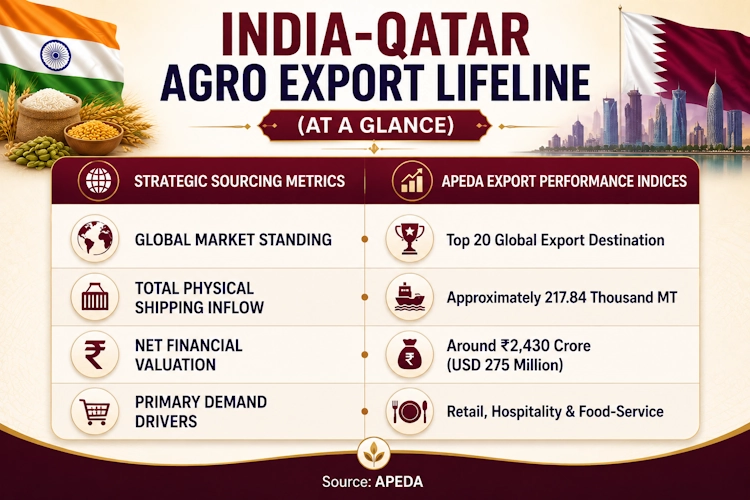
- Qatar is among India's top 20 export destinations for agricultural and processed food products.
- India exported around 217.84 thousand metric tonnes of agro products to Qatar, valued at approximately USD 275 million .
- Basmati rice is India's leading agricultural export to Qatar.
- Buffalo meat, non-Basmati rice, processed foods, and dairy products are key export categories.
- Qatar's dependence on food imports creates steady demand for Indian agricultural products.
- Consistent quality, Halal compliance, and reliable supply chains are essential for exporters.
Introduction:
The bilateral trade landscape between India and the Gulf Cooperation Council (GCC) continues to expand, driven by strategic logistics corridors and structural food security partnerships. Within this highly profitable trading zone, the State of Qatar represents an exceptionally high-value, steady destination for international agricultural suppliers. Because Qatar combines an exceptionally high per-capita income profile with limited domestic agricultural production and severe water scarcity, the country relies systematically on global trade lanes to feed its population.
According to official statistics tracked in the latest agricultural trade records, the mandate to export agro products to Qatar has emerged as a key focus area for forward-thinking agricultural millers, processors, and cold-chain operators.

During the recent trade cycle, Qatar firmly established its position among India's Top 20 export destinations for APEDA-scheduled agricultural and processed food products. In terms of physical trade volume, India exports to Qatar reached approximately 217.84 thousand metric tonnes of cargo.
This steady flow of shipments generated a total agricultural export valuation of around ₹2,430 crore (approximately USD 275 million). For processing plants looking to scale their international sales, the Qatari marketplace offers excellent contract continuity across staple grains, animal proteins, and value-added food segments.
To capitalize on this steady demand, international suppliers are moving past small spot-market allocations to export food products to Qatar institutional grids, shifting their focus toward premium single-origin products that clear strict Gulf inspection standards.
The Core Sourcing Channels: The Top 5 Product Categories
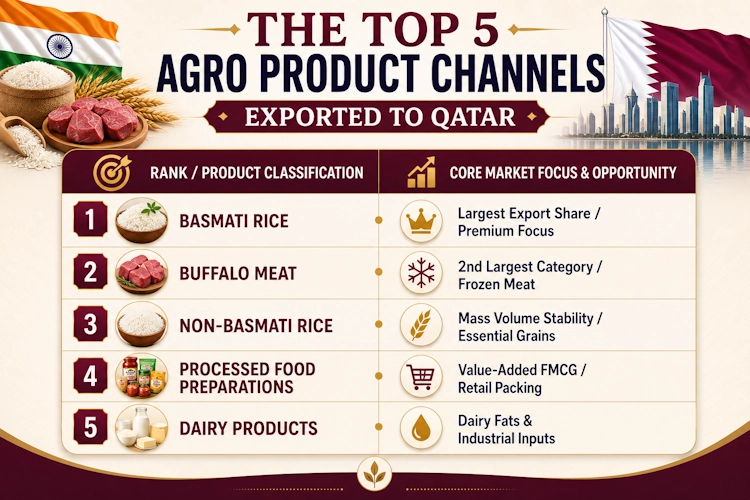
Mirroring the structural consumption patterns observed across neighboring Gulf markets, the top five product categories—Basmati Rice, Buffalo Meat, Non-Basmati Rice, Processed Food Preparations, and Dairy Products—accounted for the clear majority of India's total APEDA agricultural exports to Qatar. This high concentration provides a reliable, predictable blueprint for Indian mills planning their production allocations.
1. Basmati Rice: The Premium Household Staple
Basmati Rice stands out as India's single largest agricultural export to Qatar, claiming the highest share of India's APEDA exports to the country by both volume and value. Rice functions as a non-negotiable dietary and cultural foundation across Qatari retail networks, driving steady, year-round procurement requests.
For processing enterprises aiming to build long-term value, the strategy to export basmati rice to Qatar distribution houses represents an exceptionally stable commercial avenue. Sourcing managers across Doha heavily favor high-spec aromatic long grains, which creates a highly responsive environment for premier Indian basmati rice exporters to Qatar .

Within this premium space, executing a dedicated 1121 basmati rice export to Qatar trading strategy stands out as a highly active business lane. Qatari wholesale desks prize 1121 steam and sella selections for their extraordinary grain length elongation, strong parboiling quality, and low moisture content, which are essential to satisfy strict culinary specifications enforced across the country's luxury hospitality and high-end corporate catering sectors.
2. Buffalo Meat: Anchoring the Protein Supply Chain
Buffalo Meat emerged firmly as the second-largest export category, highlighting Qatar's continuous, non-stop institutional demand for Indian frozen meat products. To maintain stable cold-storage inventory levels across the country's extensive hospitality and retail grids, Qatari food service buyers absorb large-scale transcontinental container lots.
For commercial processing facilities, this consistent demand provides a highly stable pipeline. To successfully clear the strict border laboratory checks managed by municipal health inspectors, all outgoing meat shipments must be processed under verified Halal frameworks and maintain flawless cold-chain temperature logs from the origin plant to the final delivery dock.
3. Non-Basmati Rice: Essential Everyday Grains
Reflecting a balanced consumer demographic that requires both premium options and affordable staples, Non-Basmati Rice exports to Qatar also featured among the leading exports to the country. This category satisfies the extensive volume requirements of commercial food service blenders and institutional labor catering complexes.
Exporters looking to export rice in bulk to Qatar find a highly reliable logistical pipeline for long and medium non-basmati grains, allowing suppliers to maintain high asset utilization across their milling operations.
4. Processed Food Preparations: Capitalizing on FMCG Growth
As fast-paced urban lifestyles expand across Doha's metropolitan areas, the demand for processed food preparations and convenient retail mixes has accelerated. This category has grown into a major agricultural export channel, driven by Qatari grocery chains seeking high-purity spice mixtures, ready-to-use culinary bases, and ambient snack ingredients.
This trend opens up excellent opportunities for agri-processors who can deliver consistent flavor profiles and uniform retail packaging templates.
5. Dairy Products: The Rapidly Growing Nutritional Segment
Rounding out the top five categories is the Dairy Products sector, which continues to see increasing opportunities for value-added food exports. From high-grade anhydrous milk fat used in industrial food formulations to premium packaged dairy goods for supermarket shelves, Indian dairy processors are leveraging advanced production lines to secure steady, long-term supply agreements with major Qatari distribution networks.
Bypassing Traditional Barriers: The Digital Shift in Global Trade
While robust consumer demand and stable APEDA trade values provide a highly supportive environment, independent agricultural suppliers can easily damage their export profit margins if they rely on outdated, high-friction client acquisition networks to trade across the Gulf.
Historically, companies have spent immense sums traveling to international trade expos or purchasing unverified, static directories that are frequently clogged with dead contact data and historic customs records. Even worse, turning your supply lines over to traditional commission-based brokers can obscure your market visibility, as these agents often hide the true identity of the end-buyer to protect their position in the middle, leaving you completely exposed to counterparty risks and credit defaults during transit.
To bypass these friction points, the modern agricultural trade has shifted toward specialized digital procurement infrastructure. Digital platforms like tradologie.com have stepped in to solve these structural transparency challenges, operating as a clean, real-time B2B trade lane built to streamline transactions along global agricultural corridors.
How Tradologie facilitates global Qatar trade:
- Direct Access to Verified Buyers: Tradologie provides direct access to verified import-ready buyers who want to procure bulk commodities. You skip the guesswork and hook straight into active grain and meat procurement managers.
- One-to-One Live Negotiation: You can negotiate with the buyers live one-to-one, finalizing trade deals without any interference in pricing by the platform. This pure price discovery allows you to protect your exact export margins.
- Deeply Verified Sourcing Requirements: Sourcing requirements are verified using Tradologie's AI-assisted verification process together with internal verification procedures. The platform thoroughly checks the profile and active licensing of the buyers before allowing them to upload buying mandates.
- End-to-End Export Facilitation: You get complete end-to-end export facilitation support through a dedicated trade manager until your transactions are finalized. Your account team helps you handle strict phytosanitary checks and clear port authorities without delays.
- Capital Protection and Secure Escrow: Tradologie supports secure payment mechanisms such as Letters of Credit (LC) and Escrow setups, insulating your cash flow from international trade risks.
Summary: A Strategic Blueprint for Exporters
Qatar's high per-capita income and structural dependence on imported food products position it as one of India's most valuable, long-term strategic agricultural export markets in the GCC. For forward-thinking agricultural millers, processors, and cold-chain operators, succeeding in this premium landscape means moving past slow-moving, non-transparent physical brokerage loops.
By understanding the detailed volume demands across premium long-grain rice, frozen meats, value-added dairy lipids, and processed food matrices, and running your transactions through advanced B2B procurement systems that offer secure payment protection, your business can confidently establish a secure, scalable, and highly profitable presence within one of the most stable agricultural corridors in the Middle East.
Disclaimer
The information provided in this article is for educational and informational purposes only. Export statistics, product demand, customs regulations, Halal certification requirements, and Qatar's import policies may change over time. Exporters should verify the latest APEDA data, Qatar customs regulations, and destination-country compliance requirements before exporting agricultural products.


.webp "Types of Sugar Explained: Decoding the Global Logistics of Raw, Refined, and Specialty Supply")
.webp "Future of Agro Exports from India (2026 Outlook & Opportunities)")