Key Highlights
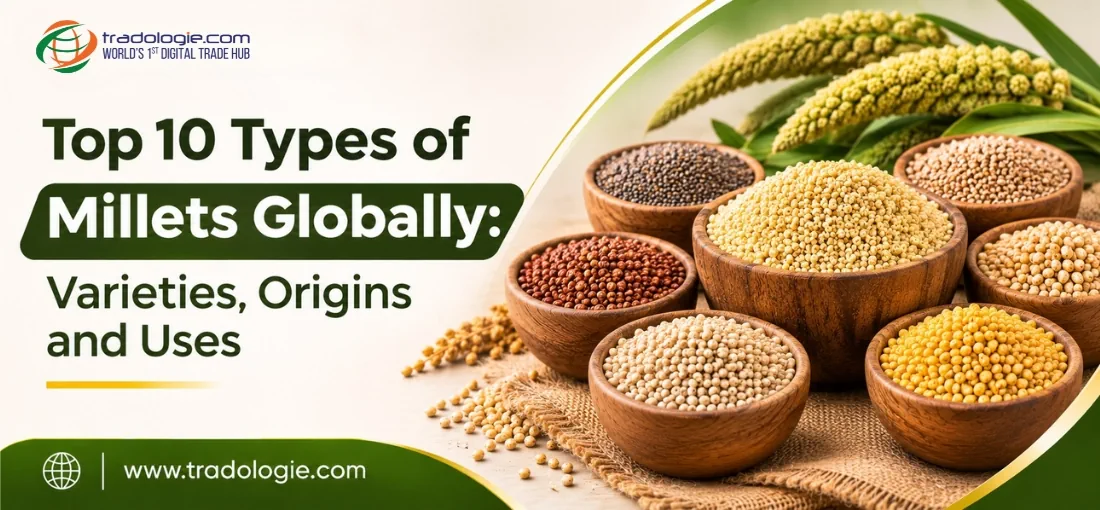
- The top 10 types of millets in the world include Pearl Millet (Bajra), Finger Millet (Ragi), Foxtail Millet, Proso Millet, Barnyard Millet, Kodo Millet, Little Millet, Sorghum (Jowar), Teff and Fonio.
- India and African countries are major cultivation centres for pearl and finger millet, while China is an important producer of foxtail and proso millet.
- Millets are used in traditional flatbreads, porridge, flour, breakfast cereals, snacks, bakery products and animal feed.
- The global millet market was valued at approximately US36.9billionin2023andisprojectedtoreachUS55.7 billion by 2030.
- India was the leading millet exporter by value in the article's 2024 WITS data, with exports of approximately US$38.09 million under HS Code 100820.
Introduction :
Millets are among the oldest cultivated cereal grains in the world. There are several types of millets in the world , ranging from pearl millet and finger millet to foxtail, proso and barnyard millet. They have been grown for thousands of years across Asia and Africa, particularly in regions where rainfall is limited and growing conditions can be challenging. Today, they are gaining renewed attention because of their nutritional value, adaptability to different climates and growing use in food manufacturing.
Although these grains are often grouped together, each variety has its own characteristics, growing regions, taste and applications. Some are mainly consumed as traditional staple foods, while others are increasingly used in breakfast cereals, flour, snacks, bakery products and animal feed.
Understanding the different types of millets is important for food manufacturers, agricultural traders, exporters and bulk buyers. The following are ten widely recognised varieties cultivated and consumed across different parts of the world.

Top 10 Millet Varieties Globally
1. Pearl Millet (Bajra) - India and Africa
When talking about types of millets in the world , the Pearl millet is one of the most widely cultivated millet varieties globally. It is scientifically known as Pennisetum glaucum and is particularly important in India and several African countries.
It is a hardy crop that can grow in hot and dry conditions, making it suitable for semi-arid regions where other cereal crops may struggle. India, Niger, Nigeria, Mali and Burkina Faso are among the important pearl millet-producing countries.
Pearl millet grains are generally round and can range from greyish-white to yellow and brown, depending on the variety.
- Origins and Location - India, Niger, Nigeria, Mali, Burkina Faso and other parts of Africa.
- Characteristics - Small round grains, earthy taste and good tolerance to high temperatures and low rainfall.
- Uses - Traditional flatbreads, porridge, flour, breakfast cereals, snacks and animal feed.
Pearl millet is also an important commercial crop because of its use in food processing and livestock feed. Its adaptability to dry climates makes it an important grain for agricultural production in regions with irregular rainfall.

2. Finger Millet (Ragi) - India and East Africa
Finger millet, commonly known as ragi, is another important variety among the different types of millets . It is scientifically called Eleusine coracana and is widely cultivated in India and East African countries.
The grain gets its name from the finger-like branches of its seed head. It is generally small, round and reddish-brown in colour.
Finger millet is recognised for its calcium content and is commonly used in traditional foods. It is also gaining popularity in health-oriented food products and gluten-free formulations.
- Origins and Location - India, Uganda, Ethiopia, Kenya, Nepal and other parts of East Africa.
- Characteristics - Small reddish-brown grains, mild earthy flavour and high calcium content.
- Uses - Ragi flour, porridge, flatbreads, breakfast cereals, biscuits, baby food and health-oriented snacks.
India is an important producer and consumer of finger millet. It is widely used in southern Indian food preparations, while its cultivation and consumption remain important in parts of East Africa.
3. Foxtail Millet - China and India
Foxtail millet is one of the oldest cultivated millet crops and is scientifically known as Setaria italica. It is widely grown in China and India, along with other parts of Asia.
The crop gets its name from its compact, bushy seed head, which resembles a fox's tail. Its grains are small and can be yellow, golden or light brown.
Foxtail millet has a mild taste and is commonly used as a rice alternative. It is also processed into flour and other food ingredients.
- Origins and Location - China, India, Nepal and other Asian countries.
- Characteristics - Small yellow or golden grains, mild flavour and relatively short growing period.
- Uses - Porridge, cooked grain dishes, flour, noodles, breakfast cereals and packaged food products.
China and India have a long history of foxtail millet cultivation. Its use in modern food products is also expanding as manufacturers explore alternative cereal ingredients.
4. Proso Millet - China, India and the United States
Proso millet, scientifically known as Panicum miliaceum, is cultivated across Asia, Europe and North America. It is also commonly called common millet or broomcorn millet.
It is known for its relatively short growing period and ability to grow with limited water. The grains are generally round and may appear white, yellow, red or brown depending on the variety.
Proso millet is used for both human consumption and animal feed. It is also an important commercial crop in certain grain-producing regions.
- Origins and Location - China, India, Russia, Ukraine, the United States and other parts of Europe and Asia.
- Characteristics - Small round grains, different grain colours, short growing period and drought tolerance.
- Uses - Porridge, flour, breakfast cereals, birdseed, livestock feed and packaged food products.
The United States is an important commercial producer of proso millet, particularly in states such as Colorado, Nebraska and South Dakota. It is also traded internationally for food and feed applications.
5. Barnyard Millet - India, China and Japan
Barnyard millet belongs to the genus Echinochloa and is cultivated in parts of Asia, particularly India, China and Japan.
It is a relatively fast-growing crop that can adapt to different growing conditions. The grains are small and generally white, cream or light brown in colour.
Barnyard millet is traditionally consumed in several Asian countries and is increasingly being used in packaged food products.
- Origins and Location - India, China, Japan, Nepal and other parts of Asia.
- Characteristics - Small grains, mild flavour, short growing period and adaptability to different growing conditions.
- Uses - Porridge, cooked grain dishes, flour, traditional meals, breakfast cereals and health-oriented food products.
In India, barnyard millet is commonly used in traditional dishes, particularly during fasting periods. Its use in ready-to-cook and packaged food products is also creating additional commercial applications.
6. Kodo Millet - India and Nepal
Kodo millet is scientifically known as Paspalum scrobiculatum. It is primarily cultivated in India and some neighbouring countries, including Nepal.
The crop is known for its ability to grow in relatively poor soil conditions and withstand periods of limited rainfall. Its grains are small and can range from light brown to dark grey.
Kodo millet has traditionally been used in rural diets and is now finding applications in processed food products.
- Origins and Location - India, Nepal and other parts of South Asia.
- Characteristics - Small grains, earthy flavour, brownish-grey colour and tolerance to dry growing conditions.
- Uses - Porridge, flour, cooked grain dishes, traditional meals, breakfast cereals and packaged foods.
India is an important producer of kodo millet. Its cultivation is particularly relevant to dryland farming areas where farmers require crops that can withstand challenging agricultural conditions.
7. Little Millet - India and Sri Lanka
Little millet, scientifically known as Panicum sumatrense, is a small-seeded cereal crop cultivated mainly in India and parts of South Asia.
It is valued for its ability to grow in relatively dry conditions and is commonly used in traditional food preparations. The grains are generally small and round, with colours ranging from cream to light brown.
Little millet is increasingly being included in millet-based flour, ready-to-cook products and breakfast food formulations.
- Origins and Location - India, Sri Lanka and other parts of South Asia.
- Characteristics - Very small grains, mild flavour and adaptability to dryland farming.
- Uses - Cooked grain dishes, porridge, flour, traditional meals, breakfast cereals and packaged foods.
Little millet is not as widely traded internationally as some larger cereal crops. However, its use in specialised food products provides opportunities for processors and millet suppliers serving health-conscious consumers.
8. Sorghum (Jowar) - Africa, India and the United States
Sorghum, commonly known as jowar in India, is one of the major drought-resistant cereal crops cultivated globally. Its scientific name is Sorghum bicolor.
Although sorghum is often discussed alongside millets, it is generally classified separately from the small millets in international trade statistics. It is included in broader discussions of millet and climate-resilient cereal crops because of its similar growing conditions and food applications.
Sorghum grains can be white, red, brown or yellow, depending on the variety. It is used extensively for human consumption, livestock feed and industrial applications.
- Origins and Location - Sudan, Nigeria, Ethiopia, India, the United States, Australia and other African and Asian countries.
- Characteristics - Larger grains than most small millets, different grain colours and good tolerance to heat and drought.
- Uses - Flour, flatbreads, porridge, breakfast cereals, snacks, animal feed and industrial processing.
Sorghum has a well-established international trade market. The United States, Australia, Argentina and several African countries are important participants in its production and export supply chain.
9. Teff - Ethiopia and Eritrea
Teff is a tiny-seeded cereal grain that is primarily cultivated in Ethiopia and Eritrea. Its scientific name is Eragrostis tef.
It is one of the most important traditional cereal crops in Ethiopia, where it is used to prepare injera, a fermented flatbread that is a staple food.
Teff grains are extremely small and are available in white, red and brown varieties. It is increasingly attracting attention in international markets because of its use in gluten-free flour and speciality food products.
- Origins and Location - Ethiopia and Eritrea.
- Characteristics - Very small grains, mild nutty flavour and different grain colours.
- Uses - Injera, flour, porridge, bakery products, pancakes and gluten-free food products.
Ethiopia remains the primary centre of teff production and consumption. Its international market is more specialised compared with widely traded cereals such as sorghum and pearl millet.
10. Fonio - West Africa
Fonio is an ancient cereal grain cultivated in West Africa. It belongs to the genus Digitaria, with white fonio scientifically known as Digitaria exilis.
It is particularly important in countries such as Guinea, Mali, Burkina Faso, Senegal and Nigeria. The crop can grow in challenging conditions and is traditionally cultivated by smallholder farmers.
Fonio grains are very small and are generally white or light-coloured. It has a mild, slightly nutty taste and is used in traditional African food preparations.
- Origins and Location - Guinea, Mali, Burkina Faso, Senegal and Nigeria.
- Characteristics - Very small grains, mild nutty flavour and adaptability to dry growing conditions.
- Uses - Porridge, couscous-style dishes, flour, bakery products, breakfast cereals and speciality food products.
Fonio is gaining attention in international speciality food markets. However, processing and supply-chain limitations can affect the availability and consistency of exportable quantities.
Global Millet Market
The global millet market is gaining attention as food manufacturers, agricultural traders and consumers explore alternatives to conventional cereals.
According to Grand View Research, the global millet market was valued at approximately US36.9billionin2023.ThemarketisprojectedtoreachUS55.7 billion by 2030, growing at a CAGR of 6.2% between 2024 and 2030.
Pearl millet accounted for approximately 40.5% of the market revenue in 2023, making it the leading segment by type in the report. Asia Pacific was the largest regional market, accounting for 42.8% of global revenue during the same year.
The market is supported by several factors:
- Food Manufacturing - Millet flour, whole grains and processed millet ingredients are used in breakfast cereals, snacks, bakery products and packaged foods.
- Health-Oriented Consumption - Growing interest in fibre-rich, nutrient-dense and gluten-free food products is encouraging manufacturers to explore millet-based formulations.
- Climate Adaptability - Several millet varieties can grow in hot and dry conditions, making them important crops for regions facing water shortages and irregular rainfall.
- Traditional Food Consumption - Millets remain staple foods in parts of India and Africa, supporting consistent domestic demand.
- Animal Feed - Certain millet varieties are used in livestock feed and birdseed, creating demand beyond human food consumption.
- Product Innovation - Manufacturers are introducing millet-based pasta, biscuits, breakfast cereals, flour blends and ready-to-cook products.
It is important to note that market estimates can differ between research companies depending on which grains, products and applications are included in their market definitions.
Global Millet Trade and HS Codes
Millets are traded internationally as whole grains, seed for sowing and processed food ingredients. However, their customs classification depends on the specific grain and its intended use.
The Harmonized System (HS) provides the international framework for classifying agricultural commodities. For millet trade, the relevant codes include:
| HS Code | Description |
|---|---|
| 100821 | Millet seed for sowing, excluding grain sorghum |
| 100829 | Millet other than seed for sowing, excluding grain sorghum |
| 1007 | Grain sorghum |
| 100890 | Other cereals, including certain small millet and cereal categories |
National customs authorities may extend these six-digit HS codes into more detailed tariff classifications. For example, India's APEDA product classification lists separate codes for bajra, ragi, barnyard, proso, foxtail, kodo and little millet under the 100821 and 100829 categories.
Leading Millet Exporters Worldwide
According to World Bank WITS trade data for 2024, the leading exporters reported under HS 100820 included:
| Exporting Country | Export Value (2024) | Export Quantity (2024) |
|---|---|---|
| India | US$38.09 million | 79.57 million kg |
| United States | US$30.19 million | 72.65 million kg |
| Uzbekistan | US$29.42 million | 13.41 million kg |
| Ukraine | US$26.42 million | 112.56 million kg |
| France | US$14.04 million | 31.15 million kg |
| China | US$7.30 million | 7.05 million kg |
| Poland | US$5.55 million | 9.97 million kg |
Source: World Bank WITS, HS 100820, 2024.
India was the largest exporter by value in this dataset, followed by the United States and Uzbekistan. Ukraine recorded the highest export quantity among the listed countries.
One important point is that the 2024 WITS dataset reports millet under HS 100820. More recent tariff classifications separate millet seed for sowing under 100821 and other millet under 100829. Therefore, these figures should be treated as data for the reported 100820 category rather than a direct breakdown of every individual millet variety.
Important Markets for Millet Imports
Millet import demand comes from countries with established food-processing industries, livestock-feed requirements and traditional consumption patterns.
The United States and European markets are important destinations for speciality grains and food ingredients. Meanwhile, countries across Asia and Africa have established domestic demand for different millet varieties.
Importers generally evaluate the following factors when sourcing millet:
- Grain Variety - Confirm whether the requirement is pearl, finger, foxtail, proso or another millet variety.
- Grain Quality - Check grain size, colour, moisture content, purity and foreign matter.
- Intended Application - Determine whether the millet is required for human consumption, animal feed, processing or seed purposes.
- Processing Requirements - Confirm whether the buyer requires cleaned, graded, dehulled, milled or otherwise processed grains.
- Documentation - Check the commercial invoice, packing list, certificate of origin, phytosanitary certificate and other applicable documents.
- Import Regulations - Verify customs classification, import duties, food-safety requirements, pesticide residue limits and destination-specific regulations.
What to Consider When Buying Millets in Bulk
When purchasing millets in bulk, buyers should identify the exact variety and quality specifications before confirming an order. Different millet varieties have different grain sizes, processing requirements, moisture limits and commercial applications.
Consider the following:
- Variety - Confirm whether you require pearl millet, finger millet, foxtail millet, proso millet or another variety.
- Moisture Content - Excess moisture can increase the risk of mould development and deterioration during storage.
- Grain Purity - Check for foreign matter, broken grains, dust, stones and other impurities.
- Grain Size and Colour - These characteristics can influence the grade and suitability of the millet for different food applications.
- Processing - Specify whether the product should be raw, cleaned, graded, dehulled, milled or processed.
- Pesticide Residues - Ensure the millet meets the destination country's requirements for pesticide residues and other contaminants.
- Packaging - Confirm whether the buyer requires bulk bags, standard export bags or retail-ready packaging.
- Documentation - Check the required certificates, including phytosanitary and certificate of analysis documents where applicable.
- Import Requirements - Verify the HS code, customs duty, food-safety standards, labelling requirements and import restrictions.
Buyers should also check the crop year, available stock, loading port, shipment schedule, payment terms and agreed Incoterms before finalising a purchase.
Finding Reliable Millet Exporters and Suppliers
The international millet supply chain includes farmers, agricultural cooperatives, grain aggregators, processors, exporters and food ingredient distributors. Their sourcing capacity, processing facilities and export experience can vary considerably.
When looking for millet suppliers , buyers should determine whether the supplier can provide the required variety, grade, quantity and documentation. It is also important to check whether they can maintain consistent quality across repeat shipments.
For exporters, identifying the right international buyers is equally important. Different markets have different preferences for millet varieties, grain specifications, packaging and intended applications.
A structured sourcing process can help reduce the risk of receiving inconsistent grain quality, incorrect varieties, delayed shipments and incomplete documentation.
Conclusion
Millets represent an important part of agricultural production across Asia and Africa. Their adaptability to different climates, nutritional characteristics and wide range of food applications make them relevant to both traditional consumption and modern food manufacturing.
Pearl millet, finger millet, foxtail millet, proso millet and other varieties each serve different markets and processing requirements. Understanding their origins, quality specifications and international trade classifications can help producers, processors, importers and exporters make better sourcing and supply decisions.
Disclaimer
Market valuations, export rankings and trade figures are based on the sources and reporting periods referenced in this article. Millet classifications may vary according to botanical definitions and international customs classifications. Sorghum is generally classified separately from small millets, while certain other cereal categories may have different HS codes. Buyers and exporters should verify the latest trade statistics, product specifications, customs classifications and destination-country import requirements before entering into a commercial transaction.