Key Highlights
- Marine products are India's highest-value food export to the USA.
- The US is India's largest export market for spices.
- Ready-to-eat foods and processed products continue to see strong demand.
- Frozen seafood, spice extracts, tea, and pulses remain key export categories.
- Demand is driven by the Indian diaspora and changing American food preferences.
- FDA compliance and value-added processing are essential for success.
Introduction:
When we talk about India's food exports to America , most of that basmati rice is the major commodity that India exports. However this isn't true. If one looks at the statistical picture then it is completely different.
American food importers aren't buying raw field crops from India in bulk. They're buying processed goods, cold-chain seafood, industrial spice extractions, and specialty pantry stock. Driven by a 5-million-strong Indian diaspora and a mainstream American push toward clean-label and global flavors, India’s trade with the US is built on high-margin, value-added categories.

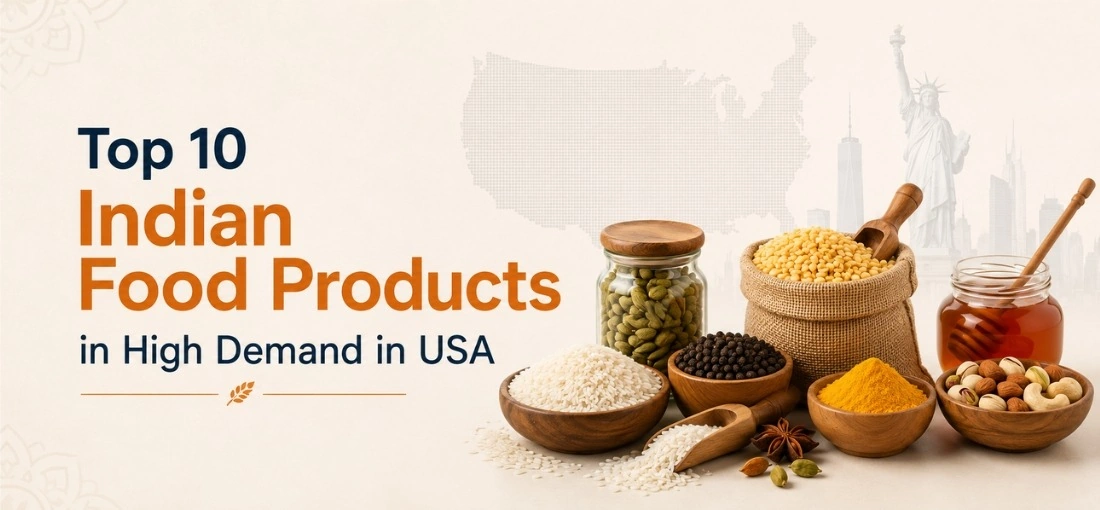
Here are the top 10 Indian Food Products in High Demand in the USA.
1. Marine Products ($2.31 Billion)
If you want to know what food to export to the USA that generates massive volume, look at cold-chain seafood. Marine products don't just lead—they account for over 27% of India's global marine shipments , pulling in $2.31 billion from the US alone.
American supermarket chains and wholesale food distributors run on imported frozen Indian shrimp (mostly farm-raised Vannamei). FDA compliance here is brutal, but processors who master cold-chain logistics secure the highest-value contracts in the global trade.
2. Spices & Industrial Extracts ($551.12 Million)
America is officially India's largest spice customer on the planet. But when companies export spices to America , very little of that trade is just small plastic retail jars of turmeric or black pepper.
- The Industrial Demand: US food manufacturers import bulk oleoresins, crushed pepper, and spice oils to flavor everything from frozen pizzas to processed meats.
- The Retail Demand: Mainstream health trends drive steady volume for organic-certified cumin, cardamom, and high-curcumin turmeric across natural grocery channels.
So if you are looking to export spice in bulk to America , it is in fact a profitable venture.
3. The Value-Added Processed Spectrum ($663.15 Million Combined)
nstead of treating processed goods as isolated list items, US buyers look at them as a unified supply pipeline:
Miscellaneous Food Preparations ($274.70 Million)
This category is quite interesting and this is where ready-to-eat (RTE) meals, instant mixes, and shelf-stable curry pastes live. Second-generation diaspora families and busy American professionals want authentic regional flavors but well within the quick prep time. The Indian food exporters getting their retort-packaging technology right are among those who see some of the highest margins in the business. Your food needs to be shelf stable in other words.
Cereal Preparations ($136.47 Million)
This isn't raw grain. We're talking frozen naan, parathas, roasted snack mixes (namkeen), and specialized atta blends. As regional Indian breads move into mainstream US grocery chains, this category keeps expanding year-over-year.
Processed Fruits, Juices & Vegetables ($212.72 Million)
Shipping fresh produce across oceans carries high spoilage risk. So, the market relies on processed alternatives:
- Fruits ($113.58M): Commercial bakeries and beverage processors import massive quantities of Alphonso and Kesar mango pulps and concentrated fruit bases.
- Vegetables ($99.14M): Anchored heavily by dehydrated onion and garlic powders—the quiet backbone of American commercial seasoning blends—alongside frozen cut vegetables.
4. Industrial Inputs & Pantry Staples
Other Agri-Commodities ($351.91 Million)
A massive catch-all category taking nearly 24% of India's global exports in this group. It covers specialized seed derivatives, plant gums, and raw crop inputs critical to American food processing plants.

Castor Oil ($103.98 Million)
The US buys roughly 9% of India's global castor oil output. While not something you pour over a salad, food-grade castor oil derivatives serve as key emulsifiers and protective coatings across US commercial food manufacturing lines.
Specialty Teas ($78.38 Million)
Unlike markets importing cheap CTC tea for mass blending, the American consumer buys single-origin orthodox Darjeelings, bold Assam teas, and functional herbal mixes. It's a high-margin, organic-driven retail segment.
Pulses & Lentils ($68.98 Million)
Deciding to export pulses to USA importers taps two clear buyers: the Indian diaspora stocking up on toor, moong, and urad dal, and the growing American plant-based food sector using whole pulses and lentil flours for gluten-free products.
Trade Data Snapshot
| Commodity Category | US Export Value | Primary Driver in the American Market |
|---|---|---|
| Marine Products | $2.31 Billion | Frozen Vannamei shrimp for food service & retail. |
| Spices | $551.12 Million | Industrial oleoresins, crushed pepper, organic turmeric. |
| Other Commodities | $351.91 Million | Specialized agri-inputs and plant derivatives. |
| Misc. Food Preparations | $274.70 Million | Ready-to-eat curries, pastes, packaged shelf-stable foods. |
| Cereal Preparations | $136.47 Million | Frozen naans/parathas, packaged flour, snack mixes. |
| Processed Fruits & Juices | $113.58 Million | Alphonso/Kesar mango pulp, juice concentrates. |
| Castor Oil | $103.98 Million | Food-grade emulsifiers for commercial production. |
| Processed Vegetables | $99.14 Million | Dehydrated onion/garlic powders, frozen veggies. |
| Tea | $78.38 Million | Loose-leaf orthodox Darjeeling, Assam, herbal tea. |
| Pulses | $68.98 Million | Ethnic diaspora staples, plant-based protein demand. |
The Takeaway: Notice what's missing? Staples like Basmati Rice, Non-Basmati Rice, Sugar, and Fresh Produce. While those dominate trade into the Middle East and Africa, the American market is strictly about value-addition, processing compliance, and shelf-stable convenience.
Conclusion:
skip chasing basic crop volumes if you want to export food in bulk to the US. The real money lies in value-addition, a strong FDA compliance which can easily pass the checks, and shelf-stable processing. Matching American standards for convenience and quality is what turns single container shipments into long-term, high-margin trade contracts, whether you ship frozen seafood, spice extracts, or ready-to-eat meals.