Key Highlights
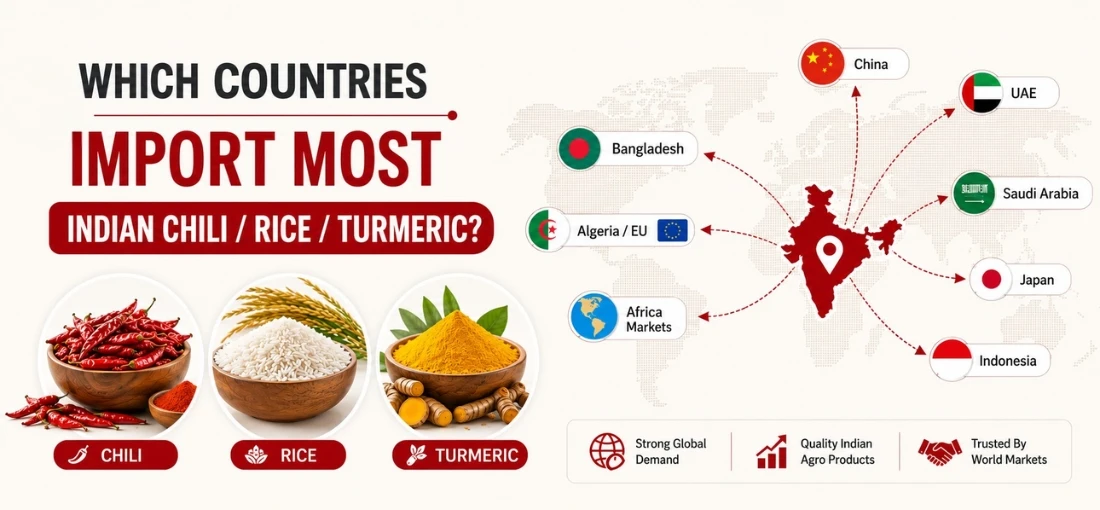
- China continues to dominate bulk chilli purchases from India, making it the backbone of the country's chilli export trade.
- Bangladesh remains one of the most dependable destinations for both chilli and turmeric shipments.
- The UAE's importance goes far beyond consumption, acting as a gateway for spice distribution across the wider Middle East.
- Demand for Indian turmeric is increasingly being driven by wellness, nutraceutical, and functional food industries.
- Spices Exporters targeting the US market can often secure better value, provided they meet stringent quality and compliance standards.
- Volume-driven markets and premium markets require completely different export strategies.
- For chilli and turmeric exporters, understanding where products are consumed versus re-exported is becoming a major competitive advantage.
- The strongest opportunities lie in combining consistent supply capabilities with destination-specific quality requirements.
The global spice trade depends heavily on a handful of high-capacity agricultural hubs to keep its supply lines moving. Look closely at the macro-movements of key rhizomes and pods, and the high regional concentration becomes obvious. Two specific crops consistently anchor the largest outbound container volumes leaving coastal terminals: chilli and turmeric.
For an active domestic trade desk, hunting down where these shipments actually drop anchor is a necessity. Relying on guesswork won't help you lock in multi-vessel supply agreements or secure reliable freight rates with ocean liners. You have to map the exact geographic hot spots currently tracked on the trading floor.

The global appetite for Indian spices remains strong. The spice exports from India climbed to an all-time high of 17.99 lakh tonnes in the financial year 2024-25. They generated massive exports worth ₹39,994.48 crore (US$ 4.72 billion). These numbers once again highlight India's clear dominance in the global spice market and the growing demand for its diverse range of spices across international markets.
Keep reading this informative piece of blog if you want to export turmeric or Chillies globally. It will provide you with detailed information on the same.
Top Chilli Importers: Primary Destination Markets
Dry chilli remains one of the heaviest bulk items cleared for outbound transit at Indian container bays. While smaller, niche ethnic brands across Western markets keep up a steady baseline of retail orders, the real volume—the kind that fills thousands of continuous twenty-foot equivalent units (TEUs)—flows directly into industrial food manufacturing sectors across East Asia and the Middle East.
If you analyze the underlying ledger tracking which countries import Indian chilli, the raw volume breakdown reveals clear patterns of market dominance:
Major Destination Ports for Indian Chilli
| Global Destination | Fiscal Cycle | Volumetric Export Weight (Metric Tons) | Total Financial Valuation (INR Lakhs) | Total Financial Valuation (USD Millions) | Core Industry Application |
|---|---|---|---|---|---|
| CHINA | 2022-23 | 157,935.05 | 340,870.68 | 424.21 | Bulk extraction for oleoresins and hot sauce blending. |
| 2023-24 | 179,672.38 | 412,363.03 | 498.08 | High-volume raw inputs for commercial paste factories. | |
| 2024-25 | 236,831.45 | 385,749.86 | 450.29 | Dominant global buying hub for value-added processing. | |
| BANGLADESH | 2022-23 | 53,986.13 | 89,234.02 | 111.05 | Cross-border retail distribution and daily culinary staples. |
| 2023-24 | 90,570.52 | 121,028.78 | 146.19 | Steady rail and road container intake. | |
| 2024-25 | 116,711.36 | 112,680.12 | 133.37 | Massive near-market volume expansion. | |
| THAILAND | 2022-23 | 54,512.19 | 126,943.49 | 157.98 | Regional processing and ready-to-eat export bases. |
| 2023-24 | 59,838.98 | 140,486.56 | 169.69 | High-grade packaging lines for Southeast Asian retail. | |
| 2024-25 | 55,102.90 | 104,426.64 | 123.07 | Balanced industrial seasoning intake. | |
| UNITED STATES | 2022-23 | 29,173.75 | 80,362.49 | 100.01 | Strict clean-label retail and premium organic options. |
| 2023-24 | 36,413.22 | 114,138.10 | 137.86 | High-ASTA color-graded specifications. | |
| 2024-25 | 39,466.11 | 112,349.98 | 132.94 | Industrial food processing and spice grinding mills. |
Sources: Spices Board of India Official Custom Tracking Ledger
China stands completely ahead of the pack here. Looking at the top chilli importers roster, the Chinese market absorbed over 236,000 metric tons during the latest final reporting cycle. This highlights a clear split in strategy for local trading firms. You can chase the tighter quality premiums in Western lanes like the US, where strict certification rules keep margins higher per kilo. But if your goal is maintaining continuous, large-scale milling and sorting shifts at your plant, you need the massive, predictable volumes found in East Asian corridors.

Top Turmeric Importers: Sourcing Zones and Global Intake
Global procurement managers evaluate the turmeric market along two completely separate lines. If you want to export turmeric in bulk , there is the standard, high-volume grinding grade destined for household culinary packs, and then there are the specialized, high-curcumin lots bought by nutraceutical and wellness firms. Because domestic growers control the vast majority of the world's turmeric cultivation acreage, overseas buying houses bypass secondary networks and set up long-term sourcing deals directly with Indian processing plants
Bilateral custom logs pinpoint the primary trade lanes, showing exactly which countries import Indian turmeric at an industrial scale:
Major Destination Ports for Indian Turmeric
| Global Destination | Fiscal Cycle | Volumetric Export Weight (Metric Tons) | Total Financial Valuation (INR Lakhs) | Total Financial Valuation (USD Millions) | Core Industry Application |
|---|---|---|---|---|---|
| BANGLADESH | 2022-23 | 34,523.90 | 26,092.59 | 32.47 | Direct consumer packaging and local seasoning mills. |
| 2023-24 | 37,577.13 | 32,825.54 | 39.65 | Wholesale market distribution and daily staples. | |
| 2024-25 | 34,073.12 | 40,798.90 | 48.35 | Steady bulk volumes with optimizing margins. | |
| U.A.E. | 2022-23 | 18,980.25 | 15,830.94 | 19.70 | Transshipment hub for the broader Middle East and North Africa. |
| 2023-24 | 17,316.11 | 19,799.42 | 23.92 | Re-exportation networks and bulk trade desks. | |
| 2024-25 | 25,135.96 | 39,966.19 | 47.52 | Marked value growth and terminal inventory storage. | |
| UNITED STATES | 2022-23 | 7,009.43 | 13,219.96 | 16.45 | Functional food supplements and organic wellness products. |
| 2023-24 | 8,602.79 | 16,113.37 | 19.46 | High-curcumin content extraction lines. | |
| 2024-25 | 8,536.35 | 22,257.57 | 26.28 | Premium wellness retail and clean-label dyes. | |
| MOROCCO | 2022-23 | 10,663.63 | 9,237.58 | 11.50 | Traditional culinary blends and North African spice suqs. |
| 2023-24(*) | 7,826.43 | 7,624.03 | 9.21 | Bulk wholesale imports for regional grinding plants. | |
| 2024-25(**) | 9,390.32 | 14,633.17 | 17.24 | Resilient consumer demand across localized networks. |
Sources: Spices Board of India Official Custom Tracking Ledger
The prominent position of the UAE tells an interesting story among top turmeric importers. While Bangladesh takes in a massive, flat layer of raw volume for internal consumption, Dubai operates strictly as a financial and logistical transshipment node. The massive value optimization shown in the recent cycle—climbing past 39,000 INR Lakhs—confirms that Western buyers and Middle Eastern distribution houses are using UAE free zones to store inventory, manage spot prices, and re-route whole polished fingers to secondary destinations across North Africa and the Levant.
Market Implications for Indian Trade Desks
The geographic footprint carries an explicit message for domestic spices exporters : stop treating every international market with the same identical sales pitch.
When you are routing shipments into high-volume corridors like China or Bangladesh, success hinges completely on your operational speed, raw pricing decimals, and securing container space before seasonal freight spikes. Facilities situated near ports like Mundra or JNPT have to run tight, high-speed cleaning lines to process thousands of tons without letting impurities drop the batch grade.
But if you are aiming your containers at hyper-regulated destinations like the United States or the European Union, your business model has to shift entirely toward strict risk shielding. In these lanes, buyers don't care about a minor discount on the price per ton if your documentation lacks verified laboratory assays. Profitability depends on total compliance: keeping moisture levels under strict caps, managing aflatoxin limits, and proving your batch traceability right back to the field. Aligning your processing infrastructure with these separate market demands is how you keep your container bays busy while protecting your top-line margins.
Conclusion
Protecting your margins in the agricultural export game isn't about pulling off a massive logistical miracle. It really comes down to boring, daily discipline. Once you start tightening your CHA contracts, maximizing your container space, and locking in your bank rates, those unexpected leaks stop happening. Moving away from risky spot trading and running a tight, predictable supply chain is exactly how you turn a volatile trade desk into a highly profitable, sustainable international business.