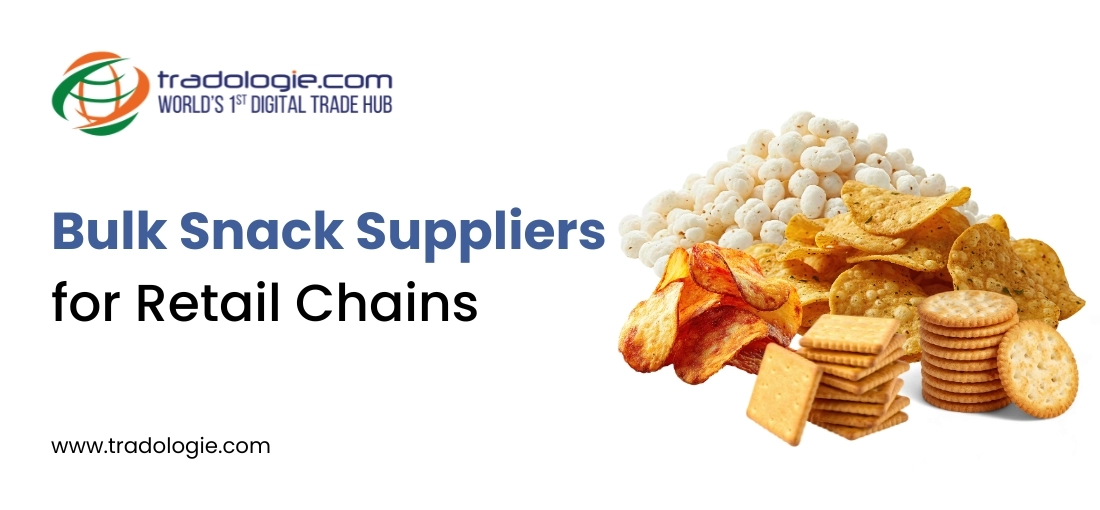
The retail industry is undergoing a dramatic paradigm change. The primary cause of this change is shifting consumer consumption habits. In addition, the demand for everyday convenience is unrelenting worldwide. The snack food industry is at the heart of this change. The category's financial forecasts are astounding. The snack food market was estimated to be worth an astounding USD 490.75 billion in 2024 by Straits Research. This amount is expected to increase to a staggering USD 686.49 billion by 2033.
Hypermarkets and large retail chains have unique operational challenges. It takes much more than just premium shelf space to secure a profitable portion of this market. It necessitates a robust and highly optimized procurement network. Additionally, this network needs to be strategically aligned with the overall objectives of the company. It is no longer merely a fundamental operational requirement to navigate the intricate network of bulk snack suppliers. Instead, it acts as a crucial lever. In the highly competitive world of international trade, it is absolutely necessary to maximize retail margins.

Evaluating Global Snack Trade Dynamics and Volume
It is crucial to comprehend the macroeconomic flow of bulk snacks. To effectively diversify their sourcing matrices, procurement officers need to understand these dynamics. Nowadays, a few major export hubs play a major role in the global trade of processed snacks, agro-commodities, and ready-to-eat (RTE) foods.
China's Export Dominance: Exports of OEM and mass-produced snacks are still dominated by China. Its unmatched manufacturing capacity is the direct cause of its dominance. For large purchasers, it also provides substantial, unbeatable cost savings.
India's Agro-Commodity Expansion: On the other hand, markets like India are quickly spreading throughout the world. They are becoming leading exporters of agro-based value products and ethnic snacks. These markets effectively take advantage of a robust domestic supply of basic spices and pulses.
Take a look at recent baseline data to put international trade volumes in perspective. The amount of snack food imported into the US has increased dramatically, according to IndexBox market intelligence. In October 2023 alone, these import volumes came to $85 million. Mexico and Canada were the primary suppliers at this time. Retail chains must thus constantly assess these changing geographic trade flows. By doing this, unanticipated geopolitical risks are reduced. In the end, it maximizes their long-term import plans.
Navigating Raw Material Price Volatility in Agro-Commodities
The foundation of the global bulk snack trade rests entirely on agricultural outputs. Consequently, retail procurement strategies face significant vulnerabilities. They are extremely vulnerable to the volatile fluctuations of the world's commodity markets.
Forecasts for the industry show that things will be very unstable in the near future. Current estimates say that prices for agricultural goods around the world could change by as much as 15% by 2026. This instability is caused by a number of macroeconomic factors that are coming together. These are things like extreme changes in the weather and changes in international trade policies. Ongoing global supply chain bottlenecks also play a major exacerbating role.
Retail buyers really need to know about these upstream dynamics. This is particularly true when searching for specific agricultural products. Some great examples are high-end broken rice crackers with spices, roasted pigeon peas, and lentil chips that have been extruded.
Think about how things in the supply chain affect each other:
- South Asian pulse yields could be significantly impacted by an abrupt climate event.
- On the other hand, important flavoring ingredients like cloves and moringa may result in higher freight costs.
- The supply chain is quickly affected by these disruptions.
- In the end, they inflate the snack product's final FOB (Free on Board) price.
Astute procurement officers are making a concerted effort to reduce these risks. Long-term forward contracts are becoming more and more locked in. They specifically go after vendors who have operations that are vertically integrated. Nowadays, having direct access to nearby farming cooperatives is a highly valued quality for suppliers. Crucial pricing stability is ensured by this tactical approach. Above all, it permanently protects retail margins from unexpected, abrupt macroeconomic shocks.
Key Criteria for Selecting Bulk Snack Suppliers
Retail chains need to look far beyond simple pricing models when assessing international bulk suppliers. Extensive due diligence is necessary. Several crucial factors must be included in a thorough supplier assessment:
Production Scalability: Evaluate the supplier's capacity first. Can they manage demand spikes during certain seasons with ease? One of the best times to witness such a spike is during the holidays. They have to be able to increase output without sacrificing lead times.
Quality Assurance and Traceability: Food safety cannot be disregarded. For suppliers, having internationally recognized certifications is essential. Examples include ISO 22000, GFSI, and HACCP. These credentials are necessary to lower the high risk of product recalls.
Raw Material Sourcing: This is especially crucial for snacks made from agricultural commodities. This includes extruded chips made from lentils, nuts, and roasted chickpeas. Does the supplier have direct access to superior agricultural inputs? The final product's consistency is directly determined by this access. It also has a significant impact on controlling price volatility.
Private Label Capabilities and Margin Arbitrage: Retailers need suppliers that provide OEM and white-labeling services in order to increase profitability. Compared to national brands, which typically have gross margins of 26%, private-label grocery products offer substantially higher gross margins of about 35%. Retailers can avoid marketing expenses and directly profit from this margin arbitrage by collaborating with foreign manufacturers who can match brand quality.

Understanding International Trade Laws and Compliance
Regulatory obstacles are a natural part of cross-border bulk trade. Snack food imports by retail chains must adhere to stringent regulations. They have to make sure that the food safety regulations of the destination nation are strictly followed. For example, FDA regulations are strictly enforced in the United States. In a similar vein, the European Union uses comprehensive EFSA guidelines.
Moreover, the product's nature introduces yet another level of complexity. Strict phytosanitary certifications are frequently required for the importation of agro-based snacks. To stop cross-border agricultural contamination, these documents are essential. In this changing environment, importers need to maintain a high degree of agility. They must continuously keep an eye on changing tariff structures. Bilateral trade agreements also require close and continuous attention. Finally, complex customs documentation requirements must be managed perfectly. Mastering these elements is the only way to prevent costly port delays or cargo rejections.
How Supply Chain Logistics Affect Retail Margins
Bulk retail operates in a notoriously high-volume, low-margin world. In this environment, logistics can truly make or break profitability. The landed cost of imported snacks is directly impacted by a number of logistical factors. These include persistent port congestion, erratic container availability, and varying freight rates.
Optimized bulk packaging is critical due to these factors. Utilizing flexible packaging solutions is highly recommended. High-barrier, multi-layered pouches are a prime example. They effectively extend the product's shelf life. More importantly, they maximize container space utilization far better than traditional rigid packaging.
Efficient palletization is another crucial factor. Strategic warehousing nodes must be combined with this. These strategies work together to help retail chains maintain the proper level of inventory on hand. As a result, companies drastically reduce their holding costs. They guarantee a consistent, dependable product rotation on the store shelves at the same time.
Cost-Benefit Analysis: Domestic vs. International Procurement
Procurement strategists constantly weigh the advantages of sourcing locally versus importing in bulk. Finding the right balance is key to a resilient supply chain.
| Procurement Strategy | Cost Implications | Lead Times & Logistics | Supply Chain Control | Product Variety |
| Domestic Sourcing | Generally higher unit costs due to local labor and manufacturing rates. | Short lead times; lower freight costs; minimal customs delays. | High visibility and easier supplier auditing. | Limited to regionally available raw materials and local manufacturing capabilities. |
| International Bulk Import | Lower unit costs; economies of scale; favorable exchange rates. | Longer transit times; vulnerable to global shipping disruptions and port congestion. | Requires robust third-party auditing and strict Service Level Agreement (SLA) enforcement. | Access to diverse, exotic, and specialized global snack varieties. |
Demographic Segmentation: How Gen Z and Millennials Are Redefining the Snack Aisle
While macroeconomic data dictates how and where to source bulk snacks, demographic data dictates exactly what needs to be sourced. Younger generations, particularly Generation Z and Millennials, are currently actively rewriting the global snacking landscape. There is a serious risk of inventory misalignment when procurement matrices do not take these particular generational behaviors into consideration.
Retail buyers need to adjust to these particular behavioral trends in order to profit from this demographic shift:
- The "Snackification" of Meals: The conventional three-meal format is becoming less common. Nowadays, 74% of consumers under 35 snack several times a day, essentially taking the place of traditional sit-down meals.
- Demand for High-Satiety: Purchasing needs to move away from empty calories since snacks are taking the place of meals. Purchasers must find filling, nutrient-dense options (such as ancient grain clusters or high-protein extruded pulses).
- "Moodful" and Functional Ingredients: Approximately 60% of Gen Z consumers actively look for snacks that improve cognitive function or reduce stress. This is generating a sizable market for probiotic and adaptogen-enhanced snacks, like ashwagandha.
- The Push for Absolute Authenticity: By 2033, the ethnic food market is expected to grow to a value of USD 138 billion. Younger, more diverse consumers prefer authentic, locally sourced snacks to westernized imitations.
- Complex Flavor Profiles: Monolithic flavors are losing ground. Procurement officers must hunt for trending, multi-layered profiles—specifically "swicy" (sweet and spicy) and the rapidly growing "swalty" (sweet and salty) combinations from international OEM partners.
- Packaging as a Function of Lifestyle: Modern retail must source single-serve, highly portable, and resealable bulk packaging because younger demographics prefer to graze all day while on the go.
Emerging Consumer Trends Shaping Bulk Import Strategies
Retail buyers simply cannot afford to source bulk snacks in a vacuum. Operating without external context is no longer a viable strategy. Instead, procurement must align seamlessly with shifting consumer dietary profiles. Buyers need to thoroughly understand what people actually want to eat today.
The market is currently undergoing a significant turn. Health-conscious snacking is becoming increasingly popular among consumers.
The largest market share is still held by savory snacks. Straits Research clearly notes this ongoing dominance. The underlying preferences within that category, however, are evolving quickly. Retailers need to identify a few significant changes in order to take advantage of this:
- The Rise of Clean Labels: More and more people around the world want ingredients that are clear and easy to find.
- Protein-Powered Options: People are actively looking for snacks that give them a healthy boost.
- Plant-Based Substitutes: The market for snacks that don't have meat or dairy in them is growing quickly.
As a result, retailers are quickly changing how they import goods. More and more people are buying bulk snacks made from valuable agricultural products. Examples of this are lentil chips that have been extruded and energy bars that have moringa in them. Additionally, consumers are increasingly demanding roasted ancient grains.
It is crucial to anticipate these trends in market intelligence. Retail chains can import highly targeted product mixes thanks to it. The continuous "premiumization" of the snack aisle is directly addressed by these specialty assortments. In the end, this strategic alignment results in much higher point-of-sale revenues.
Conclusion: Securing Competitive Advantage Through Resilient Partnerships
Finding the best bulk snack suppliers is ultimately a very difficult task. Still, it's a very fulfilling one. To be successful, retail chains need to actively reconsider their vendor relationships.
Vendors of goods and services should never be viewed as simple transactional entities. Rather, they need to be carefully developed as genuine strategic allies. This cooperative strategy creates vital operational resilience. In today's unstable market, this resilience is the only way to successfully withstand the inevitable global supply chain shocks.
Looking to partner with global FMCG brands? Start your distributorship journey
Securing a long-term advantage relies on a multifaceted approach. Retailers must execute on three main fronts:
- Actively leveraging accurate, real-time market data.
- Prioritizing strict, uncompromising regulatory compliance.
- Continuously aligning procurement with shifting consumer preferences.
Major retailers can completely change their bulk snack sourcing by grasping these fundamental components. It develops into a significant competitive advantage from a fundamental operational requirement.



.webp "FMCG Distributorship: Where the Real Profit Hides")