Key Highlights
- Global spices market projected to reach $9.7B with 6.5% CAGR
- India exports 60+ spices and contributes ~9% to agri exports
- FCL shipments allow 13–18 MT per container for cost efficiency
- Cumin exports can generate ~15–16% profit margin per container
- USA/EU markets offer higher margins (up to 25%) with compliance
- ASEAN & China are high-volume, fast-moving markets
- Export value of Indian spices reached $4.45B in FY 2024–25
India’s dominance in the global spice arena is not just a matter of heritage; it is a calculated commercial powerhouse. As the world’s appetite for authentic, punchy flavors grows, the Indian spices export market is seeing a massive shift toward large-scale, high-efficiency operations. For an exporter then moving beyond small shipments and mastering the full container load (FCL) is the fastest way to turn a modest trade into a high-margin enterprise.
The global spices market is witnessing steady growth, driven by rising demand for authentic cuisines across regions. According to Grand View Research, the market was valued at USD 5,859.2 million in 2019 and is projected to reach USD 9,700.8 million by 2027, growing at a CAGR of 6.5%.

Understanding the Indian Spices Export Market
India continues to be one of the largest suppliers in this growing global market, benefiting from rising international demand trends. In the current trade cycle the country has maintained its position as the "spice bowl" of the world so that it leverages its diverse agro-climatic zones to produce over 60 of the 109 varieties recognized by the ISO. This sector now contributes roughly 9% of India's total agricultural exports, reinforcing its status as a trusted global processing hub.

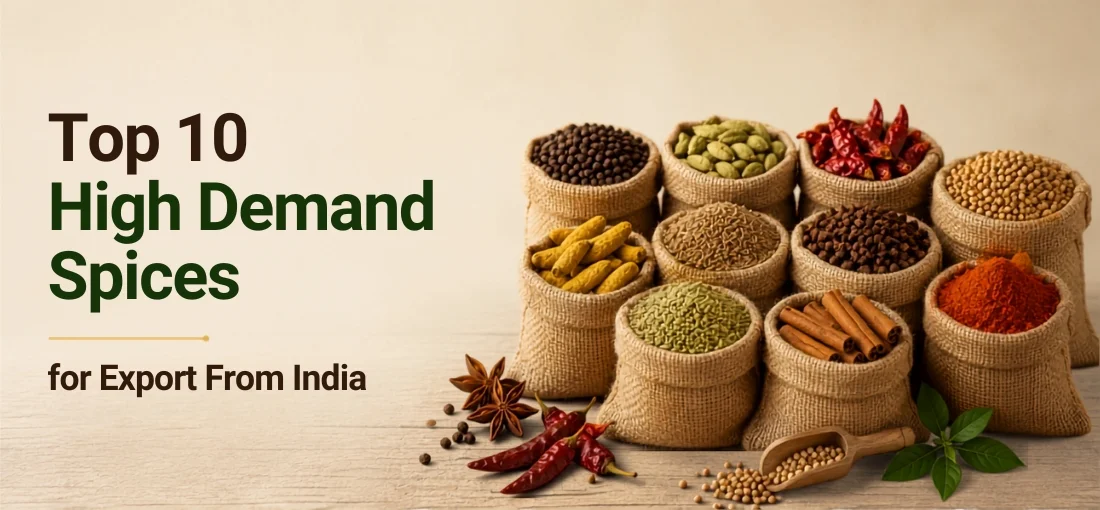
This dominance is led by a "power basket" of commodities that are essentially the heartbeat of the trade:
- Chilli: India's leading spice export, which saw a massive valuation of USD 1,508.94 million in FY 2023-24.
- Cumin: India produces nearly 80% of the world’s supply where recent cycles recorded export values reaching USD 700.23 million according to Spices Board of India
- Turmeric: Often called "Indian Saffron," India controls a lion’s share of global production, contributing USD 226.58 million in value during the same period.
- Spice Oils & Oleoresins: A critical value-added segment that recorded USD 498.01 million in exports for FY 2023-24.
How Full Container Load (FCL) Spice Export Works
When you export bulk spices then you aren’t just selling a product; you are managing a complex logistics chain where the container choice dictates your survival. A standard 20-foot container (FCL) is the "gold standard" for spice traders. Unlike LCL, where your goods share space with other cargo then FCL gives you total control over the environment.
The logic is simple:
- Maximum Volume: You can fit roughly 13 to 18 MT of spices like cumin or chilli so that you maximize the space depending on how tightly you pack the bags.
- Reduced Risk: The container is sealed at your warehouse and stays that way until the buyer’s port so that you lower the risk of cross-contamination—a major factor given that India exports to over 200 destinations.
- Cost Efficiency: Your fixed costs—like Bill of Lading and documentation—are spread across 18 tons instead of just a few pallets so that you get a much better price-negotiating lever.

Cost Breakdown of Exporting a Full Container of Spices
To run a profitable trade then you must look beyond the procurement price at the local mandi. A professional 2026 cost structure for a 20ft container involves several layers that most beginners ignore until they see their first invoice.
- Procurement & Cleaning: You have to buy at the right time. Madhya Pradesh is a massive source for traders, leading the country's production with 3.63 million tonnes in 2023-24.
- Packaging: While 25kg or 50kg PP sacks are the industry standard then moving toward premium retail-ready packs can increase your margins by 5-8%.
- Port Logistics: Inland transport is a major variable. Gujarat currently leads the way, accounting for 23.53% of total spice exports from India.
- Compliance & Testing: Steam sterilization is becoming a mandatory requirement. Initiatives like the SPICED scheme are now helping exporters upgrade post-harvest quality to meet these global bars.
Country-Wise Price Comparison for Indian Spices
Buyer behavior varies wildly by region so that your pricing strategy has to reflect the local market’s appetite for quality vs. price. In FY 2024-25, top destinations like China, the USA, and the UAE collectively accounted for over 60% of total export earnings.
| Spice Variety | Destination Market | Purity Level | Tentative FOB Price (per MT) |
|---|---|---|---|
| Cumin Seeds | UAE / Bangladesh | 99% Singapore Grade | $2,500 – $2,850 |
| Cumin Seeds | USA / Europe | 99.5% Sortex Cleaned | $3,800 – $4,200 |
| Turmeric Finger | UAE / Malaysia | Double Polished | $1,650 – $1,800 |
| Red Chilli (Teja) | China / Vietnam | Export Quality | $2,800 – $3,300 |
Profit Calculation: Full Container Spice Export
Let’s look at a 2026 P&L example for a standard 20ft Container of Cumin (18 MT) being shipped to a high-volume market like the UAE.
- Total FOB Value: Selling at an average of $3.50/kg puts your total container value at $63,000 (approx. ₹52.3 Lakhs).
- Total Procurement & Operational Costs: Once you factor in buying the seeds, cleaning, and professional bagging, your total cost hits roughly ₹44 Lakhs.
- Gross Profit: You are looking at ₹8.32 Lakhs per container.
- Profit Margin: This sits at a healthy ~15.9%.
The total export value for Indian spices hit USD 4.45 billion in FY 2024-25. And this proves that even with these high operational costs, the growth trajectory is still pointing up.
High Margin vs High Volume Markets
Exporters often face a classic dilemma where they have to decide if they sell massive volumes to nearby markets or target the high-compliance West.
- High Volume (China/ASEAN): China simply is a massive buyer, and the ASEAN region alone accounted for USD 533 million in export value. This because these specific markets often prioritize not just the quality but speed and sheer volume over ultra-premium certifications that make the container shipment ready.
- High Margin (USA/Europe): The NAFTA region imported USD 788 million, with the USA favoring specialized items like celery, curry powder, and mint products. Margins here can easily hit 25% if you meet their strict safety standards.
The Role of Technology in Spice Exports
The old days of buying "as is" are gone. Modern profitability is driven by technology so that the Spices Board has established eight crop-specific Spices Parks across India. These parks, located in hubs like Chhindwara for garlic and Guntur for chillies, offer exporters access to advanced cleaning, grading, and grinding facilities. Using these incubation centers is a trend that is starting to take off so that buyers can trust they are receiving safe, value-added products.
Challenges: The Hidden "Profit Killers"
Even in a perfect market then there are traps that can turn a green trade into a red one.
- Price Volatility: The market can shift wildly; between 2013-14 and 2024-25, export value shot up by 97% even as volumes grew by 88%, highlighting just how much price realization moves.
- Moisture Levels: Failing to handle post-harvest moisture correctly is a serious threat to your bottom line. The SPICED scheme, with its Rs. 422.30 crore outlay, was built specifically to tackle these quality gaps.
- Compliance Shifts: Regulations change without warning so that staying updated on international standards is the only way to avoid total cargo rejection.
Conclusion: The Future of Indian Spices Export Market
With the global spices market projected to reach nearly USD 9.7 billion, exporters from India are well-positioned to benefit from increasing demand across premium and bulk markets. Backed by government initiatives and modern processing infrastructure, India is transitioning from a raw commodity supplier into a globally competitive powerhouse for value-added spices. The play is clear: scale up your volume so that you master the FCL logistics and leverage India's leading position in the global spice movement
Want to export spice globally? Register as a seller and get verified buyers today.
Disclaimer
The cost, pricing, and profit figures mentioned are indicative and for informational purposes only. Actual export profitability may vary based on market conditions, commodity pricing, logistics costs, and buyer negotiations. Exporters should conduct real-time analysis before making trade decisions.
Sources: Spices Board of India, PIB, Grand View Research
Writer Profile
Pravarsh Sharma - Trade Expert at Tradologie.com
Pravarsh Sharma is directly involved in international trade assistance and global B2B sourcing. He helps exporters scale operations, optimize logistics, and connect with verified international buyers to improve profitability in commodity trade.