.webp "Soybean Price Today in India: Mandi Rate & Market Analysis 2026")
Key Highlights
- Soybean prices in India currently range between ₹4,200 to ₹5,200 per quintal.
- Prices vary based on quality factors like moisture, grain size, and oil content.
- Major price drivers include arrival volumes, crusher demand, and global markets.
- India’s soybean market is closely linked with Brazil, US, and China demand trends.
- MSP acts as a price support benchmark, not a fixed trading price.
- Futures trading (NCDEX) helps predict market direction and price expectations.
- Key mandis include Indore, Ujjain, Latur, Akola, and Kota.
Intro:
Understanding Soybean Pricing in the Commodity Market
In global commodity trade, pricing is not just a number. It’s the most critical decision point. Whether you’re a farmer, trader, processor, or bulk buyer — everything ultimately comes down to price. When to sell, when to hold, when to buy… All of it depends on how you read the market.
And soybean is no different. The soybean mandi rate in India is not decided by a single factor. It is shaped by a combination of very specific variables working together at the same time.
For instance, in any mandi, the price of soybean is influenced by:
- quality parameters like moisture, grain size, and oil content
- arrival volumes during harvest and post-harvest cycles
- demand from crushers producing oil and soymeal
- global soybean trends, especially from countries like Brazil and the US
- and even trader behaviour, where stock holding can tighten supply
So when someone tracks the soybean price today, what they are really looking at is the final outcome of all these moving parts.
That’s why prices don’t move randomly. They respond. Sometimes to visible factors like arrivals. Sometimes to expectations like future demand.
And that’s exactly what makes soybean pricing worth understanding in detail — especially if you’re trying to make a decision, not just observe the market.
Soybean Mandi Rate in India – Current Price Range Explained Properly
As of early 2026, soybean prices across major mandis are generally moving in the range of: ₹4,200 to ₹5,200 per quintal. But if you think this is “the price”, that would be incomplete.
Because within the same mandi, on the same day, prices can vary.
And that happens because soybean is not traded as a uniform product.
Quality Factors That Influence Price Variation
What Actually Changes the Soybean Mandi Rate in India
When soybean traders bid for soybean lots, they are not just looking at weight.
They are evaluating:
- moisture content (higher moisture reduces storage life)
- grain size and uniformity
- foreign matter (dust, stones, impurities)
- oil recovery potential
So two farmers bringing soybean to the same mandi can get different prices.
That’s why when someone searches for soybean rate today, the correct interpretation is not a fixed number, but a price band influenced by quality.
Disclaimer: The above price range is indicative based on recent mandi trends and may vary daily depending on location, arrivals, and crop quality.
Why Soybean Prices Move – Full Market Explanation
Now let’s get into the part that most blogs oversimplify.
Soybean prices don’t move because of “demand and supply” in a generic sense. They move because of specific triggers.
1. Arrival Pressure – The First Real Driver
During harvest months (mainly October to December), soybean arrivals increase sharply.
Now think about it practically. When mandis suddenly receive large quantities:
- traders have more options
- urgency to buy reduces
- prices soften
But once arrivals slow down, the situation flips.
- supply tightens
- traders compete more
- prices stabilise or rise
So if you track mandi data regularly, you’ll notice that price movement often follows arrival cycles, not just demand.
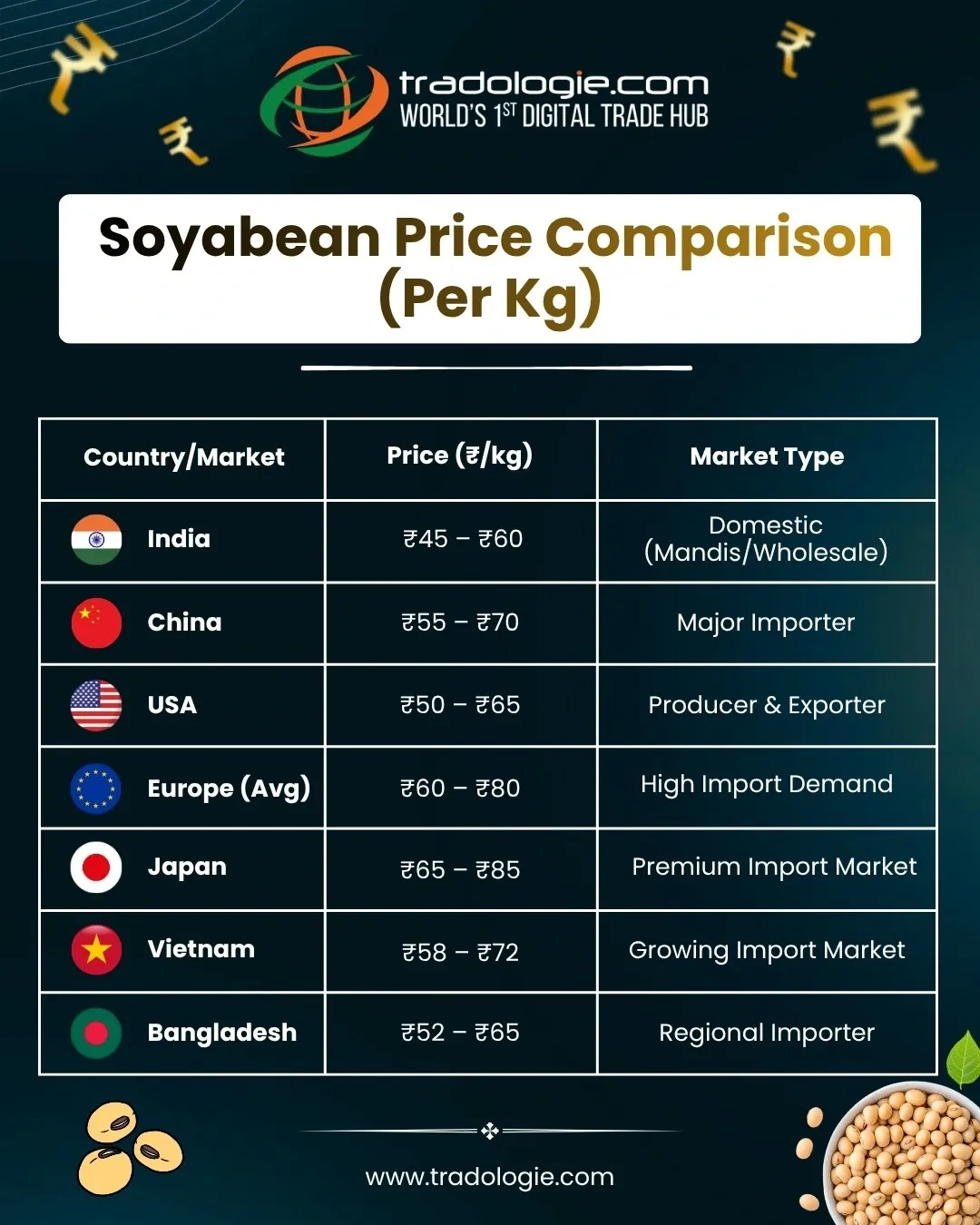
2. Crushing Demand – The Hidden Backbone
Soybean is not primarily consumed directly.
It is crushed into:
- soybean oil
- soybean meal
Now here’s where it gets interesting.
If oil prices are strong or soymeal demand increases (especially for poultry feed), crushers become more aggressive buyers.
And when crushers enter the market actively:
- mandi demand increases
- prices get upward support
So in reality, soybean pricing is indirectly linked to:
- edible oil demand
- livestock and poultry industry
3. Global Market Linkage – Not Optional Anymore
India may be a domestic market, but soybean pricing is influenced globally.
For example:
- if Brazil has a strong crop → global prices soften
- if US output drops → global prices rise
And since India participates in global trade (especially in soymeal), domestic prices adjust accordingly.
So when you track soybean future price India, you’re actually tracking global signals entering local markets.
Deeper Global Demand Dynamics (Often Ignored)
Now here’s where things get a bit deeper, and this is something most surface-level content completely skips.
According to insights published by the USDA (Economic Research Service), global soybean trade is heavily influenced by feed demand and livestock production cycles, not just edible oil consumption.
Which means soybean is not just a food commodity.
It is also a feed-driven commodity.
For example:
- When countries expand poultry or livestock production → soymeal demand increases
- When soymeal demand rises → crushing demand increases
- And that eventually pushes soybean prices upward
Another important layer here is China.
China is not just a large importer — it is the single biggest driver of global soybean trade flows.
Even a small shift in China’s import policy, stockpiling behaviour, or feed demand can:
- move global soybean prices
- and indirectly impact the soybean mandi rate India
So when you see prices moving in Indian mandis without a clear local reason…
There’s a good chance the trigger is coming from global trade dynamics, not domestic supply.
Soybean MSP 2026 – What It Really Means in the Market
The soybean MSP 2026 is expected to stay close to recent government benchmarks, around ₹4,600 per quintal (as per Government of India MSP announcements in previous cycles).
Now MSP is often misunderstood.
It is not the price at which all trade happens.
It is a safety benchmark.
How Soybean MSP 2026 Actually Works in Reality
The soybean MSP 2026 is often seen as just a government-declared price, but in practice, it plays a much more layered role in the market.
It doesn’t directly decide the mandi price every day.
Instead, it quietly shapes how different participants behave when prices move around it.
Let’s understand this properly.
When Mandi Prices Fall Below Soybean MSP 2026
If the soybean mandi rate India drops below the MSP level (around ₹4,600 per quintal in recent cycles), a few things start happening almost simultaneously.
- Farmers usually become reluctant to sell immediately.
- Instead of offloading produce at lower prices, many prefer to hold stock, either at farm level or through local storage.
At the same time, government agencies may step in for procurement, depending on policy implementation and region. This reduces the quantity available in the open market.
Now combine both effects:
- less selling from farmers
- partial procurement by government
This tightens open market supply.
And once supply reduces while demand (especially from crushers) remains steady, prices start stabilising or even moving upward.
So MSP doesn’t “increase prices” directly. It prevents prices from falling too far below a certain level.
When Mandi Prices Are Above Soybean MSP 2026
Now flip the situation.
If the soya bean price today is already trading above MSP:
- farmers are more willing to sell
- private buyers dominate procurement
- government intervention becomes minimal
In this scenario, the market operates freely based on:
- demand from crushers
- export opportunities
- global price signals
MSP quietly steps into the background.
The Real Role of MSP in Soybean Trade
So if you look at it from a trader’s or buyer’s perspective, MSP works more like a price safety boundary, not a target.
It helps in:
- reducing extreme price crashes during high-supply periods
- giving farmers a psychological and financial benchmark
- stabilising the market during weak demand cycles
But it does not cap prices on the upside.
Practical Insight
If you’re tracking soybean prices regularly, here’s how to use MSP properly:
- When prices approach MSP → watch for support levels
- When prices fall below MSP → expect supply tightening
- When prices stay above MSP → focus shifts to demand and global trends
So the soybean MSP 2026 is not just a number announced once a year.
It’s a reference point that quietly influences the entire pricing behaviour of the market throughout the season.
Soybean Future Price India – Understanding Market Direction
Now let’s go deeper into something most people overlook.
Spot price tells you where the market is.
Futures tell you where the market expects to go.
How Traders Use Futures
Soybean futures are traded on exchanges like NCDEX.
Let’s say:
- mandi price = ₹4,400
- futures price = ₹4,800
This gap is not random.
It indicates:
- expected tightening of supply or rising demand ahead
Similarly, if futures are lower than spot:
- market expects weakness
So serious buyers and traders don’t just track mandi.
They track futures + mandi together.
Global Soybean Market – Why It Matters for India
According to industry estimates (such as Grand View Research), the global soybean market was valued at around USD 193.10 billion in 2023 and is projected to reach USD 258.12 billion by 2030, growing at about 4.4% CAGR.
What’s Driving This Growth
- animal feed demand globally
- edible oil consumption
- processed food industry
And one key region stands out.
Asia Pacific holds over 40% of the market, with China being the largest importer.
Why This Affects India
When China imports more soybean:
- global demand rises
- prices strengthen
And India, even if indirectly, gets affected.
How Global Trade Translates into Indian Prices
Step 1: Global demand rises
Step 2: International prices increase
Step 3: Export parity improves
Step 4: Domestic buyers compete
Step 5: Mandi prices rise
Top Soybean Mandis in India
If you’re tracking the soybean mandi rate India, one thing becomes clear pretty quickly.
Not all mandis carry the same weight.
Some mandis don’t just trade soybean — they actually influence how prices move across regions. Traders, processors, and even bulk buyers tend to keep an eye on a few key markets because they give a more accurate sense of where the market is heading.
Let’s go through the major ones, not just by name, but by what role they play in the trade.
Indore Mandi (Madhya Pradesh)
Indore is often considered the most influential soybean mandi in India.
The reason is simple.
It sees:
- large daily arrivals during peak season
- active participation from major traders and exporters
- strong linkage with processing units and oil mills
Because of this, price discovery in Indore tends to be more competitive and transparent. Many traders across India look at Indore rates before making buying or selling decisions.
If there’s a shift in pricing here, it usually reflects broader market movement.
Ujjain Mandi (Madhya Pradesh)
Ujjain operates very close to Indore in terms of importance, but with slightly different dynamics.
It handles:
- significant arrival volumes
- a mix of local traders and bulk buyers
- steady procurement from crushers
Prices here often move in alignment with Indore, but sometimes you’ll notice slight variations based on arrival quality and timing.
For many traders, Ujjain acts as a secondary confirmation market — if both Indore and Ujjain show similar trends, the signal becomes stronger.
Dewas Mandi (Madhya Pradesh)
Dewas is another key mandi in the MP belt and plays a supporting role in overall price movement.
What makes Dewas important is:
- consistent arrivals
- proximity to processing hubs
- participation from regional buyers
While it may not set the benchmark like Indore, it helps validate whether price trends are consistent across the region.
Latur Mandi (Maharashtra)
Latur is one of the most important soybean mandis in Maharashtra and behaves slightly differently from MP markets.
Here, pricing is more closely tied to:
- local crushing demand
- activity of oil mills
- regional consumption patterns
So when crushers in Maharashtra are active, Latur mandi prices can move quickly, sometimes even independently of MP trends.
That’s why traders tracking soya bean rate today often compare Latur with Indore to understand demand vs supply dynamics.
Akola Mandi (Maharashtra)
Akola is another significant mandi in Maharashtra, especially known for:
- steady arrivals
- participation from local traders and processors
- regional distribution activity
Prices here reflect a balance between:
- supply from farmers
- and demand from nearby processing units
It’s not always the highest or lowest, but it gives a stable view of market conditions in the Maharashtra region.
Kota Mandi (Rajasthan)
Kota mandi operates in a slightly different way compared to MP and Maharashtra.
Arrivals are relatively lower, but that’s exactly why prices here can sometimes be higher.
With limited supply and steady demand:
- competition among buyers increases
- prices can firm up in certain periods
Kota becomes especially relevant when traders are looking at price differences across states for better buying opportunities.
What to Watch Going Forward in 2026
If you’re trying to understand where prices may head, watch these closely:
- arrival trends after harvest
- edible oil price movement
- soymeal export demand
- global soybean production
Final Thoughts
Soybean pricing in India isn’t just about checking the soya bean price today and moving on. It’s a mix of mandi-level activity, crusher demand, government benchmarks like soybean MSP 2026, and global trade movements happening in the background. Some days the trigger is local — like arrivals or quality. Other days, the movement comes from outside — global demand, export parity, or even shifts in soymeal consumption.




.webp "Trade Shows vs. Digital Trade Hubs in 2026: Why Smart Agro Exporters Prefer Tradologie for Verified Global Buyers")
.webp "Banana Export From India: Varieties, Top Markets And Trade Guide")