
Export Quality Standards You Must Know for Spices, Rice & Pulses
Because in bulk food trade, “acceptable” on paper still has to pass inspection on the dock
Key Highlights
- In agro exports business, quality isn't what looks good on paper. It's what survives inspection. Most shipments get judged by lab numbers and sampling sheets long before anyone talks about branding or packaging.
- Bulk Spice trade usually faces the toughest checks. One failed residue or microbial test and the whole container can sit at port, no matter how good the crop looked at origin.
- Rice and pulses are more practical stories. Bulk food traders mostly care whether the lot runs smoothly through their mills and plants without slowing things down.
- Moisture level is critical in every deal. Too much, and you invite mould or claims. Too little, and you start arguing over weight. That small number quietly decides a lot.
- Clean reports, correct HS codes, proper certificates — these things move cargo faster than any negotiation ever will.
- Over time, bulk agriculture importers simply stick with suppliers whose shipments arrive without drama. No surprises, no disputes. Just cargo that behaves the same way, every time.
Introduction
In agro exports, quality isn't a marketing adjective. It's a checklist. Somewhere between the warehouse and the vessel, your cargo will be opened, sampled, tested, and measured against tolerance limits you didn’t set. And if the numbers don’t line up, the shipment doesn’t move — simple as that.
Seasoned agriculture exporters learn this early. A lot can look excellent to the eye and still fail a certificate of analysis. A clean bag can still carry excess moisture. A bright sample can still trip a residue test. In international trade, inspection vocabulary quietly decides commercial fate.
Across spices, rice, and pulses, bulk agriculture buyers aren't chasing perfection. They're protecting process efficiency. They want lots that behave predictably on milling lines, packaging belts, or roasting drums.
So they talk in terms of specs, assay results, and rejection thresholds — not appearance
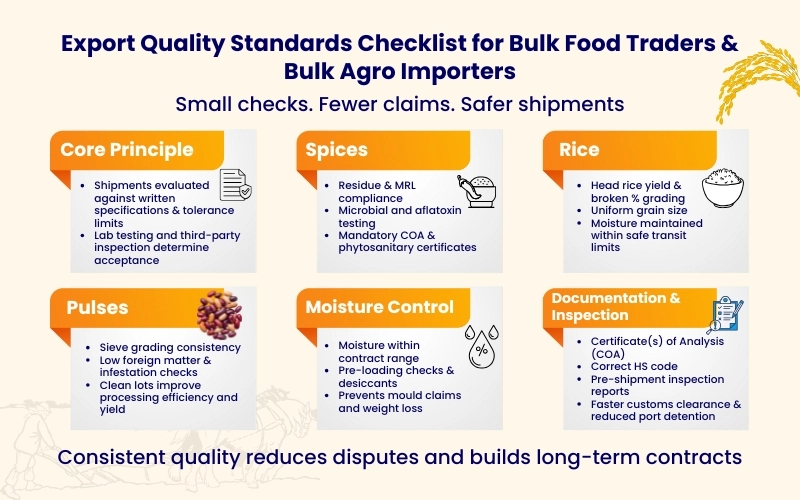
- Shipments are judged against written specifications, not promises
- Tolerance limits matter more than visual appeal
- Pre-shipment inspection is now standard practice
- Certificate of Analysis (COA) often decides acceptance
- Predictable lots win repeat contracts
Spices: Tested, Sampled, and Cleared Before They Even Board
Spices may look rustic, but they face some of the toughest quality protocols in food trade. Because they're concentrated ingredients, even tiny contamination levels get magnified downstream. So bulk spice importers rely heavily on lab assays and microbial checks before cargo is cleared.
It's common for inspectors to draw composite samples from multiple bags, send them for aflatoxin screening, and verify pesticide residues against strict MRL limits. If one parameter fails, the entire lot risks detention.
- Residue analysis and MRL compliance testing
- Salmonella and microbial load checks
- Moisture assay to prevent fungal growth
- Cleaning, sieving, and metal detection
- Mandatory COA and phytosanitary certification
Rice: Milling Yield Speaks Louder Than Looks
In the rice trade, beauty is secondary. What bulk rice buyers really care about is how the grain performs inside a mill. Head rice yield, broken percentage, chalkiness, and moisture determine whether processors make money or lose it.
So inspections often include screen grading, dockage checks, and random bag sampling. A shipment that disrupts milling recovery can quickly trigger claims or renegotiations. Reliability matters more than fragrance.
- Head rice yield and broken % measured carefully
- Dockage and foreign matter within tolerance
- Uniform grain size through screen grading
- Moisture balanced for safe transit
- Loading supervision and lot integrity checks
Pulses: Efficiency, Not Aesthetics
Pulses are treated like industrial inputs. They go straight into cleaning plants, splitting units, or canning lines. If the lot has excess dust, stones, or insect damage, machinery slows down and yield drops. And that inefficiency becomes a commercial loss both for pulses buyers and sellers.
So inspectors focus on sieve analysis, infestation counts, and impurity percentages rather than cosmetic quality. A “clean lot” simply runs better.
- Sieve grading for consistent size
- Low foreign matter and broken ratio
- Infestation and live insect checks
- Moisture stability for storage
- Random sampling under set protocols
Moisture: The Quiet Parameter Everyone Fears
If there's one number that makes bulk agriculture importers pause, it's moisture. Too high, and you risk mould claims. Too low, and you lose weight during transit. Every commodity has a safe band, and stepping outside it invites trouble.
Containers sweat during long voyages. Temperature swings create condensation. That's why many bulk food traders insist on documented moisture readings before stuffing.
- Handheld meters plus lab verification
- Random sampling across the lot
- Desiccants inside containers
- Pre-loading checks recorded in inspection logs
- Moisture kept within contract range
Paperwork Is Now Part of Quality Control
Quality doesn't end with the grain or spice. Documentation has become part of the inspection itself. A missing fumigation log or incorrect HS code can delay clearance just as quickly as a failed lab result.
Experienced exporters treat paperwork like cargo — it has to be complete, clean, and ready.
Faster customs clearance reduces ageing risk
- Phytosanitary and fumigation certificates
- Certificate of Analysis attached
- Accurate HS classification
- Pre-shipment inspection reports
Independent Surveyors: The New Normal
Trust still matters, but verification rules the day. Third-party surveyors now oversee sampling, loading supervision, and container condition checks. Their reports often decide claim settlements later.
It keeps things professional. Less debate, more data.
- Neutral inspection and sampling
- Transparent quality reports
- Container cleanliness surveys
- Reduced post-arrival disputes
- Smoother claim resolution
What Experienced Exporters Really Know
After a few seasons, a pattern emerges. The exporters who last aren't the loudest. They're the ones whose lots consistently pass inspection without fuss. No deviations, no missing certificates, no last-minute excuses.
Because in bulk trade, drama costs money. Discipline saves it.
Quality isn't about impressing bulk food importers. It's about not surprising them. And that quiet reliability — shipment after shipment — is what turns one contract into ten.
- Stable specs protect margins
- Clean lots reduce rejection risk
- Inspection-ready cargo builds trust
- Fewer claims mean smoother payments
- Consistency becomes competitive advantage




-(2).webp "Top High Demand Herbal Commodities for Export 2026 Market Guide")