.webp "Shipping Cost Breakdown for Agro Exports")
Key Highlights
- Ocean freight is only one part of the total export logistics cost.
- Inland transportation, documentation, port handling, and fumigation can significantly impact export margins.
- Mundra, JNPT, and Chennai remain the primary gateways for agricultural exports from India.
- Demurrage and detention charges are among the biggest hidden costs for exporters.
- Extended free-time agreements can help businesses avoid costly port-side penalties.
- Efficient packaging and container utilization play a major role in reducing shipping costs.
Introduction:
The financial sheet of an agricultural trade desk can be deceptively simple. You lock in your procurement price at the farm gate, calculate your domestic processing margins, and look at the base ocean freight quote from a forwarder. Yet, if you speak to any seasoned merchant shipping containers out of the major maritime outlets, they will tell you that the baseline ocean freight is just the tip of the iceberg.
Understanding a comprehensive shipping cost breakdown requires a deep dive into the localized friction points at the terminal gates. In a low-margin sector where a variance of a few dollars per metric ton determines your profitability, mastering the math behind cost in agro exports structures is what separates sustainable trading enterprises from those that face sudden operational failure.

Direct Operational Realities at India’s Primary Gateways
Agricultural shipments moving out of India flow through a few heavy-lifting port terminals. Each of these hubs comes with its own unique tariff structures, cargo turnaround speeds, and localized logistics headaches that directly impact your budget.
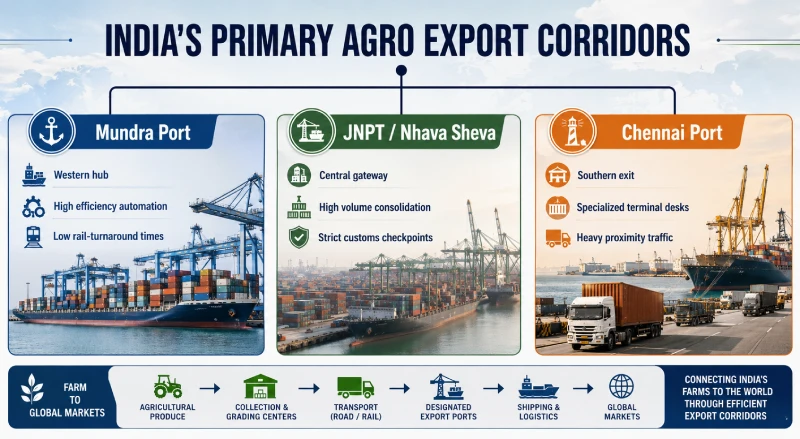
1. Mundra Port (Gujarat)
Exporters routing cargo from the northern grain belts and western spice zones favor Mundra over almost any other outlet. It handles a massive chunk of India's bulk agricultural shipments because its private management model keeps terminal handling charges (THC) uniform.
Businesses looking to export rice in bulk, export spices in bulk, and ship large agricultural consignments frequently utilize Mundra due to its extensive connectivity and cargo handling infrastructure.
The high mechanical automation means your boxes clear stuffing warehouses quickly. The real risk here isn't handling speed—it is the local port ground rent tariffs, which escalate rapidly during peak harvest surges when container storage yards hit full capacity.
Major commodities moving through this gateway include basmati rice, non-basmati rice, wheat, maize, cumin seeds, coriander seeds, sesame seeds, groundnuts , and other bulk agricultural products.
2. Jawaharlal Nehru Port Trust (JNPT / Nhava Sheva, Maharashtra)
Nhava Sheva handles the heavy lifting for agricultural processing hubs across Central and Western India. Grinding mills shipping premium basmati rice or processed food stocks count on this gateway as their primary maritime exit.
The port serves a wide range of businesses involved in bulk rice exports, processed food exports, agricultural commodity exports , and international food trade.
However, because the port manages massive national volumes, localized container freight station (CFS) bottlenecks are common. A single transport delay or paperwork stall here can keep your boxes sitting outside the terminal for days, which makes a precise grip on local shipping costs in India essential to avoid paying steep unexpected storage fees.
Major export commodities include basmati rice, non-basmati rice, sugar, soybean meal, groundnuts, onions, fresh fruits, processed food products, and spices .
3. Chennai Port (Tamil Nadu)
Chennai remains the core shipping node for agricultural goods moving out of the southern states, managing large volumes of regional groundnuts, oilseeds, and fine spices.
Companies seeking to export spices in bulk, export oilseeds, export agricultural products , and access Southeast Asian and European markets frequently utilize Chennai's shipping network.
The port infrastructure is highly reliable, but its physical location inside a dense urban center creates a unique problem. Strict city traffic restrictions limit container truck movements to specific nighttime windows, which can complicate your logistics timeline and drive up local cartage and positioning costs.
Major export commodities handled through the port include rice, groundnuts, sesame seeds, coconut products, pepper, cardamom, turmeric, oilseeds, pulses , and various processed food products .
Line-by-Line: The True Shipping Cost Breakdown
To accurately answer how to calculate shipping cost variables, you have to look past the base ocean liner freight and map every auxiliary fee levied from the factory floor to the destination vessel.
First, factor in your inland haulage and cartage fees. This is the simple expense of pulling an empty container from the port depot to your packing warehouse, stuffing it, and trucking it back to the harbor gate. Fuel surcharges and distance variables drive this cost up quickly, making proximity to the railhead a major advantage.
Second, account for Custom House Agent (CHA) and mandatory documentation charges. Your agent handles custom clearance, files shipping bills, and ensures compliance with agricultural health codes. But watch your invoices closely; the true shipping cost breakdown often hides unexpected costs within bulk cargo handling, customs facilitation adjustments, and mandatory on-site fumigation treatments required to clear biosecurity borders safely.
Third, verify your terminal handling charges (THC). Port authorities charge this baseline fee to lift your container from the staging yard onto the ship's deck. It is a fixed item on your spreadsheet, but the rate shifts significantly depending on whether you are utilizing state-run public docks or private terminals.

Finally, secure adequate marine insurance. Cutting corners on cargo protection by buying low-tier "Total Loss Only" policies is a massive operational risk. Ensuring your cost estimations include complete "All-Risk" coverage—specifically including the maritime principle of General Average—shields your enterprise from crippling liabilities if a ship faces deep-sea accidents or forced cargo sacrifices.
The Operational Ledger: How to Calculate Shipping Cost
A standard spreadsheet model for managing your outbound logistics structure requires separating fixed origin expenses from variable maritime freight metrics:
Indicative Local Port Handling & Logistics Charges
| Operational Cost Component | Typical Tariff Range (INR per 20ft Container) | Impact Category on Margins | Cost Control Strategy |
|---|---|---|---|
| Base Inland Haulage | ₹18,000 – ₹42,000 | Variable based on distance | Utilize multi-modal rail-linked inland container depots. |
| CHA Service & Filing | ₹4,500 – ₹9,000 | Fixed per shipment bill | Negotiate clear, fixed-rate yearly service contracts. |
| CFS Stuffing & Labor | ₹6,000 – ₹11,500 | Variable by commodity mass | Optimize bulk palletization to reduce handling hours. |
| Terminal Handling (THC) | ₹8,500 – ₹14,000 | Fixed by port operator | Select port gateways based on optimized port tariffs. |
| Mandatory Fumigation | ₹1,500 – ₹3,500 | Fixed per container capsule | Coordinate direct treatment at your processing site. |
Mitigating Hidden Financial Leakages
When you analyze what goes wrong at a trade desk, the financial damage rarely comes from a sudden jump in base ocean freight. It is driven by minor terminal fees that scale up when operations stall.
Unpredictable custom verification hold-ups or documentation corrections can cause a container to sit inside the terminal past its initial free-time window. This triggers severe, daily penalties known as demurrage and detention. If you do not track these variables, these daily container rentals can scale into hundreds of dollars per day, completely flipping your projected cost in agro exports equations from profit to a major liability.
Furthermore, ignoring local incentive programs like the RoDTEP scheme (Remission of Duties and Taxes on Exported Products) or failing to reconcile your internal GST Input Tax Credits can trap valuable working capital inside tax portals for months.符号 Managing your true shipping costs in India requires an integrated approach that treats local tax compliance as a direct element of your logistics chain.
Strategy for Maximizing Export Margins
To build a secure supply chain, your business must move away from generic, piece-meal forwarder quotes and professionalize its logistics layout.
First, protect your business from port-side penalty traps by making extended free-time agreements a mandatory clause in your freight negotiations. Never accept a standard three-day gate allotment from an ocean liner. Insist on a minimum 14-day factory-to-dock free-time window directly inside your contract. This provides an essential operational cushion, ensuring that a routine customs check or transport delay won't trigger immediate, budget-busting demurrage fees.
Second, optimize your volumetric spatial layout. Work directly with packaging layout specialists to design master cases that eliminate dead space inside your cartons. Every single cubic inch inside a standard 20-foot or 40-foot box must be utilized to ensure you aren't paying maritime freight to ship empty air across the water. Wrap your internal pallets securely in high-durgency shrink wraps and place clay desiccants along the container walls to completely shield your cargo from container sweat.
Finally, utilize digital freight aggregation tools to benchmark your shipping variables in real-time. Do not depend on the first rate sheet dropped on your desk by a single local agent. By cross-checking multiple liner options simultaneously and locking in your bank exchange margins via forward contracts, you remove the hidden variables from your shipping costs in India metrics. Running a highly structured, risk-shielded logistics loop allows you to minimize your total cost in agro exports and protect your international trade margins.
Conclusion
Managing a highly profitable agricultural export operation isn't about chasing speculative market trends or guessing where product demand will spike next. It comes down to running a tight, predictable logistics engine. By building a clear, line-by-line shipping cost breakdown, mastering how to calculate shipping cost variables before your cargo ever rolls toward the docks, and eliminating terminal leaks, you protect your bottom line. Transitioning your sales desk from a basic commodity trader into a highly efficient, supply-chain-literate partner is how you turn volatile international shipments into a secure, maximum-profit enterprise.