Key Highlights
- Saudi Arabia imports around 80% of its food.
- Basmati rice is India's biggest food export to Saudi Arabia.
- Buffalo meat and spices are among the top imported products.
- Processed fruits, juices, and vegetables are growing export segments.
- Fast shipping routes make India a preferred supplier.
- SFDA compliance and Arabic labeling are essential for exports.
Introduction:
Look at Saudi Arabia on a map and one thing stands out right away: it is almost all desert, so growing food on a big scale is pretty much impossible.

With over 36 million people living there—plus millions of pilgrims visiting Makkah and Madinah every year—local farms can't meet the demand. So Saudi Arabia ends up importing around 80% of all the food on its dinner tables.
This is where India steps in. Ships leaving ports like Mundra or Nhava Sheva hit Jeddah or Dammam in about ten days. It is fast, direct, and keeps the shipping costs down.
If you are curious about the top food Saudi Arabia imports from India , here is how it actually works on the ground without the complicated trade jargon.
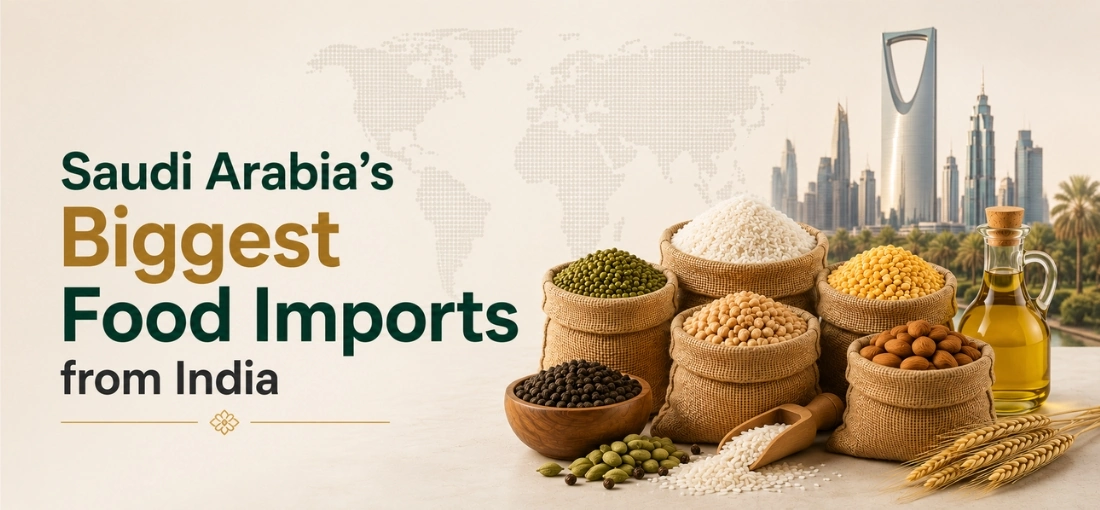
1. Basmati Rice ($942.99 Million)
Rice is easily the biggest item on this whole trade route. In fact, Saudi Arabia is the number one buyer of Indian Basmati rice in the entire world.
When talking numbers, we are looking at a massive 942.99 million dollars in trade value. To put that in perspective, this single country takes 16.62% of India's total Basmati exports by value . So basically, out of every six dollars India makes selling Basmati globally, more than one dollar comes straight from Saudi buyers.
Why such a huge demand? It just comes down to daily food culture.
Dishes like Kabsa, Mandi, and Madghout are eaten daily across the country. These recipes need long, aged grains that don't break apart or turn sticky when cooked in huge commercial pots.
If you plan to export basmati rice in bulk , the market mostly splits like this:
- Parboiled or Sella Rice: 1121 Golden Sella and Creamy Sella handle the heavy catering work. Since the grain is partially steamed before milling, it holds its shape even after sitting under hot serving trays for hours.
- Steam Basmati: This is what ends up on supermarket shelves and in fancy restaurants, where people pay extra for the rich aroma and long grain look after cooking.
During Hajj season, demand goes crazy. Caterers in Makkah buy 25 kg and 50 kg sacks by the truckload, making rice a super steady business year-round.

2. Buffalo Meat ($359.30 Million)
Frozen boneless buffalo meat is another huge item, bringing in 359.30 million dollars . Saudi Arabia is the 5th largest buyer for Indian buffalo meat, taking a 7.05% share of India's total buffalo meat export value .
A lot of people ask why Saudi buyers import Indian buffalo meat instead of standard beef. It really boils down to three simple reasons:
- It is very lean: The low fat content makes it perfect raw material for local factories that make burger patties, sausages, and minced meat.
- It saves serious money: It costs way less than buying grain-fed cattle from Australia or South American countries.
- Shipping is super quick: A short ten-day boat ride in terms of logistics means reefer containers kept at -18°C arrive without breaking the cold chain.
Just understand it this way: if you want to export buffalo meat in bulk , you cannot mess up compliance. The Saudi Food and Drug Authority (SFDA) is super strict. Your processing plant has to be APEDA-registered, certified by approved Islamic bodies, and follow un-stunned Zabiha slaughter rules. One wrong word on your paperwork and your container sits at the port racking up huge demurrage charges.
3. Spices ($193.81 Million)
Spices make up another giant chunk, pulling in 193.81 million dollars . Saudi Arabia ranks as the 5th largest buyer of Indian spices, holding a 4.85% share of India's total spice export value.
Most people think spice exports are just small colorful jars sitting on grocery store shelves. But when Indian companies export spices in bulk , most of it actually goes in heavy 25 kg bags straight to Saudi grinding mills and food factories.
Here is what moves in big volumes:
- Green Cardamom: Driven heavily by the daily local love for Gahwa—the traditional Arabic coffee served everywhere.
- Turmeric: High-curcumin fingers and powders used in everyday curries and food coloring.
- Dried Red Chili: Varieties like S17 Teja and Sannam going to sauce factories and caterers.
- Cumin and Coriander Seeds: The main base for local Baharat and Hawaij spice blends.
One important thing on customs: SFDA labs strictly test incoming spice lots for Ethylene Oxide (ETO) residues and pesticide limits. Exporters using modern steam-sterilization units get cleared quickly, while untreated lots risk getting sent right back.
4. Processed Fruits & Juices ($66.09 Million)
Mango pulp is another interesting and niche category among the top food Saudi Arabia imports from India and which often easily gets overlooked by new exporters. In fact, it accounts for a significant 66.09 million dollars in food exports from India to Saudi Arabia when talking in value terms. This puts the Kingdom as the 4th largest destination for India in this category, representing a 7.05% export share.
It is also highly economically viable because of the simple fact that mango is a perishable food commodity, and making it a value-added product by processing it into mango pulp makes it easier to export.
Just understand it this way: instead of dealing with complicated logistics for delicate fresh fruit, Indian processors extract Alphonso and Kesar pulp, seal it in drums, and ship it via standard sea freight. Once landed in Dammam or Jeddah, those drums go straight to major local juice plants, dairy brands, and bakeries.
5. Processed Vegetables ($46.81 Million)
Processed vegetables bring in 46.81 million dollars , making Saudi Arabia the 5th largest buyer with a 5.01% share of India's processed vegetable exports.
This isn't about shipping fresh veggies that spoil on the ship. It's all about shelf-stable ingredients made for commercial scale:
- Dehydrated Onions and Garlic: Flakes and powders from Mahuva in Gujarat are imported as dry, water-free ingredients for Saudi snack makers, soup makers, and seasoning factories.
- Frozen Produce: Green peas, sweet corn, and mixed veg packs stocking hypermarket freezers year-round across Panda and Lulu stores.
- Canned Goods: Pickled gherkins and canned beans supplying the booming fast-food and wrap chains.
Quick Breakdown of the Numbers
| Commodity Category | Trade Value (USD) | India's Global Export Share | Saudi Importer Rank |
|---|---|---|---|
| Basmati Rice | $942.99 Million | 16.62% | #1 Importer |
| Buffalo Meat | $359.30 Million | 7.05% | #5 Importer |
| Spices | $193.81 Million | 4.85% | #5 Importer |
| Processed Fruits & Juices | $66.09 Million | 7.05% | #4 Importer |
| Processed Vegetables | $46.81 Million | 5.01% | #5 Importer |
What This Means for Exporters
Selling food to Saudi Arabia is less about finding buyers and more about keeping your paperwork and quality clean. Saudi Arabia's food processing industry is expanding fast under Vision 2030, and that's driving strong demand for raw ingredients, grains, and certified Halal meat. If you're planning to export, don't leave the basics until the last minute. Get your SFDA registration sorted early, print Arabic labels on your packaging before shipping, and make sure your lab reports are ready before your containers leave the port. A little preparation upfront can go a long way in building a lasting business in the Saudi market.
Disclaimer
The information provided in this article is for educational and informational purposes only. Export statistics, import regulations, food safety requirements, and Saudi Arabia's customs policies may change over time. Exporters should verify the latest APEDA data, Saudi Food and Drug Authority (SFDA) regulations, and destination-country compliance requirements before exporting food products.




.webp "Import Export Documentation: Complete List of Documents Required for Export & Import in India")