Key Highlights
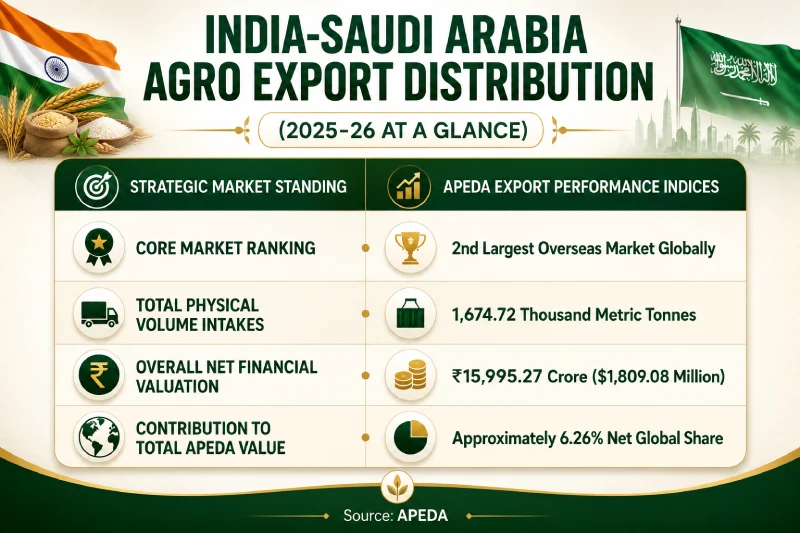
- Saudi Arabia is India's second-largest export destination for APEDA products.
- India exported APEDA products worth USD 1.81 billion to Saudi Arabia in 2025–26.
- Basmati rice accounts for more than half of India's agricultural exports to the Kingdom.
- Buffalo meat, non-Basmati rice, processed foods, and dairy products are among the top export categories.
- Demand is driven by Saudi Arabia's growing food security and retail requirements.
- Halal certification and food quality compliance are essential for exporters targeting the Saudi market.
Introduction:
The bilateral trade landscape between India and the Gulf Cooperation Council (GCC) has entered a highly lucrative, volume-driven phase. For international agribusinesses, millers, and processing houses, targeting this economic zone requires a clear focus on the specific macro-economic demand hubs driving the Middle East. According to comprehensive industry statistics published in the latest Analytical Report: India's Export of APEDA Products (2025-26), the Kingdom has systematically scaled its intake of Indian food supplies.
If you evaluate the container manifest sheets across high-capacity Indian logistics terminals or track outbound bulk vessels, the data reveals a defining market reality: the specialized push to identify the top 5 agro products exported to Saudi Arabia has turned into an essential corporate strategy for scaling global agricultural sales.

During the 2025-26 trade cycle, Saudi Arabia established itself firmly as India's second-largest export destination for APEDA products globally, coming in right behind the United Arab Emirates. The country alone absorbed approximately 1,674.72 thousand metric tonnes of APEDA products. The total export value of these agricultural and processed food shipments stood at an institutional ₹15,995.27 crore (approximately USD 1,809.08 million), accounting for a vital 6.26% of India's total global APEDA export value.
For processing operations looking to capture steady market share, the commercial blueprint centers heavily on premium agricultural categories. Rather than depending on a single commodity, Saudi Arabia features across multiple high-value APEDA export categories, spanning both premium staples and value-added segments.
For example, the continuous mandate to export basmati rice to Saudi Arabia distribution channels stands out as India’s single largest grain trade avenue, positioning the Kingdom as a premier destination globally for aromatic long grains.
To maximize margins when executing these contracts, global suppliers are moving away from small spot-market allocations to export rice in bulk to Saudi Arabia retail grids, focusing their production capacity on satisfying the intense quality parameters enforced across Gulf border inspection laboratories.
The Macro-Economic Reality: The Top 5 Core Commodity Streams
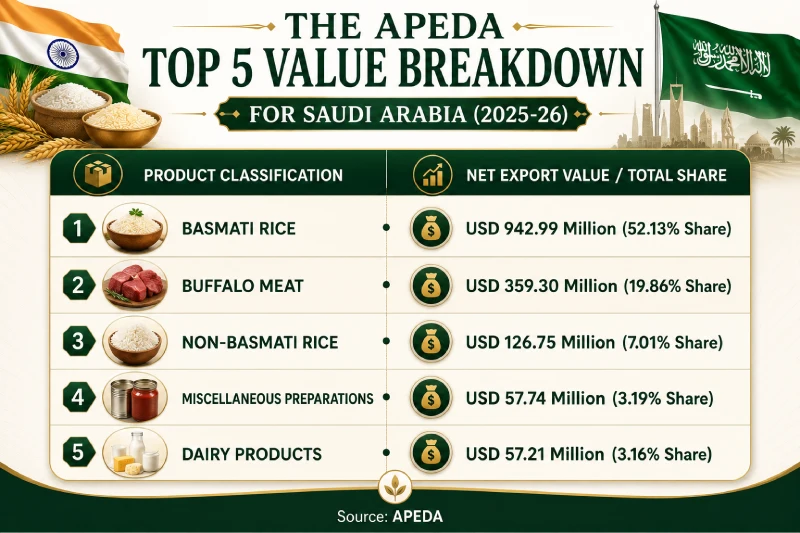
The latest agricultural report highlights that the top five APEDA export categories—Basmati Rice, Buffalo Meat, Non-Basmati Rice, Miscellaneous Preparations, and Dairy Products—together accounted for approximately 85.35% of India's total APEDA exports to Saudi Arabia in 2025-26. This concentration highlights the country's strong dependence on rice and animal-based food exports to sustain its internal food retail infrastructure.
1. Basmati Rice: The Premium Heavyweight Champion
Basmati Rice stands out as India's single largest APEDA export to Saudi Arabia by a significant margin. Valued at a massive USD 942.99 million, this single grain classification contributed an absolute 52.13% of India's total APEDA exports to the Kingdom during the 2025-26 cycle.
For processing mills trying to optimize their export yields, the strategy to export 1121 Basmati Rice to Saudi Arabia packaging houses stands out as a highly active, high-premium business lane. Sourcing managers across major cities like Riyadh and Jeddah heavily favor advanced long-grain selections.
Within this premium space, the specific drive to export 1121 Golden Sella Basmati Rice to Saudi Arabia retail networks has turned into an essential volume play. Saudi distribution networks choose these sella varieties for their exceptional grain length elongation, strong parboiling stability, and uniform color profiles, which are required to satisfy strict culinary specifications enforced across the region's top-tier hospitality and institutional catering grids.

2. Buffalo Meat: The Vital Animal Protein Pipeline
The secondary pillar anchoring the bilateral trade layout is the red meat sector, where Indian processing facilities supply significant volumes to secure the Kingdom's core protein requirements. During the 2025-26 fiscal run, the mandate to export buffalo meat to Saudi Arabia stood out as the second-largest export category, pulling in a value of USD 359.30 million and accounting for 19.86% of India's total APEDA exports to the country.
For commercial slaughterhouses and cold-chain logistics groups, the push to export Frozen Buffalo Meat to Saudi Arabia wholesale grids offers highly predictable volume cycles. To pass strict Gulf standardization audits, all outgoing shipments must strictly comply with Halal certification frameworks and pass rigorous microbiological health compliance screenings managed by Saudi food safety inspectors at entry ports.
3. Non-Basmati Rice: Essential Volume Foundations
Providing robust support to the grain trade infrastructure, Non-Basmati Rice ranked as the third-largest export category into the Kingdom. Shipments generated an institutional valuation of USD 126.75 million, capturing a stable 7.01% share of the import layout. This category satisfies the essential everyday volume needs of commercial blenders and institutional labor catering companies, ensuring a steady, regular flow of containerized shipments across the Arabian Sea.
4. Miscellaneous Food Preparations: Capitalizing on FMCG Shifts
Reflecting the changing lifestyle choices and urbanization trends across major Saudi metropolitan areas, the demand for miscellaneous processed food preparations has expanded. Ranking fourth on the APEDA priority manifest, this sector pulled in USD 57.74 million, contributing a strategic 3.19% of the overall export value. This segment covers high-value, ready-to-use ingredient inputs, ethnic snack elements, and consumer retail mixes that match the rising demand for convenient food products in the Gulf.
5. Dairy Products: The Rapidly Growing Nutritional Segmen
Rounding out the top five categories is the Dairy Products sector, which claimed a valuable 3.16% share of the APEDA export basket with outbound shipments worth USD 57.21 million in 2025-26. From premium milk fat formulations to specialized industrial ingredients, Indian dairy processors are successfully capitalizing on the Gulf's expanding retail demand for premium, long-shelf-life dairy goods.
Bypassing Traditional Barriers: The Digital Shift in Global Trade
While robust global demand and solid APEDA volume statistics provide a highly supportive environment, independent agricultural suppliers can easily damage their export margins if they rely on outdated, high-friction client acquisition networks to trade across the GCC.
Historically, companies have spent immense sums traveling to international trade expos or purchasing unverified, static directories that are frequently clogged with dead contact data and historic customs records. Even worse, turning your supply lines over to traditional commission-based brokers can obscure your market visibility, as these agents often hide the true identity of the end-buyer to protect their position in the middle, leaving you completely exposed to counterparty risks and credit defaults during transit.
To bypass these friction points, the modern agricultural trade has shifted toward specialized digital procurement infrastructure. Digital platforms like tradologie.com have stepped in to solve these structural transparency challenges, operating as a clean, real-time B2B trade lane built to streamline transactions along global agricultural corridors.
How Tradologie facilitates global Saudi-Arabia trade:
- Direct Access to Verified Buyers: Tradologie provides direct access to verified import-ready buyers who want to procure bulk commodities. You skip the guesswork and hook straight into active grain and meat procurement managers.
- One-to-One Live Negotiation: You can negotiate with the buyers live one-to-one, finalizing trade deals without any interference in pricing by the platform. This pure price discovery allows you to protect your exact export margins.
- Deeply Verified Sourcing Requirements: Sourcing requirements are verified using Tradologie's AI-assisted verification process together with internal verification procedures. The platform thoroughly checks the profile and active licensing of the buyers before allowing them to upload buying mandates.
- End-to-End Export Facilitation: You get complete end-to-end export facilitation support through a dedicated trade manager until your transactions are finalized. Your account team helps you handle strict phytosanitary checks and clear port authorities without delays.
- Capital Protection and Secure Escrow: Tradologie supports secure payment mechanisms such as Letters of Credit (LC) and Escrow setups, insulating your cash flow from international trade risks.
Summary: A Strategic Blueprint for Exporters
APEDA's latest destination analysis places Saudi Arabia consistently among India's most important agricultural export markets, underlining its strategic role in India's export diversification across the Gulf region. For forward-thinking agricultural millers, processors, and cold-chain operators, succeeding in this high-yield landscape means moving past slow-moving, non-transparent physical brokerage loops.
By understanding the detailed volume demands across premium long-grain rice, frozen meats, and value-added food matrices, and running your transactions through advanced B2B procurement systems that offer secure payment protection, your business can confidently establish a secure, scalable, and highly profitable presence within one of the most valuable long-term agricultural corridors on earth.