Key Highlights
- Private label products roughly account for 20-22% of global FMCG sales, higher in Europe.
- Retailers use private labels to control pricing, branding, and product positioning.
- Global suppliers manufacture products while retailers sell them under their own brands.
- India, Thailand, and Vietnam are key sourcing hubs for private label food.
- Buyers prioritize consistent quality, certifications, scalable production, and reliable supply chains.
- Growing consumer acceptance is driving rapid expansion of private label food globally.
Spend ten minutes inside a large supermarket and something interesting starts to appear. Right next to the famous global brands, there are products that carry the store's own name. Pasta sauces, cookies, breakfast cereals, frozen meals… all sitting there with the retailer's branding on them. Food companies and retail stores actively look for private label food suppliers.
That's a private label. Private label products interestingly account for nearly 20-22% of total global FMCG sales, and in some mature markets like Europe they represent over 35-40% of supermarket sales.
And here's the thing — it's not a small side category anymore. Retailers are pushing it hard. Walk down a few aisles and you'll see it everywhere. Shelf after shelf. Some shoppers don't even realize they're buying private label products.
Retail chains love it. Why? Because it gives them control. Control over pricing. Control over branding. Even control over product positioning.
For packed food products suppliers and bulk food exporters from India, this shift has quietly opened a very large door.
What Private Label Actually Means
Private labels sound complicated, but the idea is pretty simple.
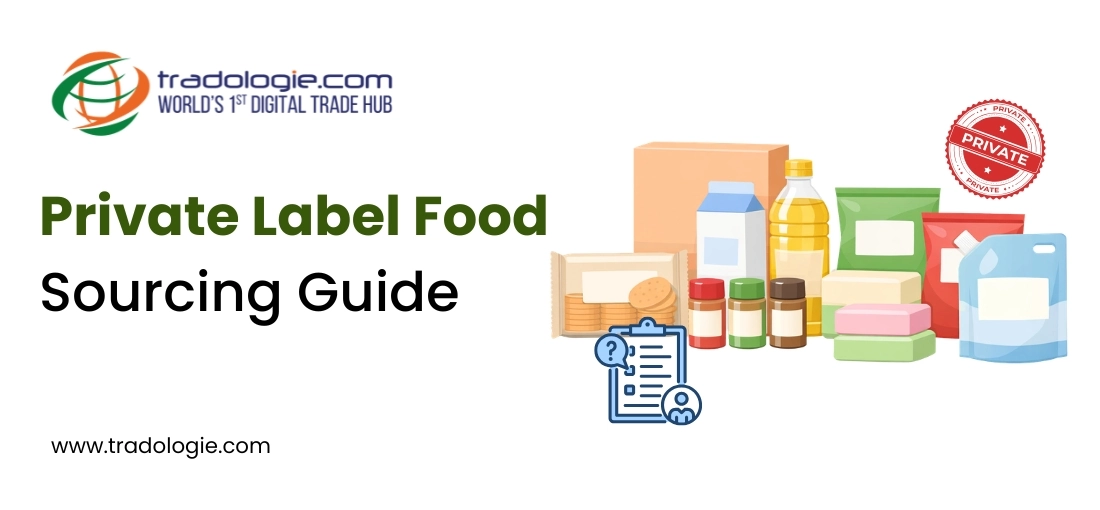
A retailer simply sells a product under its own brand name. But the retailer usually doesn't manufacture it. A supplier produces the product behind the scenes instead.
Think of it like this. A supermarket might sell a jar of pasta sauce with its logo on the label. Customers assume it belongs to the store. In reality, a manufacturer somewhere else is producing it.
Retailers provide the branding and packaging direction. Manufacturers handle the production.
It's a partnership. And when it works well, it can run for years.
Why Retailers Are Expanding Private Label So Aggressively
Retailers didn't always take private labels seriously. Years ago it was mostly a budget option.
Not anymore.
Today, store brands compete directly with major brands. Sometimes they even outsell them. And retailers know exactly why.
First, private labels improve margins. Retailers don't have to pay brand premiums.
Second, it strengthens store loyalty. When shoppers like a retailer's own products, they keep coming back.
And third — this one matters a lot — retailers can move faster. They can introduce new flavors or packaging without waiting for big brand approvals.
So you'll see it happening everywhere. Retailers adding private label products across snacks, sauces, frozen food, beverages, and ready meals.
The shelves are changing quickly.
Why Global Suppliers Are Part of This Story
Now here's where international suppliers come into the picture.
Retailers rarely produce private label food themselves. They look for private label food suppliers that can deliver quality and scale.
And they look globally.
Countries with strong food manufacturing industries — India, Thailand, Vietnam, parts of Europe — often become sourcing hubs.
Distributors and retailers regularly import FMCG food products in bulk from these regions. It makes commercial sense.
For bulk food exporters from India, private label sourcing has become one of the fastest growing opportunities in packaged food exports.
Many Indian manufacturers already produce spices, sauces, snacks, and ready meals. Producing private label versions for overseas retailers is a natural next step.
What Buyers Actually Look For
Retail buyers are careful when selecting private label suppliers.
They're not just looking for someone who can produce food. They want a partner who can handle long-term supply.
A few things usually matter the most:
- Consistent taste and product quality
- Certifications that prove food safety compliance
- Ability to handle large production volumes
- Flexible packaging options
- Competitive pricing for bulk shipments
- Reliable delivery timelines
In other words, buyers want stability. Once a product goes onto supermarket shelves, it needs to stay there.
No surprises.
Certifications Still Matter — A Lot
Private label buyers don't compromise much on food safety.
Retailers are putting their own brand name on the product. That means they want strong assurance that manufacturing standards are solid.
So certifications come up quickly during sourcing discussions.
Standards like HACCP, ISO 22000, BRC, and FSSC are commonly expected.
Depending on the market, additional certifications might be required too. For example, halal certification becomes important when products are sold in Middle Eastern countries.
For packed food products suppliers, having these certifications already in place makes sourcing conversations much easier.
Packaging Is Where Private Label Gets Interesting
Packaging is a big part of private label deals.
Retailers usually design their own labels and branding. The manufacturer then produces and packages the product exactly according to those specifications.
Sometimes buyers even request custom packaging sizes that fit their retail strategy.
For example, a supermarket might want a smaller snack pack for convenience stores or a larger value pack for hypermarkets.
Manufacturers that can adapt quickly tend to win more contracts.
Logistics Still Decides a Lot of Deals
Even with a great product, logistics can still make or break a sourcing relationship.
Retailers want suppliers who understand export procedures and shipping schedules.
Bulk shipments need to arrive on time. Packaging must survive long-distance transport. Documentation needs to be accurate.
Companies that regularly import FMCG food products in bulk usually prefer suppliers who already understand these operational details.
It saves time. And headaches.
Private Label Is Only Getting Bigger
Here's the reality.
Private labels are not slowing down.
Retailers are expanding these product lines year after year. Consumers are becoming more comfortable with store brands. In many cases, shoppers don't even differentiate anymore.
If the product tastes good and the price is right, they buy it.
That's why private label sourcing will continue to grow.
For bulk food exporters from India and other international manufacturers, this is a major opportunity. Not just short-term contracts. Long-term supply relationships.
And once a supplier gets a product onto a retailer's shelf under a private label… well, that business can run for a very long time.