
-in-agro-trade-how-it-works-types--tips.webp "Letter of Credit (LC) in Agro Trade")
Key Highlights
- Payment security is one of the biggest challenges in international agro trade.
- The global Letter of Credit confirmation market was valued at USD 4.6 billion in 2024.
- The market is projected to reach USD 6.5 billion by 2034.
- Letters of Credit help reduce buyer default risk in export transactions.
- Confirmed LCs offer the highest level of payment protection for exporters.
- LC at Sight enables payment within 3 to 5 banking days after document approval.
- Documentation accuracy is critical for successful LC settlement.
- Letters of Credit remain a preferred payment security tool in global commodity trade.
Introduction:
In international agro trade, payment risk often becomes a bigger concern than finding buyers. That is the reason why Letters of Credit continue to maintain relevance. This is true especially when exporters and importers are dealing with each other for the first time.

Shipping a container of premium non-basmati rice from India to West Africa or delivering high-value spices to Europe requires more than just coordinating the logistics. Rather, it involves capital exposure over weeks at sea.
Agricultural commodities are known to face unpredictable price swings, sudden updates in the trade policy, and quality disputes at the destination port. If a buyer backs out or faces a sudden cash shortage while the vessel is in transit, an exporter using unsecured terms is left vulnerable. Utilizing a letter of credit in export trade bridges this trust gap by shifting the payment obligation from the commercial buyer directly to an international financial institution. For those navigating the terrain of what is LC in export India, mastering this banking mechanism is a requirement to turn cross-border transactions into secure, predictable revenue streams.
Why Letters of Credit Continue to Matter in Global Trade
Trade finance instruments rarely receive the same attention as commodity prices or freight rates. Yet the scale of the market tells its own story. The global Letter of Credit confirmation market was valued at approximately USD 4.6 billion in 2024 and is projected to approach USD 6.5 billion by 2034 according to Zion Market Research. This makes it grow at a compound annual growth rate (CAGR) of 3.5% through 2034.
| Metric | Value |
|---|---|
| Market Size (2024) | USD 4.6 Billion |
| Forecast (2030) | USD 6.5 Billion |
| CAGR | 3.5% (2025–2034) |
The growth may appear moderate on paper, but it reflects the continued importance of risk mitigation in international trade transactions. As geopolitical shifts alter shipping lanes and national central banks adjust liquidity requirements, international trade desks face an increasingly complex border environment. Buyers cannot always secure unsecured credit lines from foreign suppliers. At the same time, exporters cannot afford to absorb payment friction. By embedding a verified letter of credit in export trade into the contract architecture, trade desks insulate their working capital from banking sector drops and sovereign defaults in volatile destination markets.
What Is LC in Export India? Understanding the Basics
A common misconception among first-time exporters is that a banking instrument is merely an automated escrow account. In reality, it is a binding document containing a conditional payment guarantee issued by a bank. When exploring what is LC in export India, it is best understood as a structured triangle of financial commitments involving distinct international parties.
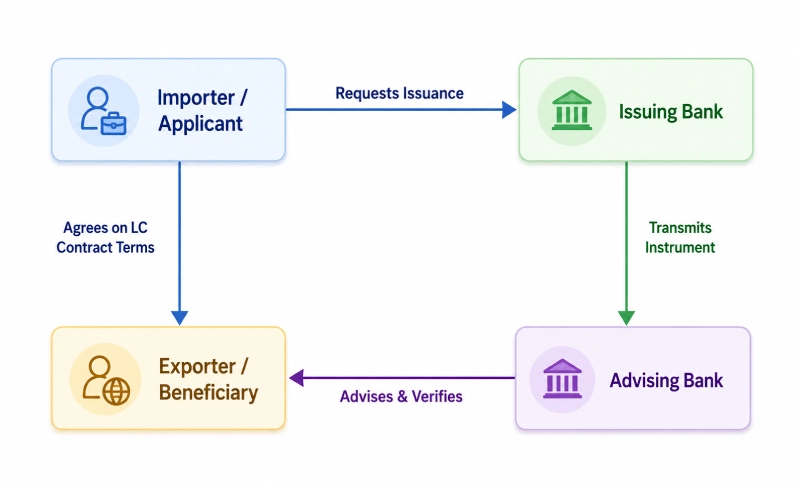
To execute a secure agricultural transaction, five core players must interface with precision:
| Party | Operational Trade Role |
|---|---|
| Importer (Applicant) | Requests their local bank to issue the financial instrument in favor of the seller. |
| Issuing Bank | The buyer's bank, which reviews creditworthiness and assumes the conditional liability to pay. |
| Advising Bank | An international bank operating in the exporter's country that authenticates the instrument's validity. |
| Exporter (Beneficiary) | The agro-merchant who prepares the cargo, ships the goods, and claims the capital. |
| Confirming Bank | A top-tier financial house that adds its own payment guarantee, insulating the exporter from issuing bank default. |
This multi-layered structure turns a private commercial risk into an institutional bank obligation. The exporter no longer relies on the individual financial stability of a foreign buyer. Instead, they depend on the credit profile of the issuing and confirming banks.

Letter of Credit Process: Step-by-Step Workflow
The letter of credit process operates as a strict documentary timeline. It leaves zero room for casual deviations. If a single comma mismatches between the commercial invoice and the bank transmission, payment can stall at the border indefinitely.
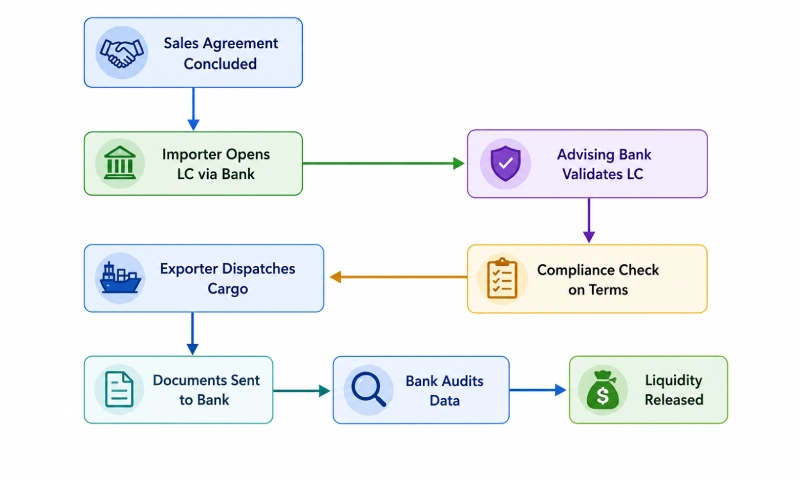
Stage 1: Sales Contract & Term Finalization
The transaction fires up when the buyer and seller conclude a sales agreement. Here, they meticulously define the product specifications, harvest metrics, packing guidelines, and shipping windows.
Stage 2: Instrument Request & Issuance
The importer formally requests their domestic financial house to structure and issue the instrument. This request specifies the exact list of shipping papers required to release funds.
Stage 3: Transmission and Authentication
The issuing bank routes the structured financial swift message straight to the advising bank located in the seller's market. This intermediary verifies the security parameters of the document.
Stage 4: Critical Review & Shipment Execution
The exporter reviews every single clause. If the terms match the mill's operational capabilities, the cargo is processed, packed, and delivered to the shipping line for transport.
Stage 5: Paperwork Collection and Bank Verification
The trade desk collects the clean Bill of Lading, phytosanitary certifications, certificates of origin, and custom documents. This entire pack is submitted to the bank within the strict validity window.
Stage 6: Audit and Cash Settlement
The banking team audits every line against the master instrument rules. If no discrepancies are uncovered, funds are transferred straight to the exporter's corporate account.
What becomes visible here is that discrepancies are almost always generated by poor administrative tracking rather than bad intent. For example, if a soybean meal exporter states "Indian Non-GMO Soybean Meal" on the invoice, but the master document simply requests "Soybean Meal," the reviewing bank must flag this as a document discrepancy. This mismatch can halt payment processing until costly amendments are executed.
Different Types of Letters of Credit Used in Agro Trade
Agro-exporters encounter highly distinct variations of trade financing instruments depending on the destination region and the complexity of the sourcing operation. Choosing the wrong configuration can trap capital or leave a mill exposed to unilateral cancellations.
| LC Type | Primary Sourcing Application | Bank Acceptance Level |
|---|---|---|
| Irrevocable LC | Standard trade baseline; cannot be amended or cancelled without consent from all parties. | Highly preferred by all international desks. |
| Confirmed LC | Utilized for high-risk markets where the issuing bank's stability is uncertain. | Maximum security; preferred by export finance teams. |
| Transferable LC | Designed for middle-tier trading companies sourcing from multiple primary millers. | Widely used by global merchant brokers. |
| Revolving LC | Deployed for long-term supply arrangements featuring multiple monthly shipments. | Optimizes administrative speed for continuous trade. |
| Standby LC (SPLC) | Functions as a secondary backup guarantee if a primary payment method fails. | Serves as an institutional safety net. |
In typical agricultural setups, trading firms frequently leverage Back-to-Back configurations. A merchant broker uses an incoming instrument from a premium European buyer to establish a secondary, distinct instrument for a primary oilseed crusher in Madhya Pradesh. This strategy allows the intermediary to manage cash flows and control procurement volumes without using their own equity lines.
LC at Sight Meaning: When Does the Exporter Get Paid?
When evaluating payment speed, understanding the LC at sight meaning is essential for maintaining corporate liquidity. In the international grain and spice trade, this format represents the premium standard for fast cash-flow optimization.
| Instrument Format | Cash Liquidation Timing | Financial Impact on Working Capital |
|---|---|---|
| LC at Sight | Immediate release within 3 to 5 banking days upon clean document validation. | Maximizes mill liquidity; lowers borrowing costs. |
| Usance / Time LC | Payment takes place at a fixed future date (e.g., 60, 90, or 180 days post-shipment). | Extends credit to the buyer; demands external trade finance hedging. |
The baseline benefit of an at-sight arrangement is immediate settlement. The moment the advising bank verifies that the packed shipping sheets match the conditional rules, the cash is liquidated. This fast turnaround shields the agro-trader from currency exposure during long ocean transits and supplies immediate cash flow to purchase raw materials for subsequent processing runs.
LC vs. TT Payment: Which Is Better for Exporters?
Agribusiness procurement desks must balance financial security against processing overhead and customer acquisition costs. Comparing a LC vs TT payment framework highlights a clear trade-off between risk mitigation and administrative simplicity.
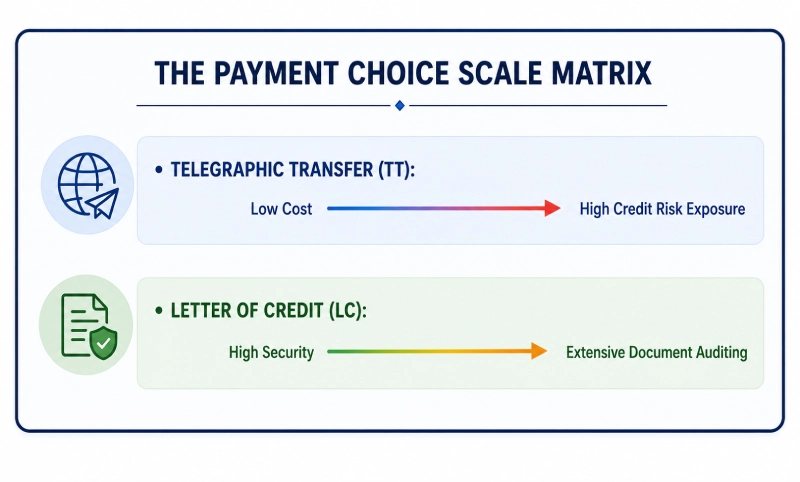
Telegraphic Transfers (TT) rely almost entirely on commercial trust. If an importer pays a 30% deposit via wire transfer, the exporter remains exposed for the remaining 70% balance until shipping papers are released. If a target market experiences an unexpected economic shift, a buyer can simply walk away, leaving the supplier stuck with specialty container cargo at a distant port.
| Sourcing Factor | Letter of Credit (LC) | Telegraphic Transfer (TT) |
|---|---|---|
| Payment Security | High; bank assumes conditional default risk. | Moderate to low; rests on buyer integrity. |
| Bank Fee Overhead | Higher; includes issuance, advising, and confirmation fees. | Minimal; basic international wire charges. |
| Documentation Work | Extensive; zero tolerance for data errors. | Minimal; standard commercial sheets. |
| Execution Processing | Moderate speed; tied to bank review turns. | Fast; automated clearing house routing. |
For seasoned trade desks, the final path is clear. When supplying a high-volume client in an unverified region, using a structured banking tool is non-negotiable. However, if a spice exporter has maintained direct, verified trade channels with a German buyer for a decade, switching to TT payments reduces friction and slashes administrative banking bills for both entities.
Practical Tips for Agro Exporters Using Letters of Credit
Surviving an international bank audit requires moving away from casual trading styles and adopting precise administrative procedures. Sourcing desks can avoid costly holdups by embedding specific operational rules straight into their documentation pipelines:
- Audit Drafts Before Issuance: Never allow an issuing bank to finalize the swift message without your team reviewing a preliminary copy. Ensure unachievable inspection conditions or vague descriptions are completely purged.
- Match Product Descriptions Verbatim: If the contract specifies "Non-GMO HPS Groundnut Kernels Count 40/50," every single document—from the certificate of origin to the weight certificate—must reproduce that phrase letter for letter.
- Synchronize Calendar Windows: Verify that the expiration date gives your freight forwarder enough time to load the vessel, secure a clean Bill of Lading, and route the paperwork through customs to the bank counter.
- Deploy Expert Freight Forwarders: Sourcing teams should partner only with logistics operators who understand how to prepare clean documents that clear bank checks without issues.
- Engage Trade-Finance Specialists: When dealing with high-value transactions or unverified banks, consult your banking advisors early to add confirmation lines that protect your export capital from foreign sector defaults.
Conclusion
The international agricultural trade corridor continues to place a premium on transactional discipline and automated risk insulation. For agribusinesses looking to systematically scale up their overseas distribution networks, a letter of credit in export trade remains an essential financial shield.
The mechanism balances payment security with commercial confidence by turning private default risks into institutional banking obligations. While the extensive documentation work and multi-tiered fee structures demand careful management, the absolute cash protection it delivers is unmatched. Agro-merchants who master the letter of credit process, align their paperwork with precision, and select the proper instrument structures are the ones uniquely positioned to lock in high-margin volumes across the global trade matrix.
Want to export agro commodities globally? Register as a seller on Tradologie and connect with 1 Million+ Buyers.
Disclaimer
The information provided is for educational and informational purposes only and should not be considered legal, financial, banking, or trade finance advice. Exporters and importers should consult qualified banking institutions, trade finance professionals, and legal advisors before entering into international trade agreements or using Letter of Credit facilities.


-transactions.webp "Top First-Class International Banks for Secure Letter of Credit (LC) Transactions")
-export--import-trade-indias-complete-market-guide-(1).webp "Soybean (Soya) Export & Import Trade: India's Complete Market Guide")
.webp "Millets Export from India: Types, Global Markets & Trade Guide 2026")