Key Highlights
- Global jackfruit market projected to reach USD 781.8 million by 2034.
- India’s jackfruit exports crossed USD 40 million in FY 2023–24.
- Saudi Arabia remains the largest importer of Indian jackfruit.
- Processed jackfruit exports are growing faster than fresh fruit shipments.
- IQF and retort pouch formats are driving premium export demand.
- Netherlands acts as a major redistribution hub for Europe.
- Plant based food demand is accelerating global jackfruit consumption.
- HACCP and FSSC 22000 compliance are critical for exports.
Intro
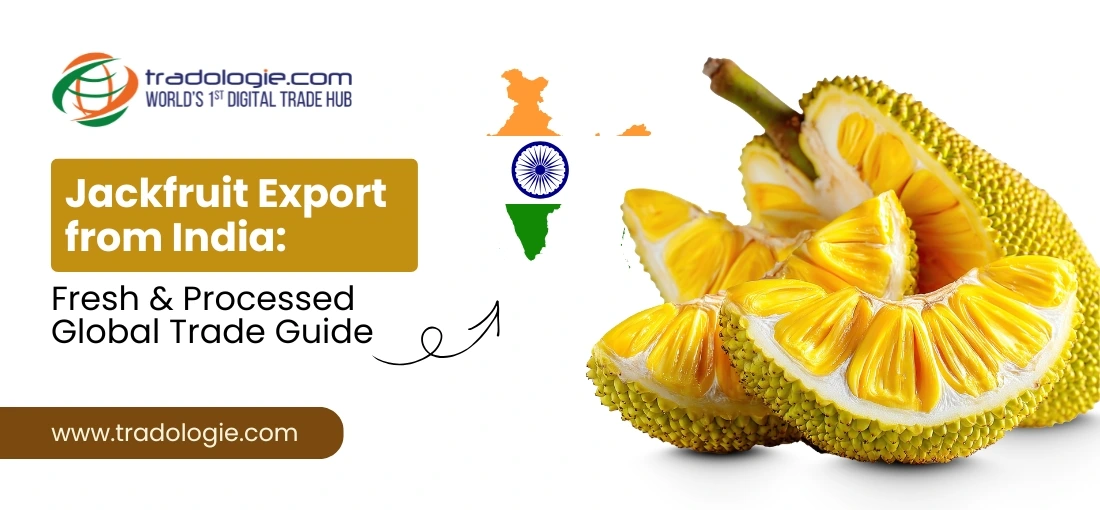
Quietly, without attracting the same mainstream attention as basmati rice or marine products, jackfruit has started building a serious export footprint. The numbers are still modest. But the direction? Increasingly important for processed food buyers for bulk Jackfruit imports.
A radical realignment of global eating habits has altered the equation. Western tables demand new plant-based options, and raw green jackfruit fits the blueprint perfectly. It has stepped into a major gap in global procurement as an authentic, whole-food meat alternative. When unripe, the pulled, dense structure of the pulp tears like poultry or pork, eagerly soaking up sauces while keeping its physical bite during thermal processing. Buying from India has transitioned from a minor ethnic experiment into a standard, asset-backed logistics routine for supermarkets, international distributors, and hotel chefs.

The sub-continent holds a massive biological production advantage, but converting wild harvests into high-margin container shipments bound for Rotterdam or New York requires rigorous compliance, zero-defect processing, and deep operational trade intelligence.
Keep reading this informative piece of blog if you are looking for Jackfruit export from India. This blog will provide you vital information on the same.
Global Jackfruit Market Size and Trade Direction:
A decade ago, jackfruit was still treated largely as a regional consumption fruit in many markets. Today, the economics are changing. According to Zion Market Research, the global jackfruit market stood at approximately USD 543.1 million in 2024 and is projected to touch nearly USD 781.8 million by 2034, growing at a CAGR of 3.5% through 2034. That growth rate may not look explosive on paper. In food trade terms, however, it signals something important—steady institutional demand. For processors looking to dodge commodity price spikes, low volatility is the ultimate incentive to commit long-term capital.
| Metric | Value |
|---|---|
| Market Size (2024) | USD 543.1 Million |
| Forecast (2034) | USD 781.8 Million |
| CAGR | 3.5% |
Convenience drives this procurement shift. Fresh trade faces obvious biological boundaries, forcing the real margin pool into the processed jackfruit export sector. Consumers are actively refraining from using complex, soy-packed faux meats because of allergen and additive fears. Green jackfruit is known to serve a clean, gluten-free, single-ingredient product high in nutrients. It is known to check every box for modern health mandates that encourage global trade desks to lock down long-term supply arrangements directly at the source.

Kathal Export India Performance: Value and Volume Trends
The export numbers have not exploded dramatically. But stability itself tells a story in agricultural trade. When ocean freight rates spiked and container availability suffered globally, the Indian jackfruit channel held its ground with notable resilience.
According to Seair Exim Solutions trade statistics, the multi-year macro baseline shows a clear, settled trajectory:
| Financial Year | Export Value | Export Volume |
|---|---|---|
| 2021-22 | USD 40.45 million | 28.79 million kg |
| 2022-23 | USD 39.68 million | 26.45 million kg |
| 2023-24 | USD 40.14 million | 26.66 million kg |
Observe the performance dip between the first two cycles. Volume dropped by 2.34 million kilograms, but the dollar value barely moved, giving up less than a million USD. This dynamic tells an experienced trader everything they need to know: pricing power was strengthening as buyers migrated away from cheap, whole bulk fruit toward advanced, value-added finishes.
Once global logistics networks found their footing in 2023-24, the trade achieved a clean balance. Raw commodity risks were left behind in favor of shelf-stable retort pouches, quick-frozen blocks, and standardized canning lines. This predictable baseline allows jackfruit exporters India to hedge their forward processing expenses safely.
Top Countries Importing Jackfruit from India
Sourcing strategies follow two distinct consumer targets. First, high-volume retail hubs cater to large expatriate populations. Second, industrial Western processors buy clean raw materials to feed their manufacturing lines.
Seair Exim Solutions trade data maps out this geographical distribution clearly:
| Country | Export Value | Sourcing Driver |
|---|---|---|
| Saudi Arabia | USD 11.79 million | Bulk diaspora consumption; catering networks |
| United States | USD 6.98 million | Plant-based manufacturing; natural food chains |
| Netherlands | USD 4.94 million | Continental distribution; logistical staging |
| UAE | USD 2.33 million | Free-zone re-exports; regional retail access |
| Germany | USD 2.25 million | Premium organic extraction; vegan CPG brands |
| United Kingdom | USD 1.48 million | Multi-tier retail contracts; premium grocery |
| Poland | USD 1.37 million | Eastern transit gateway; industrial packaging |
| Belgium | USD 1.36 million | Institutional food service; strategic port access |
| Australia | USD 1.32 million | Strict biosecurity compliance; high-end health retail |
| Canada | USD 905.87K | Specialty retail growth; natural ingredients market |
Traditional consumption needs dominate the Gulf sector, with Saudi Arabia leading at USD 11.79 million. Turn your attention to Europe and North America, however, and the commercial profile transforms. The US and the Netherlands handle over USD 11.9 million in trade value combined. Rotterdam acts as a critical staging ground, unsealing incoming ocean containers and routing the processed blocks directly into Europe’s premium food labs.
Fresh vs. Processed Jackfruit Export: What Buyers Prefer
Logistical friction governs the execution of this trade. Whole fresh jackfruit is a difficult asset to handle. It is exceptionally heavy, meaning it consumes high air-freight margins while demanding telescopic corrugated boxes and a strict ambient line held between 11°C and 13°C. Let the holding zone drop below 10°C, and chilling injuries turn the skin black and ruin the internal pulp.
Then comes the processed segment. This is where exporters are unlocking true price discovery.
| Product Type | Key Market Advantage | Operational Reality |
|---|---|---|
| Fresh Jackfruit | Ethnic retail demand | High air-freight overhead; rapid spoilage risk |
| Frozen Jackfruit | Longer shelf life | Continuous cold-chain auditing (-18°C) |
| Canned Jackfruit | Foodservice usage | Excess deadweight; standardized metal lines |
| Vacuum Packed | Retail convenience | Demands automated retort processing setups |
Individually Quick Frozen (IQF) processing provides an excellent logistical hedge. By extraction and blast-freezing bulbs below -35°C, traders can secure up to 24 months of shelf life without breaking the cell walls.
Not just fresh fruit either. The raw green sector commands the highest long-term interest for kathal export India. Packed cleanly into multi-layered retort laminate pouches with light brine, raw jackfruit cubes travel effortlessly in standard dry containers. This slashes deadweight shipping overhead and bypasses the steep energy bills of continuous refrigeration.
Jackfruit Price for Export: What Influences Pricing
Calculations on a trade desk cannot be modeled on domestic wholesale market gluts. While primary farm-gate costs can look incredibly low during sudden peak-season harvests, the final jackfruit price for export answers to processing inputs, quality grades, and target custom requirements.
| Product Form | Indicative Export Positioning | Primary Cost Drivers |
|---|---|---|
| Fresh Whole Jackfruit | Volume trade | Immediate air-freight rates; seasonal spot demand |
| Frozen Jackfruit | Mid-to-premium | Uninterrupted cold chain energy; manual coring lines |
| Vacuum Packed | Premium retail | Multi-layer retort films; industrial sterilization |
De-coring, automated peeling, skinning, latex neutralizations, and deseeding require extensive manual handling or custom mechanical slicing setups. For that reason, value-added configurations escape the steep pricing volatility that routinely threatens raw commodity brokers. Furthermore, ocean container freight fluctuations can heavily adjust final landed costs at western ports of entry.
Disclaimer: Export pricing mentioned in this article is indicative and may vary depending on seasonality, quality specifications, packaging standards, freight costs, and destination-country import requirements.
How Indian Exporters Can Enter the Global Jackfruit Market
Bypassing entry barriers into high-income markets requires moving past informal trade models and implementing institutional quality frameworks. Western customs offices have significantly escalated random sampling protocols. They target everything from trace pesticide limits (MRLs) to salmonella strains and heavy metals.
To systematically insulate capital, jackfruit exporters India must adopt a zero-defect quality roadmap:
- Secure Core Accreditations: Manufacturing operations must run under verified HACCP or FSSC 22000 food safety certifications.
- Rigorous Chemical Audits: Water lines, processing gear, and raw farm inputs must face regular, independent screening for chemical residues.
- Optimize Traceability: Leveraging state-backed digital registration systems allows traders to provide verified field-to-port tracking, an increasingly mandatory requirement for major European buyers.
Finding verified buyers requires looking beyond basic commercial listing pages. Forward trade desks should establish clean presences on dedicated global B2B platforms, maintain consistency at major international trade shows like Gulfood or SIAL, and leverage institutional networks to double-check importer credit histories before releasing bills of lading. Utilizing smart credit insurance lines is vital to control payment risks, preserve long-term buyer relationships, and scale the operational footprint safely.
Conclusion
The jackfruit export from India sector has officially left its casual, unorganized origins behind. The category is still developing. But the trade direction is becoming difficult to ignore. As high-value global supply loops increasingly demand traceable, whole-food plant products, the reliance on risky fresh freight will continue to shrink in favor of stable, value-added processed alternatives. Trading houses that prioritize absolute chemical compliance and invest directly in asset-backed origin processing loops will capture the highest commercial yields from this global market realignment.
Want to export Jackfruit in bulk globally? Register as a seller on Tradologie today.




-transactions.webp "Top First-Class International Banks for Secure Letter of Credit (LC) Transactions")